Samuel Rubinstein

Samuel Rubinstein is a history student and writer currently based in Paris. He studied history at Cambridge

When did double-barrelled surnames stop being posh?

From our UK edition

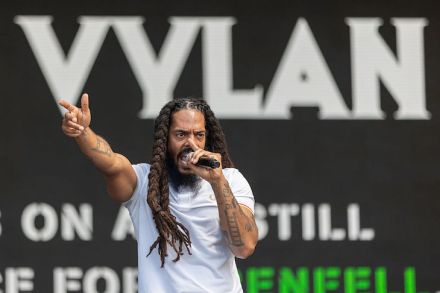
When the lead singer of Bob Vylan’s name was revealed, it caused a fair amount of amusement. This anti-establishment musician who hit the headlines after ranting about the Israel at Glastonbury is actually called…Pascal Robinson-Foster. In football, there has been a crop of stars with double-barrelled names ‘A posh double-barrel name is perhaps not the best handle for a self-styled Rasta radical. So he goes by the name Bobbie Vylan instead,’ wrote veteran broadcaster Andrew Neil. But while it’s vaguely amusing that Vylan’s real name is rather less ‘rock-n’roll’ than his stage act suggests, Neil got one thing wrong: the era of double-barrelled surnames signifying poshness is over.
Cambridge can do better than Gina Miller

From our UK edition

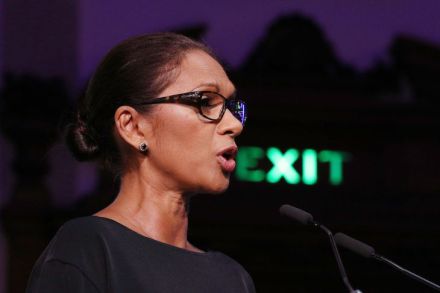
Oxford, said Matthew Arnold, was “the home of lost causes and forsaken beliefs”. Now Cambridge is giving it a run for its money. Oxford’s chancellor election last year was widely billed as a two-horse race between the elder statesmen Lords Mandelson and Hague; the latter in the end won handily. They both had their hang-ups and lost causes too, of course, but they were also men who matter. Fortunately for Gina Miller it is customary for Cambridge chancellors to be lacking in political acumen Does Gina Miller – who in her latest attention-seeking stunt wants to be the next chancellor of Cambridge University – matter? She did once.

Why Duolingo isn’t helping you learn a foreign language

From our UK edition

Duolingo claims that it is 'the world's best way to learn a language'. The app – which has tens of millions of users – boasts a 'science-backed approach' that it says 'delivers measurable results'. I'm not convinced: it seems to me that time wasted on Duolingo would be far better spent doing almost anything else. Busy people, of course, can't be expected to learn languages the most efficient way: dropping everything to spend some time in a foreign country and learn by immersion. But flicking through one of those kitsch phrasebooks, or listening to a podcast in another language, slowed down to 0.5x speed if necessary, is probably more likely to help your language skills, in a way that is better tailored to your abilities and interests, than five minutes a day on Duolingo.

Why young Brits think the social contract is crumbling

From our UK edition

Something is stirring. In WhatsApp groups and Westminster pubs, wherever wonks, spads, and other SW1 types gather, there’s a name on everybody’s lips. It’s like John Galt in Atlas Shrugged or Tyler Durden in Fight Club. It’s at once a wail of despair and a call to arms. Who is this man they whisper of? Who is “Nicolas (30 ans)”? The hard-done-by in society, on this increasingly popular account, are not Barbour-wearing farmers “Nicolas (30 ans)” is the protagonist of “Le contrat social”, a meme posted onto Twitter, as it then was, in April 2020. It was popularised by a French account which goes by the nom de plume Bouli, after an obscure children’s TV show about a friendly snowman.

Britain doesn’t know how to remember the Holocaust

From our UK edition

On 27 January next year, the world will commemorate the 80th anniversary of the liberation of Auschwitz. ‘The commemoration will be the last of its kind’, says Michael Bornstein who, having hidden for six months in his mother’s bunk, aged only four, was among the youngest survivors.   What lies ahead regarding Holocaust memory – and anti-Semitism – when Michael Bornstein is no longer with us? Lily Ebert’s death last week week feels like an important moment: the most famous Holocaust survivor, at least to the TikTok generation, is also now gone. So far, Britain has met this historical moment in bizarre ways. The D-Day anniversary that Rishi Sunak left a few months ago was the last time such an event would occur with living veterans present.

The real problem with Jonathan Glazer

From our UK edition

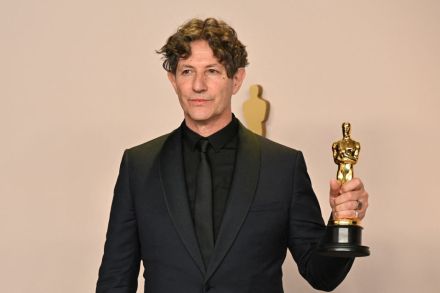
Every year the Oscars unleashes some kind of political controversy, and this year’s revolves around Jonathan Glazer’s speech denouncing Israel. Glazer, the director of the acclaimed Holocaust film The Zone of Interest, used his moment in the spotlight to rail against ‘the Holocaust being hijacked by an occupation which has led to conflict for so many innocent people’. An open letter has sprung up to rebuke him, and even the film’s executive producer has distanced himself from Glazer’s remarks. Some argued that Glazer unwittingly betrayed his own film’s core message. In fact, Glazer’s comments flow naturally from the film itself, and from the very problem of focusing a Holocaust film on the ‘banality of evil’.

The trouble with The Rest is Politics podcast

From our UK edition

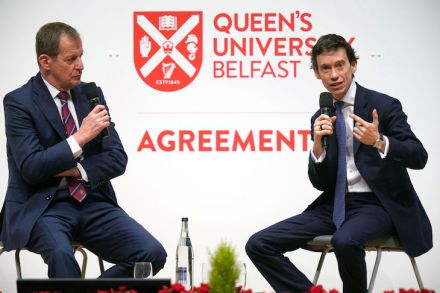
You have probably already heard of The Rest is Politics, which consistently tops the podcast charts. You have certainly already heard of its two hosts, and have a flavour of their temperaments as well as their political views. Alastair Campbell may once have been lost in the shadow of Malcolm Tucker, but every week on the podcast his real self fights its way through. He finds his perfect foil (so we are told) in his co-host, the awkward nerd Rory Stewart.  The Rest is Politics is a strange name. What does it mean? It isn’t a phrase. The pieces begin to fall together once you realise that the company behind it, Gary Lineker’s Goalhanger Podcasts, had already struck gold with the wonderful The Rest is History.

Dan Snow is the ultimate midwit historian

From our UK edition

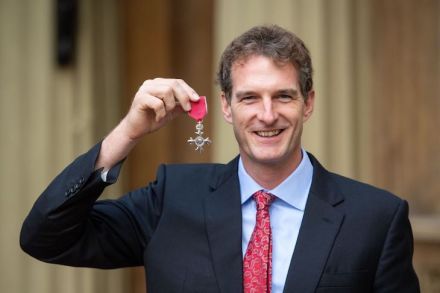
Dan Snow, the TV historian, is anxious about his 'privilege'. One of many 'nepo babies' in the British media, Snow's debut came when he was 23 years old, fresh out of Oxford, co-presenting with his father Peter. Having benefited from his well-heeled upbringing, Snow now excitedly foresees the end of 'inherited monarchy' and 'organised religion'. In an interview with the Times, Snow makes a confession: 'Yes, I myself am a privileged white guy who went to Oxford and read history. Once upon a time the world was made for English-speaking white guys like me — the challenge is how I act now.' Snow appears to express disappointment that Prince Harry, in Spare, didn’t try hard enough to expose the monarchy as 'racist' and 'dangerous to those within it as well as its subjects'.