Rory Sutherland

Rory Sutherland

The Wiki Man | 14 February 2009

From our UK edition

Two years ago my father decided to try selling books on the internet. Since he had spent much of my childhood expatiating his theory that computers involved more work than they saved, this was something of a U-turn. But he quickly opened a seller’s account on Amazon where he listed for sale the 1,500 of his books he was least likely to miss before sitting back and waiting for the orders to come in. Rather to the surprise of his sceptical sons, orders did come in — and have kept on coming. Two years on, along with a few neighbours who are eBay sellers, he has turned the village post office into a hub for global commerce, parcels being sent out every week to almost anywhere.

All of a Twitter

From our UK edition

I was a little uncomfortable when writing my piece on Twitter for the Wiki Man column at the beginning of this year. Mindful that some of the magazine's offline readership are sometimes faintly sceptical about newfangled gadgetry (the telegram, the Newcomen engine, the loom...) I was cautious about writing a fairly upbeat piece about a new form of communication which lies dangerously close to the line which divides useful innovation from senseless absurdity. Many would say Twitter lies on the wrong side of that line. A year or so before I had registered http://twitter.com/The_Spectator, but mostly for my own amusement. I thought it useful to have updates from Coffee House, and used Twitterfeed to convert the RSS feed from The Spectator's site into automatic Tweets.

The meritocracy of <em>Mad Men</em>

From our UK edition

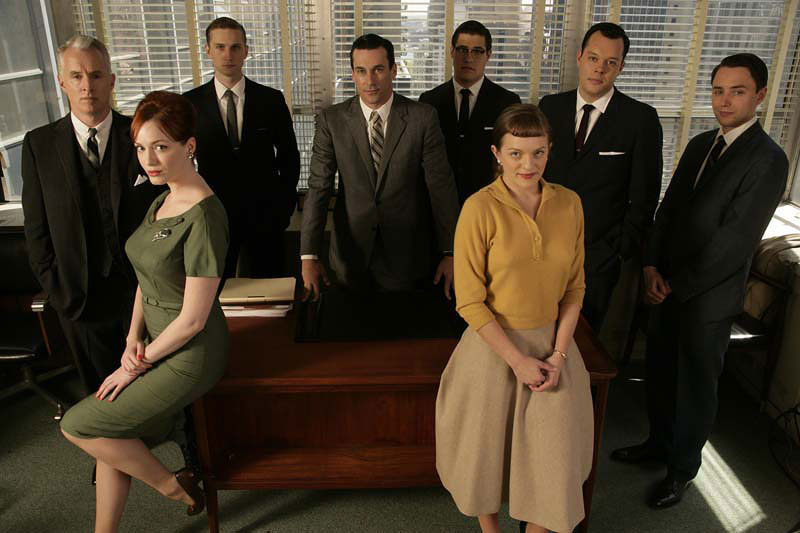
The second season of Mad Men launches tonight on BBC4 (and, more sumptuously still, on BBC HD). Today's Times has a timely interview with both Mary Wells Lawrence and Charlotte Beers, both two legendary Mad Women in their day. Wells Lawrence is fairly disdainful of the series - not only are the people not rich enough, she says, but it needn't really be about advertising at all: "It's just a narrative about people - you could have set it in a hedge fund." She has a point. There are some inaccuracies and fanciful inventions, not least of them being the title, a phrase I had never before heard in twenty years working at Ogilvy. And yet an ad agency is in many ways a more interesting and amusing standpoint from which to see than era than almost anywhere else.

The Super Bowl ads weren’t that super

From our UK edition

I rather like baseball, but I must admit I find American Football incomprehensible and slightly absurd:  much of it seems to be a bad game of rugby played by motorcylists. Although, in its defence (pronounced dee-fence), the very best moments are spectacular. This year I forced myself to watch Superbowl XLIII, preferring to view online via www.ustream.com and not on the BBC in order to see the advertising. The Superbowl has over the years become a showcase for American advertising at its extravagant best - and the commercials now form part of the overall razzamatazz . A few—most famously the 1984 60-second spot for the launch of the Apple Macintosh, written by my New York colleague Steve Hayden—have entered advertising mythology.

Advertising alone can’t cheer people up. But advertisers could.

From our UK edition

Generally the view of marketing and advertising is that it is a zero sum game. A nifty piece of advertising might steal a bit of brand share here and there, but at the expense of someone else's sales. That's the usual assumption. Today I'm not sure it's true. I think we are now in a position where we need to stimulate demand rather than merely redirecting it. In some cases, marketers have already responded ingeniously to this problem. Hyundai in the US offers a kind of redundancy insurance with every purchase of a new car and under the banner of "We're in this together" the car manufacturer offers to take back any new car for a full refund if the purchaser finds himself out of work in the 12 months after purchase.

The Wiki Man | 31 January 2009

From our UK edition

I try hard to like the new, darker James Bond, but I miss the camp insouciance of the earlier films. If you’ve grown up with the type of 007 who briefly interrupts a bout of exotic love-making to sabotage a Russian spyplane with a champagne cork, it’s hard to warm to a character who spends most of the film engaged in the kind of fighting you’d expect to see in a pub car-park in Maidstone. But, like him or not, there is nothing un-British about the new Bond. In many ways, crude, inelegant but effective is what Brits do best: the Routemaster bus, PG Tips, the London taxi, the full English breakfast, the Aga, the Blower Bentley and the 125 High Speed Train are all fine examples of our ‘it’s not fancy but it works’ approach.

The Wiki Man | 17 January 2009

From our UK edition

Last month saw the usual spate of newspaper articles ridiculing the circular letters sent with Christmas cards. A series of books by Simon Hoggart now documents the worst of these. Funny as his examples are, he’ll be hard put to beat the instance sent in by a reader of the Daily Telegraph: ‘I suppose the high spot of our year was John’s Nobel Prize.’ Even so, am I alone in being slightly uncomfortable with all this opprobrium? If you care enough to spend 50p sending someone a Christmas card, shouldn’t you expect them to spend a minute or so hearing what’s happened to you in the past year? Is it all that awful to hear that your children passed their exams? Why do we hate this all so much? Largely it’s our national horror of self-promotion.

The Wiki Man | 3 January 2009

From our UK edition

I’d like to start 2009 with a few words of thanks to everyone who has joined the Spectator readers’ lending team at www.kiva.org/team/spectator. So far we have lent money to over 100 small businesses in the developing world, a figure buoyed by the disproportionate generosity of the Spectator’s Australian readership (including a lady from Cairns in a particularly elegant hat). We still have some way to go before overtaking the largest lending team — 1,700 people from Team Obama, since you ask — but every new joiner helps. And, thanks to the depreciation of the pound, the interest-free loans I made earlier in the year through Kiva (the loans are repaid in US dollars) have turned out to be unexpectedly profitable.

The Wiki Man | 13 December 2008

From our UK edition

It’s not always a good idea to read certain books when you’re too young. At school it didn’t occur to any of us that Brave New World was meant to be a bad place — it seemed like a utopian fantasy world to me. Advice to writers: if you want to alarm teenagers with the nightmarish prospect of a dystopian future, it’s a good idea not to fill it with really cool drugs and high-tech pornography. More mature people, however, do worry about new technology, especially its effects on sex and morality.

What will we be better off without?

From our UK edition

Back in the 1960s an old Welsh steel magnate's son, who in his youth in the 1930s had been immensely rich but had by now fallen far behind, was asked by my father what he thought about the likely result of the general election. "I don't care who gets in", he replied, "so long as they put an end to this damned prosperity." Economic growth has its downsides as well as its benefits. In this week's issue, Venetia Thompson and I list thirteen of them - the idiot trends and self-indulgent nonsense we won't miss from the last fifteen years. What are yours?

Things we’ll really all be better off without

From our UK edition

Most journalists have spoken of the financial crisis as evidence of a failure of capitalism. But is it? Or is this kind of reversal in fact necessary if capitalism is to work at all? After all, a free-market economy doesn’t do a perfect job of rewarding success. It may pick better winners than, say, governments, but it is still largely arbitrary. Even relatively worthy successes such as Google’s or Microsoft’s may be as much the result of lucky timing as anything else. Instead, capitalism is at its indisputable best not when picking but when picking off. In unerringly killing off the bad: the inefficient, the redundant, the outdated or the needlessly complex.

The Wiki Man | 29 November 2008

From our UK edition

I am a great fan of Richard Dawkins — the brilliant geneticist Richard Dawkins, that is, not the amateur theologian of the same name. The Selfish Gene and Climbing Mount Improbable are among the most mind-changing books I have read. I can’t say the same of the atheist stuff. Dawkins seems a much better evangelist than polemicist; more persuasive when exalting Darwin than attacking God. If you want to be a polemicist, it helps to be funny, which Dawkins isn’t (for convincing and witty attacks on non-science nobody beats the late John Diamond). But I also find it annoying that Dawkins picks on such clunking, unoriginal targets. If you want to attack irrationality, in Britain at any rate, why pick on God?

The Wiki Man | 15 November 2008

From our UK edition

The most powerful storyline of the US election, which the fawning media did nothing to challenge, was the idea that Barack Obama was an underdog who had miraculously triumphed against a hostile establishment to make a presidential bid. In this he was rather helped by the simplistic American belief that race somehow trumps all other claims to adversity. To me this seems, well, slightly racist. If asked to choose between a) being a black editor of the Harvard Law Review or b) spending five years of my life in a small bamboo cage being tortured by some really angry North Vietnamese, I wouldn’t think long before ticking box a). But being seen as an outsider has always been electorally useful, and more so now than ever.

The Wiki Man | 1 November 2008

From our UK edition

An amazing piece of financial analysis has been circulating by email recently. If you had purchased $1,000 worth of AIG stock a year ago, you would have $44.34 left. With Wachovia, you would have had $54.74 left of the original $1,000. With Lehman, you would have had $0.00 left. But if you had purchased $1,000 worth of beer one year, drunk all of the beer, then turned in the cans for the aluminium recycling refund, you would have $214 cash. Even better, if a year ago you had decided to entrust your $1,000 to the needy rather than the greedy, you would have ended up today with $1,000. This market-beating 0 per cent rate of return is available through a website called www.kiva.org.

The Wiki Man | 18 October 2008

From our UK edition

Last month I bought from eBay a strange little electronic gadget called a Chumby, an item not yet on sale outside the United States. Last month I bought from eBay a strange little electronic gadget called a Chumby, an item not yet on sale outside the United States. It worked happily for ten minutes and then died. I duly performed a hard reboot (that’s the technical term for ‘switching it off and on again’) only for the same thing to happen again. And again. With hindsight, of course, I should have simply called the government pretending to be a banker and explained that I had bought something that at first looked clever but turned out to be worthless crap.

The Wiki Man | 4 October 2008

From our UK edition

One of the most interesting books from the last year has been Revisiting Keynes: Economic Possibilities for our Grandchildren (MIT Press, £20) — a reprint of a 1931 essay by J.M. One of the most interesting books from the last year has been Revisiting Keynes: Economic Possibilities for our Grandchildren (MIT Press, £20) — a reprint of a 1931 essay by J.M. Keynes in which he describes what his readers’ grandchildren should expect 100 years on. The piece is followed by 14 essays from present-day economists (four of them Nobel Laureates) discussing why Keynes got some things right and others so wrong.

The Wiki Man | 20 September 2008

From our UK edition

I recently saw a photograph of a street vendor’s stall in Argentina. The menu reads simply Orange Juice $5. Jugo de Naranja $4. Here unsuspecting Anglophones are paying a premium of 25 per cent for not knowing Spanish. It’s a practice known to economists as price discrimination — in other words setting a price in proportion to a customer’s propensity (or indeed ability) to pay. There’s a lot of it about — and in the internet age we can expect to see it more and more. How low a price will a website quote you for your new Mini Cooper if it knows you already own a Jaguar? It’s reminiscent of the famous comedy scene where Bill Cosby’s attempts to bargain down the price of a car are ruined when a passing friend greets him as Dr Cosby.

The Wiki Man | 6 September 2008

From our UK edition

A friend of mine, a professor at an Ivy League university, specialises in research into transgenic mice, learning how DNA modifications affect intelligence and memory. A few years ago, after some genetic tinkering, he created a batch of mice of quite spectacular dimwittedness. They were useless in the maze, ditzily wandering about with no sense of spatial awareness and incapable of finding the cheese after repeated attempts. This wasn’t the only interesting thing about these mice. Every one of them had a most unusual pigmentation, at least for mice: they were blond. This was huge. ‘You’ve found the blond gene — phone the Sun!’ ‘Um, I was thinking more in terms of Nature or Scientific American,’ he said.

The Wiki Man | 23 August 2008

From our UK edition

In their now famous book Nudge, self-described ‘paternalistic libertarians’ Richard Thaler and Cass Sunstein cite this new paint as an example of ‘feedback’ — the notion that people will make better choices when their decisions have rapidly visible results. If you’ve tried typing on an outdated PC, where characters take seconds to appear on screen, you know how disconcerting slow feedback can be. But it can be a matter of life or death: Vehicle Activated Signs (the ones which flash up your speed) have been shown to prevent more accidents than speed cameras — at 5 per cent of the cost. Instant feedback may improve behaviour more than delayed punishment.

The Wiki Man | 9 August 2008

From our UK edition

Toby Young in last week’s Spectator remarked on the peculiar malice, as he saw it, of the online comments posted in response to his articles. He has a point. The people who post comments are not the same reverential folk who form a paper’s traditional print readership. On the other hand, at a time when the Telegraph and the Guardian attract more than 18 million online readers each month, your online readership is no longer a small niche you can safely ignore. Why then do they seem so nasty? Most people who comment on writings on- line aren’t nasty at all. Responses to blog posts are often complimentary and constructive.