Roderick Conway-Morris

Sense and sensuality

From our UK edition

Correggio and the Antique National Gallery and other locations in Parma, until 25 January 2009 Unlike the other leading artists of the Italian High Renaissance — Leonardo, Raphael, Michelangelo, Titian — Correggio lived a life of provincial obscurity. Unable to find any likeness of him, Vasari was obliged in his Lives of the Artists to leave blank the portrait space in the frontispiece above Correggio’s brief and often inaccurate entry. Born Antonio Allegri in Correggio near Parma in around 1489, he spent his entire career in this out-of-the-way region on the northern plains, dying there in 1534. Yet even during his lifetime he won fame, inspiring artists for generations to come and powerfully influencing the development of the Baroque and Rococo.

Lost and found

From our UK edition

Josef Maria Auchentaller (1865-1945): A Secessionist on the Borders of the Empire Palazzo Attems-Petzenstein, Gorizia, Italy, until 30 September The story that unfolds in this fascinating exhibition is a strange and poignant one. The Viennese-born Auchentaller was a contributor to the Munich Secession of 1892 and a key player in the Vienna Secession of 1897, two of the most important fin-de-siècle revolts against the conservatism of the artistic establishment. Along with Klimt, he was one of the editors of Ver Sacrum (Sacred Spring), the official voice of the Vienna Secession, and in 1901 an entire issue was devoted to Auchentaller’s work in various media. His life was long and artistically productive, but through a series of mishaps many of his works were lost.

Brave new world

From our UK edition

All empires eventually bite off more than they can chew. Rome and the Barbarians, the latest exhibition under the new management at Palazzo Grassi in Venice, suffers from the same syndrome. It aims to cover the entire first millennium of the Christian era by displaying more than 2,000 artefacts, from 200 collections in 23 countries, the material remains of Greeks, Romans and scores of barbarian peoples, from the Alamanni, Avars, Franks and Huns to the Ostrogoths, Visigoths, Vandals and Vikings.

Saints on the move

From our UK edition

In August 1766, the printmakers of Augsburg brought a case of plagiarism against the Veneto publishers and printmakers Remondini. One of the witnesses they summoned was Giuseppe Fietta, an itinerant pedlar, who was then doing the rounds of Bavaria selling Remondini’s Santi, or prints of saints. They were very popular with country-folk, Fietta explained, because they were not only cheaper than other prints, but also highly coloured and even decorated with silver and gold. Fietta was one of hundreds of pedlars working for the Remondini, an extraordinarily enterprising workforce that was a cornerstone of the company’s enormous success. The Remondini family began their operation in 1657 in Bassano del Grappa on the banks of the Brenta, 40 miles north-west of Venice.

Lessons from the East

From our UK edition

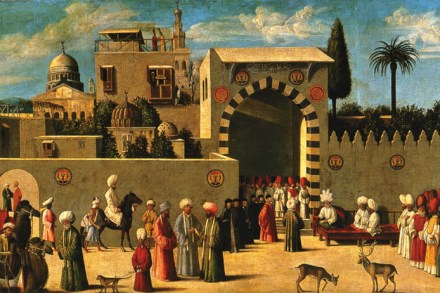
Venice and Islam: 828–1797 Gazing up at the walls of the Sala dello Scrutinio in the Doge’s Palace, at the enormous canvases depicting tumultuous scenes of colliding fleets, flashing armour and swords, flying arrows, broken spars, burning and sinking ships, and waters congested with enemy dead and dying, you could be forgiven for thinking that Venetian history was one long sea-battle, with the Serenissima fighting almost single-handed to stem the Islamic tide.

Fount of all gardens

From our UK edition

According to an Hellenic historian, Nebuchadnezzar built the Hanging Gardens of Babylon in the 6th century BC to make his wife, who was from a mountainous region of Iran, feel at home. In fact, he and other rulers of Mesopotamia before him (the first such gardens were probably at Nineveh) were seeking to impress a much wider audience, and the Babylon version made it on to the list of the Seven Wonders of the World. The archeological evidence is limited, but these gardens very probably occupied a series of terraces of an enormous ziggurat that would have been visible from miles away.

Sins of commission

From our UK edition

‘They order, said I, this matter better in France.’ It is the norm at the national pavilions (a record 76 nations are present this year) for a new commissioner to be appointed for each edition, who selects the artist, or artists, to represent their country, or heads a committee that does so. A dozen years ago, France reversed this process, selecting the artist first, who then named their own commissioner. Sophie Calle, this year’s French artist, found hers by advertising in Libération (the Gallic Guardian). Her extensive floor-to-ceiling installation of texts, photographs and videos was triggered by an email from her lover announcing he was dumping her, which ended ‘Prenez soin de vous’ (Take care of yourself), now the title of the show.

Saint for all ages

From our UK edition

‘His clothes are drenched in brine, his beard drips with seawater, and his brow is covered in perspiration due to his continual efforts to reach sinking ships to save them from the angry waves.’ Such is the lively picture of St Nicholas recorded by an anthologist of popular Greek calendar customs, contrasting somewhat with the venerable stasis of his painted images in Orthodox churches. Protecting sailors from shipwreck was and still is one of the saint’s primary occupations. Even today no Greek vessel would put to sea without his portrait on board. But over time he also became the patron saint of travellers in general, children, scholars, merchants, pawnbrokers, pirates, robbers, Russia and many towns and cities.

Fear of failure

From our UK edition

The ‘Michelangelo Buonarroti, Florentine, Painter, Sculptor and Architect’ of Giorgio Vasari’s Lives, the only living artist to be included in this compendious work, at one time or another denied he was any of the above, except ‘Florentine’. The only formal training he ever received was as a painter. But when Julius II called on him to fresco the Sistine chapel ceiling, the self-taught sculptor claimed he was unqualified for the task, recommending Raphael. When in 1546 Paul IV sought his advice on the Vatican’s defences, we find the artist maintaining that, while he ‘knew little of sculpture or painting’, fortifications were indeed very much his occupation.

An ancient modernist

From our UK edition

In 1944 an Allied bomb fell into the circular courtyard of the ancient Roman-inspired house that Andrea Mantegna had built for himself in Mantua, bouncing off its frescoed frieze. It failed to detonate. On 11 March of the same year, another landed on the Eremitani church in Padua, blowing the Ovetari chapel, whose walls were decorated with the precocious young Mantegna’s first fresco cycles, to smithereens. By then the only other surviving monumental work executed by the artist in Padua was the San Zeno altarpiece, destined from the beginning for Verona. It was delivered there on the eve of his departure for Mantua, where, from 1460 until his death in 1506, he was to stay as court painter to the Gonzagas.

Papal travels

From our UK edition

In 1435 a young Tuscan poet and diplomat visited the court of James I in Edinburgh. The purpose of his mission remains something of a mystery. But he was impressed by the women of the country, whom he described as ‘fair, charming and easily won’. It also did not take him long to discover that ‘there is nothing the Scotch like better to hear than abuse of the English’. The writer was Aeneas Sylvius Piccolomini, the future Pius II, and the book in which he recorded his experiences (in the third person, in imitation of Julius Caesar) his astonishingly frank autobiography, the Commentaries, available in unexpurgated form (and translated into English by Florence Gragg) only in modern times. Piccolomini returned to the Continent, passing through England in disguise.

Sales hype

From our UK edition

An ancient Roman sceptic wondered how, when two augurs passed in the street and caught one another’s eye, they managed not to burst out laughing. A Damien Hirst bisected lamb suspended in a glass tank of formaldehyde was sold for $3.37 million at Christie’s in New York early in May. Works by Donald Judd, who did not construct his industrial box productions himself, also, like Hirst, having others to do that kind of thing for him, fetched nearly $10 million. The final take for these and similar pieces was $143 million. What started as a joke in the days of Dada has become big business, and postmodern conceptual art is now as solemn a comedy and serious a money-spinner as the augury of old.

Adventures of the gods

From our UK edition

The Christian Church sought to banish the ancient gods, but their fascination proved too strong. Their reappearance in their many manifestations during the Renaissance transformed Western visual culture, reviving, nourishing and sustaining the nude and the erotic as legitimate subjects of art. How the antique gods and demigods descended to earth again, enlivening panels, canvases, furniture, cameos, jewels, medals, ceramics, prints, and as sculptures, is now unfolded in a thought-provoking exhibition of more than 200 pieces at Palazzo Pitti. The seeds of the revival of ancient mythology were sown in the Middle Ages.