Robert Gorelangton

A break from posh

From our UK edition

The actor Ed Stoppard is kicking off the year in some nice period costumes. One of our brightest young actors, he’s back at 165 Eaton Place in the new BBC Upstairs Downstairs (reviewed on page 60) playing the diplomat Sir Hallam Holland. It’s got gas masks, the Munich Crisis, cocktails, a dead pet monkey, the odd conchie servant and, not least from Ed’s point of view, some great clothes. ‘In this series I get to wear jodhpurs and hacking jacket, naval uniform, black tie, white tie and a dressing-gown that would make Hugh Hefner green with envy. It will look sumptuous — more so than the last series.

Consumed by Dickens

From our UK edition

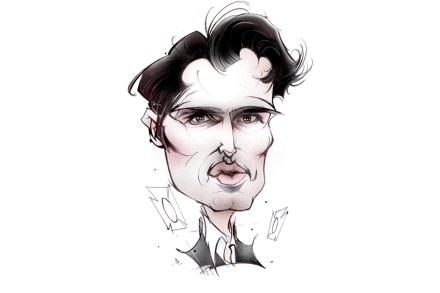
If you don’t like Simon Callow, you probably don’t like the theatre either. He is as theatrical as a box of wigs. Who else would bark ‘come!’ when someone knocks on his dressing-room door? There he is with a glass of wine, a boom of good cheer, having peeled off his side whiskers after his lushly enjoyable one-man show based on two rediscovered Dickens stories, Dr Marigold and Mr Chops. But that tour is now over and Callow (probably still best known for his part in the film Four Weddings and a Funeral — the funeral was his) is going straight into another Dickens, his new version of A Christmas Carol. The actor-writer who has cornered the market in Dickens works likes Dickens. He has a book coming out next year, his 13th.

Playing Churchill

From our UK edition

Where would gentleman actors be without Churchill? No prime minister has given as much work to the profession as Winston (though Blair comes a close second), patron saint of jowly thespians of a certain age. Churchill now features in a new stage play called Three Days in May, about the British war cabinet in May 1940. The great man is played by Warren Clarke, whose fleshy fizzog is well known to fans of the 12 series of the BBC’s Dalziel and Pascoe — he plays Detective Superintendent Dalziel. A splendidly robust actor, he has roughly the same baby-fed-on-whisky looks as Churchill. In this he doesn’t wear rompers, instead you get the Churchill outdoors look — spotty bowtie, homburg and cigar.

Priestley values

From our UK edition

The J.B. Priestley flame is kept alive today by his son Tom, who resides in the same Notting Hill flat he has lived in for more than 50 years. His father — novelist, dramatist, scribe, broadcaster, socialist (who died in 1984) — was glad that Tom, now 79, hadn’t chosen the same life. ‘The only time he came here to the flat he said, “Don’t be a writer. Dreadful business.”’ Tom is a retired film editor who manages the literary estate. He is the offspring of J.B.’s second marriage to Jane Bannerman, the divorced wife of the humorist writer Bevan Wyndham Lewis. There was one more Mrs Priestley after her — Jacquetta Hawkes, the distinguished but flinty archaeologist.

Wilton’s Music Hall – The good old days

From our UK edition

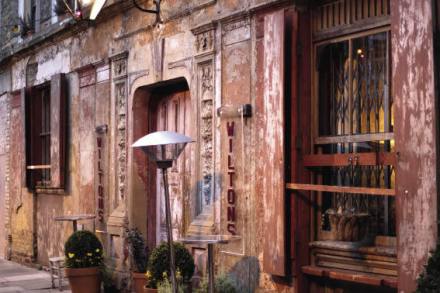
John Major is half way through a book about the rise and fall of the music hall. His father, Tom, was a song-and-dance man who formed a double act with his wife, Kitty. John’s brother Terry was a trapeze artist, and the former prime minister must have come close to going into the family trade. Parliament’s gain was, in John Major-speak, showbiz’s not inconsiderable loss. Oh, yes.   Tom Major was a name in his day, although the fag-end of the music hall he knew is deader now than even the madrigal. The generation of halls that emerged in 1850 were very rapidly gone. Only one survives, in the East End of London, off Cable Street in Stepney.

The face of space

From our UK edition

Everyone loved Yuri Gagarin – but he was always a Soviet sideshow Fifty years ago, on 12 April, Yuri Gagarin, a tractor-driver’s son from Smolensk, climbed aboard a capsule about the size of a Morris Minor, perched on top of a massive rocket. He followed into space a mongrel bitch called Laika, but unlike the poor mutt he survived. He completed a single orbit of Earth in 108 minutes flat and parachuted safely back on to Russian soil. The first human in space, he instantly became the most famous man on earth. Within weeks of touchdown, the 27-year-old Gagarin arrived in Manchester, home of a new TV soap called Coronation Street. Yuri was mobbed, the girls infatuated with the beaming Soviet pin-up Macmillan called ‘a delightful fellow’.

‘I play to middle England’

From our UK edition

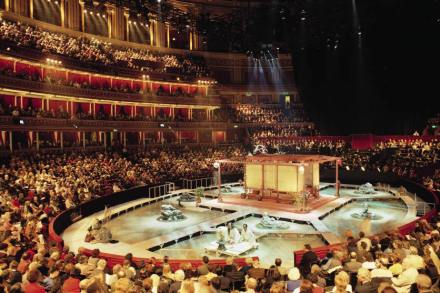
Raymond Gubbay is a hard man to avoid. Especially at Christmas. Last year Raymond Gubbay Ltd presented roughly 600 concerts, of which 180 were part of his annual Christmas Festival and he lived up to his festive catchphrase: ‘You want carols? We’ve got carols.’ Gubbay’s packaging of live classical music has been amazingly successful. He came up with the idea of Vivaldi by candlelight played by men in wigs. His regular Johann Strauss galas are a big hit, as is Strictly Gershwin, and his own-brand laser-lit Classical Spectaculars. The genial man with the Midas touch is famous, too, for his operas at the Albert Hall, where Madam Butterfly is about to return. It comes complete with a 60,000-litre pond, which turns the place into a giant Japanese garden centre.

Two men in a boat

From our UK edition

Robert Gore-Langton on a stage adaptation of the Erskine Childers classic Riddle of the Sands The Riddle of the Sands was published in 1903. It was an instant bestseller and has never been out of print since. It’s the story of two young Englishmen who, while sailing off the German coast, unearth a fiendish plot to invade Britain. The book is often cited as the first ‘factional’ spy story, one that launched a genre. With its mass of authentic, verifiable detail it set the trend for Fleming, le Carré and the rest. The book includes maps, charts and tide timetables.

What’s a war book without a dead Nazi?

From our UK edition

Objections are raised to a cracking new children’s book on account of a dead German soldier and pictures of frostbite. But the young adore grisly bits, says Robert Gore-Langton There’s a cracking new children’s book out, Mission Telemark, by the award-winning writer Amanda Mitchison. It is set in the second world war and it’s based on the story of the Norwegian sabotage raid on Hitler’s ‘heavy water’ atomic plant in Telemark. You might remember the film The Heroes of Telemark, starring Kirk Douglas as a most unconvincing Norwegian. Both the film and the book were based on the famous 1942 mission — a tale of great courage, skis and atoms.

Sellotape and string pants

From our UK edition

More than ever in the UK, fuel bills now resemble school fees and so, despite the bitter cold, few of us can afford full-on 24-hour heating. But, driven by desperation, I’ve been researching the matter and have discovered several ways of surviving this miserable weather. Forget about replacement double glazing: it looks nasty and it doesn’t pay for itself until you are over 100. But if you don’t mind living in a house that shrieks ‘credit crunch’ to visitors, there are ways of keeping the cold out and the bills down. First attend to your windows: attach cling film with double-sided tape (try your local DIY shop) to your window frames. Apply a hair dryer to get it taut as a drum. It lasts one winter.

Moral and political dilemmas

From our UK edition

Robert Gore-Langton talks to Ronald Harwood about musical life in Nazi Germany Nazis in the theatre liven things up no end. They provide the hilarity in The Producers, the creepiness in Cabaret. And when you can’t take any more bright copper kettles or warm woollen mittens in The Sound of Music on comes the SS, arguably the best moment in the show. Now there’s a new play about music in Nazi Germany, a sobering reminder of just how seriously the Third Reich took its music and music-makers. Collaboration is about Richard Strauss and his relationship with the Jewish writer Stefan Zweig, who together wrote an opera in the 1930s while the storm was gathering over Europe.

An eccentric part of the landscape

From our UK edition

Robert Gore-Langton talks to an irreverent Dominic Dromgoole about the Globe A few months ago I was at a literary festival on a drama panel which featured a senior actress of the stage. She was holding forth about working with the Royal Shakespeare Company at Stratford when I suggested that Shakespeare’s Globe was just as hugely popular but nobody took it half as seriously. ‘Ah, well, you see there’s a feeling in the industry that it’s all a bit twee — you know, a bit heritage Shakespeare,’ she said. ‘Patronising cow,’ I thought at the time, while laughing along sycophantically. But she probably spoke for most of her generation to whom Stratford is the sacred temple of Shakespearean excellence. A dubious claim these days.

‘It’s the most English thing you could imagine!’

From our UK edition

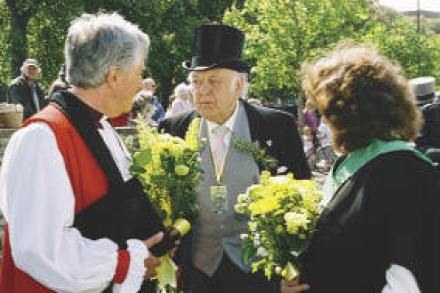
Shakespeare’s birthday celebrations in Stratford-upon-Avon may be a small-town affair, but it is one of the very few non-London dates that involves the diplomatic corps. On Saturday 26 April no fewer than 18 ambassadors will attend the occasion, the world’s nations joining sundry Warwickshire dignitaries, Stratford’s mayoral chain gang, various Shakespearean bodies, the band of the Corps of Royal Engineers, the Coventry Corps of Drums, sweet little local schoolchildren in boaters, Morris men and some 20,000 delighted onlookers. You never hear much about this terribly English event because it’s been going on for so long (since 1824) it is taken for granted.

Snowy and friends

From our UK edition

Hergé’s Adventures of Tintin is at the Playhouse Theatre, London, 6 December to 12 January; 0870 060 6631. The first time I saw Hergé’s Adventures of Tintin on stage it starred a West Highland white called Chester, playing Snowy. The dog’s is a walk-on part only; he’s rapidly substituted for a talking actor with a shock of white hair. But talk about canine ego-trips! He belonged to the show’s musical director, who told me that Chester soon started to ‘autograph’ the scenery every night before making a stage-door appearance where kids would queue up to stroke him. Chester lapped it up. He was not, it is true, a fox terrier as per the Tintin books, but then again no fox terrier I’ve ever met is all white like Snowy.

Packing a punch

From our UK edition

It’s a good month for the Great War. At the National Theatre this week a new play by Michael Morpurgo tells the story of the war seen through the eyes of a horse. Staged with huge puppet nags, War Horse sounds on paper like the theatrical lovechild of Equus and Birdsong. Up in Bolton, with a good deal less hype, they are doing another war horse — Oh! What a Lovely War. It was first staged in 1963 by the radical Theatre Workshop, in the East End. The Great War satire was aimed at the political edification of the working class, but sadly for the Revolution it quickly attracted posh nobs from Kensington, transferred to the West End and became a huge commercial hit and finally an all-star extravaganza film in 1969. The show remains a legend.

Old gold

From our UK edition

Warren Mitchell is lying on an air mattress in rehearsals. He’s 81 and in constant pain, made worse by a recent operation. Warren Mitchell is lying on an air mattress in rehearsals. He’s 81 and in constant pain, made worse by a recent operation. He looks very tired, very old and I wondered, hauling him up off the floor by his wrists, whether he’d make it through our interview, let alone a ten-week tour. Why on earth isn’t he at home with his feet up instead of rehearsing all day long? Doesn’t his wife object? He says, slowly and with effort, ‘Yes, my wife does object; she says, “You’re not fit enough, you should retire, you’re mad!

Blackpool’s cheap thrills

From our UK edition

Whatever happened to poor old Blackpool? The last time I went it was alive, busy and reasonably full of life. The place today is a windswept vision of destitution and bleakness, home to roaming bands of stag and hen weekenders, fat people with limps and aimless geriatrics waiting to be mugged. A town once synonymous with aspiration and elegance struck me as a deeply seedy place, notable for its lovebites and sick. It is, however, cheap. This presumably explains why, despite its dramatic decline, it’s still Britain’s most popular seaside resort. There are legions of beyond-parody hotels where you can stay for £20 a night or less — including all the grease you can eat for breakfast. Not that there’s much to do in town.

Thrilling stuff

From our UK edition

This season’s they-don’t-make-’em-like-that-any-more offering at the Old Vic is Gaslight. The chief reason for going to see it is that it stars the talented young actress Rosamund Pike. Time spent gazing at the astoundingly beautiful Miss Pike is never wasted. But Gaslight has other attractions as an entertainment. It’s a 1938 three-act thriller set in murky Victorian London, with a married couple, servants, horsehair furniture and a nice juicy vein of psychopathic sadism. Most of us know it from the 1944 film version in which Ingrid Bergman went mildly bonkers and won an Oscar for rolling her eyes. When you read the play, it is startling how unfaithful are the two Gaslight films (an earlier screen version starred Anton Walbrook).

In the mood

From our UK edition

The Hound of the Baskervilles first appeared on stage 100 years ago in Berlin, presented by Ferdinand Bonn. Herr Bonn was dead keen on realism and decided that his wife’s huge, beloved black dog would be the star of the show. Every night she would wait in the wings ready to produce a lump of German sausage, the idea being that, as Stapleton lured Sir Henry Baskerville on to the moor, the dog would belt across the stage and leap at the dangled bratwurst. For a spectral effect, the brute had lamps attached to its head; its savage howling was produced by a man backstage yodelling into a gramophone horn. What became of the dog’s showbiz career remains a mystery. But even as Arthur Conan Doyle was writing the stories, Holmes was appearing on stage and silent film.

‘Call me Larry’

From our UK edition

Fifty years ago, the Royal Court theatre detonated its second H-bomb. The first had been Look Back in Anger, in 1956. The next was The Entertainer, John Osborne’s follow-up play, which opened 50 years ago in April. Out were blown the West End play’s French windows and in came the kitchen sink. The memorable first line of the play — ‘Bloody Poles and Irish! I hate the bastards’ — set the tone for an unsavoury evening which ushered in a whole new drama movement. Noël Coward loathed it. The shock back in 1957 was perhaps not so much the play itself but Laurence Olivier’s part in it.