Richard Bratby

Richard Bratby is the chief classical music critic of The Spectator

In Mumbai, orchestras are playing western classics without apology

Choosing a concert opener is an art in its own right. Fashions shift: the traditional overture has fallen from favour in recent years, and you might go seasons now without hearing such one-time favourites as The Thieving Magpie or Euryanthe. The opening slot is more likely to contain something short and contemporary, or worthy and obscure (cynics call it ‘box-ticking repertoire’). Or it might be empty, tipping you straight into a symphony or concerto the way a Michelin-starred chef presents his signature creation – unadorned, on a bare white plate. The Symphony Orchestra of India began its latest UK tour with John Williams’s ‘Imperial March’ from The Empire Strikes Back – and goodness alone knows why.

Simply not as good as Mozart’s: RCM’s Don Giovanni Tenorio reviewed

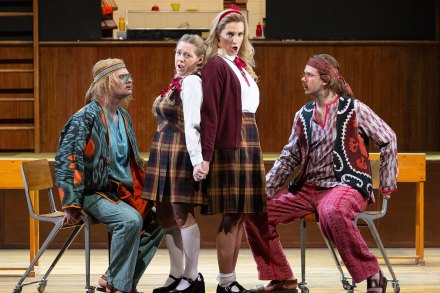
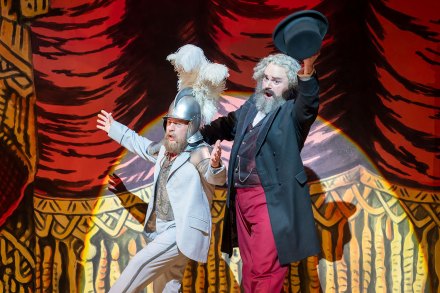
In Bernard Shaw’s Man and Superman, Don Giovanni finds himself in hell, chatting to the sentient Statue that dragged him to his doom. ‘It sounds rather flat without my trombones,’ admits the Statue, conceding that once you remove the genius of Mozart from the mix, you’re left with a trite (if titillating) morality tale. You could draw the same conclusion from the opera Don Giovanni Tenorio, by Giuseppe Gazzaniga (1743-1818), and if you haven’t heard of him you might wonder why not. Institutional racism? Patriarchal hegemony? Not this time. Gazzaniga was a Neapolitan composer of perfectly adequate operas that simply aren’t as good as Mozart’s. Anyway, Don Giovanni Tenorio made an amusing end-of-term show at the Royal College of Music.

Eloquent, understated poetry: Llyr Williams, at the Wigmore Hall, reviewed

Imagine being a concert pianist and choosing your own programmes. All those possibilities; all that power! ‘I am the orchestra!’ declared Hector Berlioz, imagining himself inside the head of Franz Liszt. ‘I am the chorus and conductor as well. My piano sings, broods, flashes, thunders.’ The heart lifts when a pianist thinks a little differently about their recital programmes and tries to make connections and tell stories beyond the familiar tramlines of Bach, Beethoven and late Schubert. Don’t get me wrong; the Austro-German big boys are a healthy part of a balanced musical diet. It’s just that – well, you know. There is a world elsewhere. Solo piano recitals leave me cold.

Magical: The Box of Delights, at Royal Shakespeare Theatre, reviewed

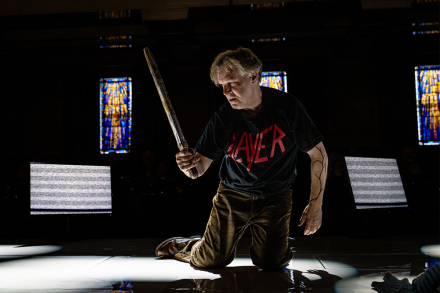
In Stratford-upon-Avon, the wolves are running. And if you’re old enough to feel a little thrill of wintery excitement at those words, you’ll have questions of your own about the Royal Shakespeare Company’s The Box of Delights. Questions about talking rats and flying cars, and whether time and tide and buttered eggs still wait for no man. John Masefield’s novel thrived on radio adaptations for decades after its publication in 1935 but the beloved BBC TV version was in 1984, and four decades is a horribly long time. Piers Torday’s new dramatisation faces the double challenge of entertaining a new generation of youngsters while also pleasing the nostalgia-addled oldies who are, after all, splashing the cash.

Cliché, cynicism and a car-crash finale: Royal Opera’s Jephtha reviewed

London’s two opera houses have been busy staging non-operas. Handel’s English oratorio, Jephtha, is his final exercise in a form that only existed because it was, explicitly, not opera (Georgian theatres needed something to play during Lent). We know better today, and dramatised reboots of Handel oratorios are proliferating, possibly because – unlike his actual operas – they give the chorus something to do. Katie Mitchell directed Theodora at Covent Garden last year. Now Oliver Mears has had a bash at Jephtha and has encountered the same basic problem. Operas seduce; oratorios preach. These are explicitly Christian, implicitly patriotic works, and what self-respecting contemporary director could allow that?

Funny, faithful and inventive: Scottish Opera’s Barber of Seville reviewed

A violinist friend in the City of Birmingham Symphony Orchestra used to talk about an orchestra’s ‘muscle memory’; a collective instinct that transmits itself, unspoken and unconscious, among the members of the ensemble. The occasion was a return visit from Sir Simon Rattle, a good decade and a half after he’d left Birmingham. At that point, perhaps only one third of the musicians had been present when Rattle last conducted this particular work. No matter. ‘You know how we play this,’ said Rattle, and sure enough they did, slipping as one into the exact articulation and dynamics that Rattle had instilled all those years ago. As with the human body, cells are replaced, but the individual remains the same.

Modest means, but striking results: Opera North’s La rondine reviewed

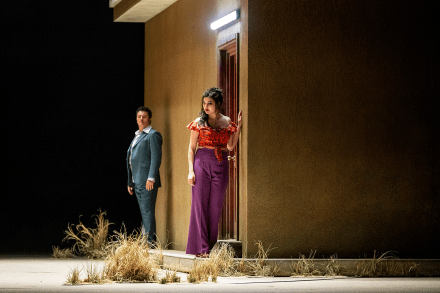
Opera North is ending its autumn season with a big-hearted production of a lopsided opera. There’s much to love about Puccini’s La rondine, and much to drive you up the wall. This bittersweet love story about an older woman and a younger man, set in Paris and Nice and channelling the operetta sweetness and sparkle of Puccini’s great friend Lehar, ought to sweep you off your feet. Instead, it tempts critics into that most shameless form of condescension, the armchair rewrite. Giacomo, old chap, isn’t five minutes into Act One a bit soon to be introducing your big hit aria? We’re halfway through Act Two: shouldn’t the lovers be together by now? And isn’t this basically just La traviata played for lower emotional stakes? Come on, man, you wrote Bohème.

The miracle of watching a great string quartet perform

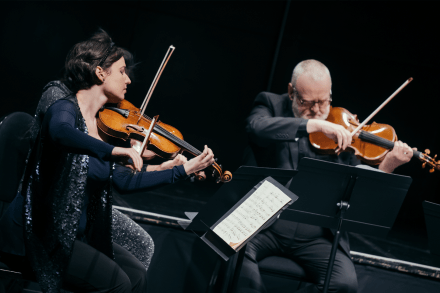
Joseph Haydn, it’s generally agreed, invented the string quartet. And having done so, he re-invented it: again and again. Take his quartet Op. 20, No. 2, of 1772 – the first item in the Takacs Quartet’s recital last week at the Wigmore Hall. The cello propels itself forward and upward, then starts to warble like a bird on the wing. The viola sketches in a rudimentary bass line; the second violin – higher than the cello on paper, but actually playing at a lower pitch – shadows the melody in its flight. The first violin? Nothing: the leader (or so you might imagine) of the group is entirely silent until finally, blissfully, he isn’t. It’s the opposite of how a string quartet is supposed to begin, and it’s perfect.

Juicy solution to the Purcell problem: Opera North’s Masque of Might reviewed

Another week, another attempt to solve the Purcell problem. There’s a problem? Well, yes, if you consider that a composer universally agreed (on the strength of Dido and Aeneas) to be a great musical dramatist left only one stageable opera (that’d be Dido and Aeneas), but hour upon hour of theatre music that’s effectively unperformable in anything like its original context: i.e., yoked to text-heavy Restoration dramas. How to get this stuff back on stage?  The story is rudimentary – just enough to support song, dance and a thumping great moral Masque of Might, David Pountney’s new extravaganza for Opera North, is one solution, and it’s rather a fun one.

Ebullience and majesty: Opera North’s Falstaff reviewed

Opera North has launched a ‘Green Season’, which means (among other things) that the sets and costumes for its new Falstaff are recycled. On one level, that’s nothing new: this eternally underfunded company has been performing miracles of sustainability for years now, and there’s usually at least one production each season that looks like it’s been cobbled together from the lumber room. A few seasons back, when ON rebooted their ‘little greats’ season of one-act operas, they mixed ’n’ matched sets between wildly different operas, with cheerful abandon.

ENO’s Peter Grimes shows a major international company operating at full artistic power 

In David Alden’s production of Peter Grimes, the mob assembles before the music has even started – silhouetted at the back, muttering and menacing. Ah, Britten’s mob: simultaneously the source of some of the most electrifying, elemental choral writing since Mussorgsky and a licence for British directors to indulge in premium-strength snobbery. Fully endorsed by the composer, of course: it’s essential to Britten’s artistic schema that we believe the inhabitants of small-town England are only ever one beer away from forming a lynch mob. As their hatred boils over, Alden has them pull out little Union Flags, completely without pretext. There’s no trace of political nationalism anywhere in the libretto or score.

Wagner rewilded: Das Rheingold, at the Royal Opera House, reviewed

In Northern Ireland Opera’s new Tosca, the curtain rises on a big concrete dish from which a pair of eyes gaze down, impassive. Walls of scaffolding tower on three sides of the stage, creaking as they expand under the heat of the stage lights. Point taken: Cameron Menzies’s production (the sets are by Niall McKeever) is a semi-abstract updating. It’s a fairly standard contemporary approach to Puccini’s Napoleonic thriller, though whether you get the full impact that comes with a more period-specific setting – that sense of individuals being crushed beneath the wheels of history – is another question.

A euphoric meat-and-two-veg programme: Tonhalle-Orchester Zürich/Paavo Jarvi, at the Proms, reviewed

We used to call it a ‘meat and two veg’ programme, back in my concert planning days: the reliable set menu of an overture, a concerto and a symphony. It was an unfortunate term. No artistic planner likes to feel that they’re playing it safe, still less (and sources report that this goes double at the BBC) that they’re giving the public what they want. Traditional formats, familiar warhorses, dead white males: yawn! Then Paavo Jarvi and the Tonhalle-Orchester Zürich rock up at the Proms with a Beethoven overture, a Tchaikovsky concerto and Dvorak’s New World symphony and what do you know? The Royal Albert Hall was packed.

Doesn’t get better than this: The Threepenny Opera, at Edinburgh International Festival, reviewed

It’s the Edinburgh International Festival, and Barrie’s back in town. Once, Edinburgh was pretty much the only place that you could see Barrie Kosky directing in the UK; there was a satisfyingly transgressive thrill about an opera director whose priorities were so self-evidently about the whole art form that he’d happily stage Monteverdi as a tango-powered revue. In recent years, Baz the Knife has supplied increasingly rare moments of discovery amid the EIF’s all-you-can-eat buffet of touring orchestras and reheated prestige productions. But he’s not the rare bird he was. In fact, with a Carmen in rep at Covent Garden and a new London Rheingold coming soon after his Dialogues des Carmélites at Glyndebourne and the Proms, he’s starting to look like a fixture.

Fast cars, minimalist design and en suite bathrooms: the real Rachmaninoff

The train from Zurich to Lucerne tips you out right by the lakeside, practically on the steamboat piers. A white paddle-steamer takes you out of the city, past leafy slopes and expensive-looking mansions. Tribschen, where Wagner wrote the ‘Siegfried Idyll’, slides away to the right as you head out across the main arm of the lake. At the foot of Mount Rigi, shortly before the steamer makes its whistle-stop at the lakeside village of Hertenstein, is a promontory where – if the sun is coming from the west – a yellow-coloured cube shines among the trees. This is the house that Sergei Rachmaninoff built between 1931 and 1934: Villa Senar, his last attempt to make a home outside Russia in Europe.

Imagine a school concert hosted by Bela Lugosi: Budapest Festival Orchestra and Ivan Fischer, at the Proms, reviewed

‘Audience Choice’ was the promise at the Budapest Festival Orchestra’s Sunday matinee Prom, and come on – who could resist the chance to treat one of the world’s great orchestras like a colossal jukebox? Actually, this wasn’t the latest wheeze of some clueless BBC head of music: it’s a favourite party trick of the BFO and its conductor Ivan Fischer. The audience has a ‘menu’ of some 275 individual works and symphonic movements; they vote for six of them and the BFO plays their selection, unrehearsed, on the spot. Orchestral musicians never do anything unrehearsed. They hate it. But the BFO does it anyway, because they’re the best, and they know they are.

An absolute romp framed by dutiful tut-tutting: Semele at Glyndebourne reviewed

If directors will insist on staging Handel oratorios as if they’re operas, it makes sense to pick Semele, which is practically an opera already. Under George II, opera was banned in London theatres during Lent (too exotick, too irrational), so Handel slipped his best material past the authorities by presenting it in concert format, set to biblical stories. Possibly by 1744 he was getting a bit careless, because there’s nothing remotely biblical about lovely, pouting Semele’s 24/7 shagathons (‘endless pleasure’, apparently) with King of the Gods and all-round studmuffin Jove. Handel’s sometime collaborator Charles Jennens denounced Semele as ‘no oratorio but a bawdy opera’: all the tunes, double the outrage.

The future of opera – I hope: WNO’s Candide reviewed

Bernstein’s Candide is the operetta that ought to work, but never quite does. Voltaire’s featherlight cakewalk through human misery, set to tunes from the West Side Story guy: what’s not to like? And what can be so wrong with its twinkle-toed score that the combined rewriting efforts (and this is not remotely the full list) of Lillian Hellman, Dorothy Parker and Stephen Sondheim have all failed to make it work as theatre? For my money it’s the ending. Voltaire coolly pricks his own bubble and tells us to get on with tending our gardens. Bernstein, the all-American idealist, just can’t, and he kills the whole thing dead with ‘Make Our Garden Grow’, a Hallmark moral drenched in gooey musical uplift. Unless you can solve that, Candide simply can’t be fixed.

Was Vera Brittain really this insufferable? Buxton Festival’s The Land of Might-Have-Been reviewed

‘Ring out your bells for me, ivory keys! Weave out your spell for me, orchestra please!’ It’s lush stuff, the music of Ivor Novello, and when the Buxton International Festival announced a new musical ‘built around’ his songs, the heart took flight. Novello is one of those fringe passions that are, one suspects, a lot less marginal than fashion might suggest. If his great hit operettas of the 1930s and 1940s – The Dancing Years, King’s Rhapsody and the rest – really are unrevivable (and the jury is still out on that), a sympathetic, newly constructed showcase for his finest material in the manner of the Gershwin reboot Crazy For You might be the next best thing.

Featherweight fun: La Cenerentola, at Nevill Holt Opera, reviewed

‘Goodness Triumphant’ is the subtitle of Rossini’s La Cenerentola, and you’d better believe he delivers. It’s the sweetest thing imaginable; true, the stepsisters are awful, but their spite bubbles over in streams of such sunny major-key effervescence that it’s hard to hold it against them. As for their father Don Magnifico, you can’t seriously hiss a villain whose principal ambition is unhindered access to the palace wine cellar. It’s testimony to just how deftly Rossini handles his material that the final scene – in which the now-royal Cinderella asks only that her stepfather address her, for the first time, as ‘daughter’ – can still make you go as gooey as a chocolate fondant.