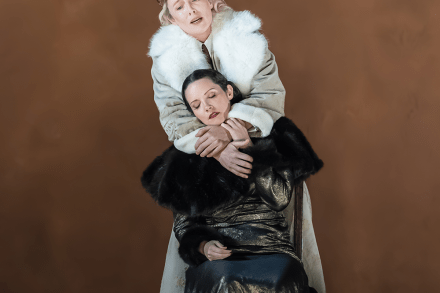
Richard Bratby

Richard Bratby is the chief classical music critic of The Spectator

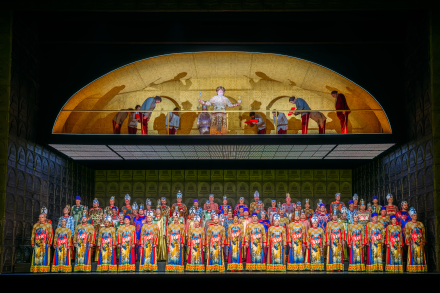
Summer opera festivals have gone Wagner mad

From our UK edition

Another week, another Wagner production at a summer opera festival. This never used to happen. When John Christie launched Glyndebourne in the 1930s, he hoped to stage the Ring. So he gathered a team of refugee musicians from Germany, who quickly assured him that it was impossible and he should stick to Mozart. The man

Thrilling: Garsington’s Queen of Spades reviewed

From our UK edition

Tchaikovsky’s The Queen of Spades is one of those operas that under-promises on paper but over-delivers on stage. It’s hard to summarise the plot in a way that makes it sound theatrical, even if you’ve read Pushkin’s novella, and I’ve never found a recording that really hits the spot. And yet, time and again, in

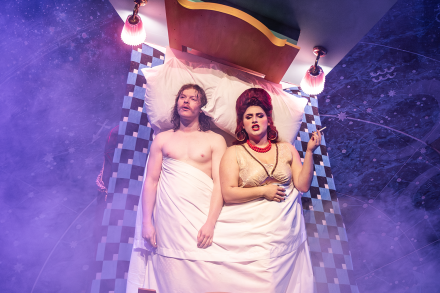
Sincere, serious and beautiful: Glyndebourne’s Parsifal reviewed

From our UK edition

‘Here time becomes space,’ says Gurnemanz in Act One of Parsifal, and true enough, the end of the new Glyndebourne Parsifal is in its beginning. We don’t know that, at first: the sickbed image that’s glimpsed during the prelude doesn’t resolve itself until the opera’s closing scenes. In between, characters appear on stage in multiple

James Heale, Angus Colwell, Alice Loxton, Lloyd Evans, Richard Bratby, Christopher Howse and Catriona Olding

From our UK edition

38 min listen

On this week’s Spectator Out Loud: James Heale analyses the splits in Labour over direction and policy (1:27); Angus Colwell asks if the ‘lanyard class’ are the new enemy (6:21); Alice Loxton explains why bite-sized histories have big appeal (9:58); Lloyd Evans reports on how Butlin’s is cashing in on nostalgia (15:00); Richard Bratby on Retrospect

The forgotten story of British opera

From our UK edition

British opera was born with Purcell’s Dido and Aeneas, and then vanished for two-and-a-half centuries, apparently. Between the first performance of Dido in 1689 and the première of Britten’s Peter Grimes in 1945, serious British operas effectively didn’t exist – or so we’re told in textbooks and biographies. But what if there was a different

A spate of re-releases suggests that Wolfgang Sawallisch was no B-lister

From our UK edition

Grade: A It’s clearance-sale time for the great classical labels of the 20th century. As streaming platforms drain the remaining value out of once-prestigious recorded catalogues, even B-listers are being pulled up from the vaults and remastered for one last re-release. Eleven-disc Rafael Frühbeck de Burgos edition? Walter Weller’s complete Decca recordings? Now’s your chance:

Our half-time scorecard on the Royal Opera’s Ring cycle

From our UK edition

With Die Walküre, the central themes of Barrie Kosky’s Ring cycle for the Royal Opera are starting to emerge, and one of them seems to be wood. Not trees, so much; at least not as a symbol of life. After the rapid assembly of a world from theatrical nothingness (a bare stage), Hunding’s forest hall

Inspired: Scottish Opera’s Merry Widow reviewed

From our UK edition

The Merry Widow was born in Vienna but she made her fortune in the West End and on Broadway. The original 1905 Viennese production was a shoestring affair. It was the English-language revivals in London and New York that made the Widow a global smash, and that happened only after extensive rewriting, done with Lehar’s

Imagine Dua Lipa releasing an album of Victorian parlour ballads

From our UK edition

Grade: B+ This is unexpected. A bright young cellist – one of the brightest, in fact – makes his recorded debut with a collection of opera fantasies. In the 19th century, touring virtuosos routinely ransacked hit operas for melodies, then decked them out with every conceivable bit of flummery, dazzlement and top-end-tinsel, the better to

Devastating: WNO’s Peter Grimes reviewed

From our UK edition

Britten’s Peter Grimes turns 80 this June, and it’s still hard to credit it. The whole phenomenon, that is – the sudden emergence of the brilliant, all-too-facile 31-year-old Britten as a fully formed musical dramatist of unignorable force. W.H. Auden had urged him to risk everything – to step outside his admirers’ ‘warm nest of

Sunny Schubert and iridescent Ravel: album of the week

From our UK edition

Grade: A Maurice Ravel was tougher than he looked. True, he dressed like a dandy and wrote an opera about a dancing teapot. But when he was rejected for military service in the first world war (he was 39 and 5ft) he practically forced his way to the front line as a lorry driver –

The liberating force of musical modernism 

From our UK edition

It’s Arvo Part’s 90th birthday year, which is good news if you like your minimalism glum, low and very, very slow. Lots of people seem to. The London Philharmonic’s concert on Saturday night was a reminder of an earlier, less ingratiating Part: the dissident composer in Soviet-controlled Estonia. Hannu Lintu revived Part’s First Symphony of

Barbara Hannigan needs to stop conducting while singing

From our UK edition

Last week, Barbara Hannigan conducted the London Symphony Orchestra in Haydn, Roussel, Ravel and Britten, though to be honest she had me at Haydn. It’s still relatively unusual to encounter him in a symphonic concert, and more than one promoter has told me that Haydn is ‘box office poison’, which is a shocking description of

A luminous new recording of The Dream of Gerontius

From our UK edition

Grade: A– There’s a species of music-lover who enjoys pointing out that Elgar isn’t played much on the Continent – the musical equivalent of those social media bores who pop up each April to reveal that Saint George was Turkish, ackshully. It’s all rot, of course. Some of the best Elgar performances of recent years