Richard Bratby

Richard Bratby is the chief classical music critic of The Spectator

Double trouble | 7 January 2016

From our UK edition

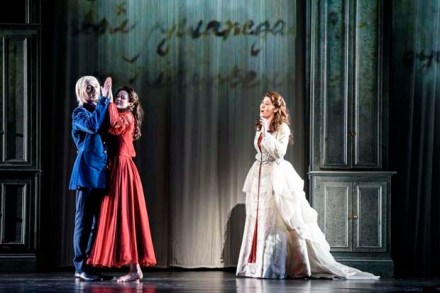
It’s scene five of Kasper Holten’s production of Tchaikovsky’s Eugene Onegin and Michael Fabiano’s Lensky is alone with a snow-covered branch and his thoughts. Well, not quite alone. At the other side of the stage stands the man he is about to face in a duel: his friend Onegin, who’s apparently arrived ahead of the appointed time and is listening to every word of Lensky’s anguished soliloquy. Except he isn’t: this is the Onegin of the present, looking back on a tragedy in his past. Or possibly imagining it? He can’t, after all, have heard Lensky’s words, for the practical reason that he wasn’t there. Can he? Oh, is that applause? The aria’s over.
Lost in translation | 3 December 2015

From our UK edition

About 15 minutes into act one of Jenufa, the student in the next seat leaned over to her companions and whispered, ‘They’re singing in English!’ And so they were, in Otakar Kraus and Edward Downes’s translation. Janacek was obsessed with the shapes and intonations of speech; for a non-Czech speaker, a first-rate singing translation is really the only way to make Jenufa strike home with anything like the immediacy and realism he intended. But even with surtitles, the effort is useless if — as was the case throughout much of act one of this performance by Opera North — the singers are almost inaudible. It might have sounded clearer in the circle. From the front stalls, however, the situation was impossible.

Stravinsky’s ingenious toy

From our UK edition

Is Stravinsky’s The Rake’s Progress anything more than an exercise in style? ‘I will lace each aria into a tight corset,’ Stravinsky told Nicolas Nabokov, and for most of three acts that’s pretty much what he does, deftly fitting W.H. Auden and Chester Kallman’s libretto to a steadily chugging parade of his smartest, pertest neoclassical tricks. The motor-rhythms, the acid harmonies, the borrowings from Mozart, Rossini and Handel: it’s all brilliantly accomplished and supremely knowing. In small doses, it’s appetising enough, and even at full length there’s much to enjoy — especially when played with the relish that Sir Andrew Davis and the Scottish Chamber Orchestra brought to this concert performance.