Richard Bratby

Richard Bratby is the chief classical music critic of The Spectator

False start

From our UK edition

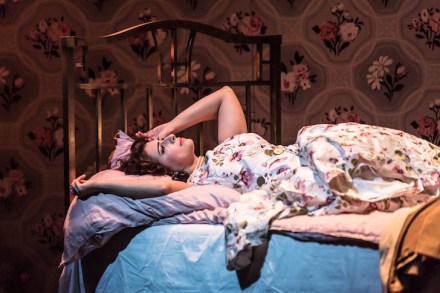
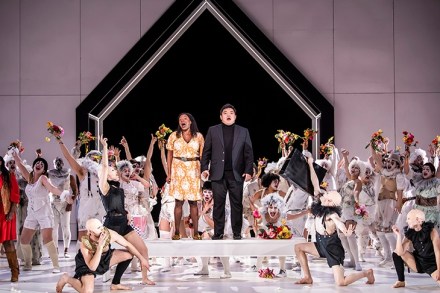
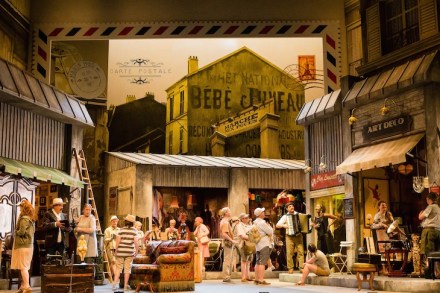
When a composer begins an opera, they create a world. You don’t need a full-scale overture: the tear-stained violins that Verdi drapes over the opening bars of La traviata do the job perfectly. The orgasmic upswing that launches Der Rosenkavalier, the cosmic hum that sets the Ring on its course — those very first notes tell you exactly where you are and what’s at stake. Puccini gets it just right at the start of La bohème: a cheerful orchestral clap on the shoulders that shoves you straight into the boisterous, bantering world of these four incurable optimists. Not here. André Barbe & Renaud Doucet’s new production for Scottish Opera opens in modern Paris, with no Puccini to be heard.

Stand and deliver

From our UK edition

Some opera-lovers prefer concert performances to full stagings. I don’t. It’s that whole Gesamtkunstwerk thing: opera needs to be seen as well as heard. There’ll always be circumstances in which concert performances are welcome — to rescue a neglected score, say, or if a symphony orchestra wants to stretch itself. But when a major company presents standard repertoire in concert, it feels like an admission of defeat. Opera North recently mounted a magnificent concert version of Wagner’s Ring — but for all the brave talk about a ‘radically stripped-back’ production, who seriously doubts that, if funds had allowed, it’d rather have gone the whole way? Now it’s doing Turandot in concert.

Blowing the bloody doors off

From our UK edition

As we waited for curtain-up on Scottish Opera’s new production of Bartok’s Bluebeard’s Castle a member of staff walked out on stage. Don’t worry, he reassured us, he wasn’t about to announce that a member of the cast was indisposed. Nervous laughter from the auditorium. Still in the same matter-of-fact tone, he carried on, and I’ll admit that only at this point did I twig that this wasn’t a member of staff and that he was actually delivering a cleverly skewed version of the librettist Bela Balazs’s spoken prologue to the opera — something more often omitted than performed.

Rued awakening

From our UK edition

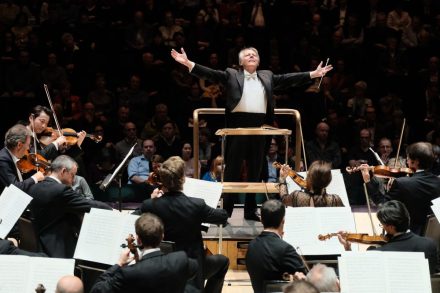
It’s always promising when the orchestra won’t fit on the stage. For the UK première, some 97 years after it was written, of the Danish composer Rued Langgaard’s Sixth Symphony (The Heaven-Rending), the BBC Scottish Symphony Orchestra filled every available inch of platform space, with four additional trumpeters perched in the choir seats. Everything was set for what the conductor Thomas Dausgaard described, pre-concert, as a ‘cosmic struggle between good and evil’. And god knows, it certainly made a fantastic noise. In a venue as compact as Glasgow City Halls, the onslaught of two sets of timpani had an almost physical impact. You felt the air wobble.

Scottish power

From our UK edition

‘Perhaps in this world nothing ever happens without purpose,’ sings old, blind King Arkel in Debussy’s Pelléas et Mélisande, and that at least is something to hold on to. God knows, you need it. Peel away the fairy-tale trappings of Maeterlinck’s original play, and the world of this opera is profoundly cruel. Its characters are often passive observers of their own fate (Pelléas admits before his final scene that he’s never yet returned his beloved Mélisande’s gaze). And yet Debussy pretty much compels you to feel for them, in a score of all-but-unbearable tenderness and beauty.

A thoroughly entertaining shot of Mozartian optimism: Mid Wales Opera’s Magic Flute reviewed

From our UK edition

The Magic Flute Mid Wales Opera, touring until 4 May The backdrop is a hexagonal matrix, glowing in neon blue. Mist billows from the wings, and as a figure in a pink gas mask huddles in the foreground, a Victorian funeral party marches slowly across the stage. 'Where am I?' asks Tamino in the first scene of The Magic Flute and in Richard Studer's new production for Mid Wales Opera, the answer seems to be the faintly eerie world of 1970s British sci-fi – an episode of Sapphire and Steel perhaps, or Tom Baker-era Doctor Who. Well, why not? Mozart and Schikaneder – whose libretto invokes Egyptian gods while specifying that Tamino should wear 'Japanese hunting costume' – clearly weren't too fussed.

British sea power

From our UK edition

The story so far: in 1986 English National Opera hired Jonathan Miller to direct Gilbert and Sullivan’s The Mikado. The result was so fresh and funny that it’s been a mainstay of the ENO schedule for more than three decades, to the indignation of hardcore opera fans who can’t understand why audiences keep flocking to hummable melodies and humour instead of, say, Berg’s Lulu. Attempting to repeat the formula, ENO then made the rookie error of engaging Ken Russell who, being Ken Russell, promptly updated Princess Ida to the 21st century and set it in a futuristic sushi bar. Finally, in 2015 they entrusted The Pirates of Penzance to Mike Leigh, whose G&S biopic Topsy-Turvy seemed to guarantee a safe pair of hands. Good call.

Age concern | 9 February 2017

From our UK edition

Brahms didn’t always have a beard. The picture in the London Symphony Orchestra’s programme book showed him clean-shaven, and rightly. The beard didn’t reach its final imposing form until 1878, around the time Brahms started sketching his Second Piano Concerto. (‘Prepare your wife for the grisly spectacle,’ he wrote to his friend Bernhard Scholz, ‘for something so long suppressed cannot be beautiful.’) But this concert opened with the First Piano Concerto, premièred in January 1859 when the composer was still a few months short of his 26th birthday. Younger, in fact, than tonight’s conductor — the 26-year-old Alpesh Chauhan — and not much older than the soloist, Benjamin Grosvenor.

Snow blindness

From our UK edition

Rimsky-Korsakov’s The Snow Maiden has not received a professional staging in the UK for 60 years. Think about that for a moment, and what it says about British operatic priorities. Sixty years of Massenet and early Verdi, of Manon Lescaut and Donizetti ‘rediscoveries’. Not that those aren’t worth having, as part of a healthy and balanced operatic diet. But the fact that during those six decades no major company showed any curiosity about an acknowledged masterpiece by one of the 19th century’s most prolific and original musical dramatists is perverse, to say the least.

Giving it both barrels

From our UK edition

In Joseph Roth’s The Radetzky March, the ageing Emperor Franz Joseph regrets the drab field-grey that has replaced his army’s once-colourful uniforms, seeing in it a premonition of an empire — a world — soon to be defeated and broken up. Franz Joseph is present in Act One of Robert Carsen’s new production of Der Rosenkavalier, right there in the Marschallin’s boudoir: I counted at least four portraits of the old man, gazing phlegmatically down on the sexually charged capers below. And the men in grey are there too. In Carsen’s conception, Baron Ochs and his yobbish retinue are cavalry officers, plotting on one side of the room, while on the other gorgeously dressed fashion models resembling drawings by Erté parade and pose.

Brief encounters

From our UK edition

When Mozart was commissioned to write an opera for the coronation of Emperor Leopold II, he produced La clemenza di Tito: a hymn to the benevolence of a Roman despot. When Matt Rogers and Sally O’Reilly were commissioned by the Inner Temple, they came up with an opera in which the protagonist is a law student who tries to obstruct the emergency services. The Fire of London is spreading, you say. And the only way to save life and property is by creating firebreaks? Sorry, I think you’ll find that, under Section 15 (4) of the Irresponsible Pettifogging Jobsworth Act 1661, you can’t do that. Truly, an operatic hero for our time.

A night at the circus

From our UK edition

The Royal Opera’s latest production is Shostakovich’s The Nose and to paraphrase Mark Steyn, whatever else can be said about it, you certainly get a lot of noses for your money. Noses are tossed from character to character, noses kneel in prayer and noses stroll casually past in the background. They poke through curtains, mingle in crowds, and form a high-kicking, tap-dancing all-nose chorus line. At one point, a little tiny nose toddles unaided across the vast, almost-empty stage. Around them swirls bustling, multicoloured madness: bearded ladies and moustachioed cops, women dressed like dayglo matryoshka dolls, and a couple of pigtailed cartoon Chinamen who might have wandered in from an Ellen Kent production of Turandot. It’s a regular circus.

Sinful treat

From our UK edition

Shiny swags of gold cloth hang in front of the curtain before David McVicar’s production of Der Rosenkavalier, and that’s good. You want a touch of luxury in a Rosenkavalier. This is 20th-century opera’s great sinful, indulgent treat. Think of it and you think of Karajan and Schwarzkopf: huge creamy voices, silken Viennese strings, and New York Met production budgets. In truth, when Der Rosenkavalier gets under your skin, none of that matters. It’s not the glittering set pieces that turn out to be the real heart of the thing; not even the final Trio or the justly famous sequences in which the Marschallin ponders the transience of youth.

Pole apart

From our UK edition

Alas, poor André Tchaikowsky. A survivor of the Warsaw Ghetto, with an assumed name that probably did his musical career as much harm as good (he was born Robert Andrzej Krauthammer), he died of cancer in 1982 shortly after his only opera, The Merchant of Venice, was rejected by ENO. He’s remembered today principally for bequeathing his skull to the Royal Shakespeare Company for use as a prop, in which capacity he starred alongside David Tennant in Hamlet in 2008. That skull had a tongue in it and could sing once.

My idea of fun

From our UK edition

We don’t really do operetta in Britain these days — and at this stage in the game, I don’t really need to tell you why, do I? We’re simply too philistine in these benighted islands, goes the argument; too coarse, too provincial, too clodhoppingly Anglo-Saxon ever to grasp the ineffable lightness and sophisticated wit of Offenbach, Lehar and Strauss. So anyway, here’s Offenbach’s Croquefer, or The Last of the Paladins: a one-act comedy set in the time of the Crusades, which climaxes with the leading characters belting out a stormy ensemble as they succumb to a collective attack of explosive diarrhoea. Basses heave; the brass section emits ripe, flatulent parps. There’s your Gallic sophistication for you, right there.

Where new is good

From our UK edition

On Saturday night, the City of Birmingham Symphony Orchestra makes its first appearance at the BBC Proms under its new music director, the 30-year-old Lithuanian Mirga Grazinyte-Tyla. It’s all a bit sudden. Grazinyte-Tyla only conducted the CBSO for the first time last July, and she’ll have made her debut as official successor to Simon Rattle, Sakari Oramo and Andris Nelsons at Symphony Hall, Birmingham, the previous night. The programme comprises Mozart, Tchaikovsky, and the London premiere of Hans Abrahamsen’s Grawemeyer Award-winning song cycle let me tell you. That’s right, the ‘London premiere’. It says so on the BBC website. Auntie has blessed the venture; the metropolis is poised to give its imprimatur.

On full beam

From our UK edition

What’s the best first opera for a sceptical adult first timer? It’s a favourite topic among opera buffs, and once you get past the assumption that novices need to be spoon-fed familiar tunes, the consensus — slightly surprisingly — often settles on Jenufa. Surprisingly? Well, yes: Janacek still isn’t guaranteed box office (maybe people conflate that spiky Czech name with a mental picture of Eastern bloc bleakness). In fact, this is a piece that can upend every lazy prejudice about the form: a concentrated plot, a concise running time, and no heroes or villains, just believable characters with painfully human failings. And all set to music that never judges, never sentimentalises: simply cuts raw and direct to the heart.

First thing’s first

From our UK edition

Leonore is the first version of Beethoven’s Fidelio, and Stephen Medcalf thinks it’s better. ‘What Leonore gives us is more discursive but more dramatic,’ he declares in the programme of this Buxton Festival production. Well he would, wouldn’t he? He’s the director. You’d hope he’d have some faith in the piece. And what’s undeniable is that with Leonore you get more Beethoven for your buck than in Fidelio. True, there’s no ‘Abscheulicher!’ and no glowing declaration of universal brotherhood from the Minister.

The eyes have it | 23 June 2016

From our UK edition

Tchaikovsky knew what he thought of the title character of his Eugene Onegin. ‘I loved Tatyana, and was furiously indignant with Onegin who seemed to me a cold, heartless fop,’ he wrote to a friend; and directors, by and large, have been happy to leave it at that. And why not? Dishy but emotionally unavailable Regency dandies have been a growth area in recent years — blame it on Colin Firth, if you like — and Eugene Onegin is probably the standard repertoire opera you’re least likely to see subjected to a directorial updating, in the UK at any rate. Michael Boyd’s new production at Garsington certainly doesn’t update anything.

Speech impediment | 19 May 2016

From our UK edition

‘So you’re going to see the gay sex opera?’ exclaimed my friend, open-mouthed. People certainly seem to have had some odd preconceptions about Mark Simpson’s new chamber opera Pleasure. The distinguished critic of the Daily Telegraph let it be known that he awaited ‘with trepidation, something set in the lavatories of a gay nightclub’. And to be fair, the news that Pleasure was to star Lesley Garrett — last seen in Welsh National Opera’s Chorus! ascending to the heavens aboard an enormous pair of lips — didn’t exactly dampen suspicions that we were about to see some sort of camp spectacular: Adès’s Powder Her Face meets RuPaul’s Drag Race.