Petroc Trelawny

Petroc Trelawny presents In Tune on Radio 3.

Petroc Trelawny, Gareth Roberts, Tom Lee, Leyla Sanai and Iram Ramzan

From our UK edition

28 min listen

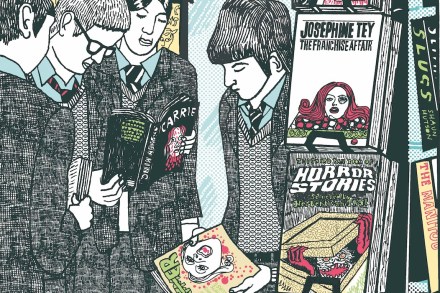
On this week’s Spectator Out Loud: Petroc Trelawny reads his diary for the week (1:14); Gareth Roberts wants us to make book jackets nasty again (6:22); Tom Lee writes in defence of benzodiazepines (13:44); Leyla Sanai reflects on unethical practices within psychiatry, as she reviews Jon Stock’s The Sleep Room (19:41); and, Iram Ramzan provides her notes on cousin marriages (24:30). Produced and presented by Patrick Gibbons.
Heaven is an oeuf en gelée

From our UK edition

The cherry blossom was at its finest as I made my last early morning trip through Regent’s Park to Broadcasting House to present Radio 3’s Breakfast. When hire-bikes arrived in London, the planners were thoughtful enough to install a docking station outside my flat. I have used the heavy cycles for my commute ever since. Over the past 14 years I have become accustomed to the regular faces on my route: the man in an elegant dressing gown, surveying the morning scene while waiting for his dog to pee; the jogger who for some reason processes backwards along the pavement (whatever the supposed health benefits of his technique, I’ve always wondered how he avoids colliding with one of the elderly lampposts, some of which date back to the reign of George IV).

Cindy Yu, Charlie Taylor and Petroc Trelawney

From our UK edition

17 min listen

Cindy Yu tells the story of how she got to know Westminster’s alleged Chinese agent and the astonishment of seeing herself pictured alongside him when the story broke (01.12), Charlie Taylor, His Majesty’s Chief Inspector of Prisons, talks breakouts, bureaucracy and stabbings, and wonders – where have all the inspirational leaders gone (06.45), and Petroc Trelawney shares his classical notebook and describes a feeling of sadness as the BBC Proms wraps up for another year (11.54). Produced and presented by Linden Kemkaran.

The arts world wants Labour

From our UK edition

A pang of melancholy as I detach the Royal Albert Hall pass from my BBC lanyard. I had a similar feeling late on Saturday night as I watched our team of engineers start to take down the hundreds of microphones that have enabled us to broadcast the Proms live each night on Radio 3. It has been a remarkable two months of music-making. The last season was curtailed by the death of the Queen; Covid infected the mood and scale of the 2020 and 2021 festivals. This time around, from my eyrie in the radio commentary box at the back of the side stalls, or the television studio high up in the gallery, there was a sense of a fresh start. On the Last Night the BBC Singers got the loudest applause.

‘Smile, segue and shut up’

From our UK edition

Three weeks before Classic FM launched, I was on the radio in Hong Kong, introducing hits by Rick Astley and Wet Wet Wet. I’d just turned 21, and was working as a presenter for British Forces Radio. A phone call came from London. ‘My name is Michael Bukht. I’m setting up a new radio station and have heard good things about you. We’d like you to present our afternoon show. By the way, do you know anything about classical music?’ Michael Bukht would not have fared well in today’s consensual media world, where respect is the watchword. He was a bit of a bully, capable of exploding at anyone promoting views not aligned with his own. But he had absolute belief in what he was doing.

Playing Bach to hippopotamuses

From our UK edition

Michael Bullivant tells Petroc Trelawny how he became Bulawayo’s chief musical impresario For an extraordinary month in 1953, Bulawayo became the epicentre of culture in the southern hemisphere. In celebration of the centenary of the colonialist and diamond magnate Cecil Rhodes, the Royal Opera House and Sadlers Wells Ballet took up residence. Sir John Gielgud staged and starred in a production of Richard II. The musical programme was left to the Hallé Orchestra, who flew in from Manchester with their music director Sir John Barbirolli and gave 14 concerts.

China’s piano fever

From our UK edition

Petroc Trelawny visits the world’s largest piano factory in the country where under Mao it was dangerous to play the instrument As my plane makes its final approach into the southern Chinese city of Guangzhou, the mountains give way briefly to green paddy fields, and then industry takes over. Beneath are hundreds of vast blue-roofed sheds and smoking red-brick chimney stacks. The landscape is mapped with railway marshalling yards and lorry parks; heavily laden barges crawl along the creeks of the Pearl River. With a massive economy that’s now larger than that of nearby Hong Kong, Guangdong Province deserves its title as the factory of China.

‘The name is Elder, not Elgar’

From our UK edition

A large portrait of Mark Elder hangs backstage at the Bridgewater Hall in Manchester. It’s not a flattering representation; in it the Hallé’s music director looks tired, haggard, old. Interestingly, the picture is positioned so that the conductor doesn’t have to go anywhere near it as he passes through the corridors from his dressing room to the concert platform. On 2 June, the 150th anniversary of Edward Elgar’s birth, Elder turns 60. He could pass for a man 15 years younger. We meet outside his north London home. I arrive early, and he catches me loitering round the corner as he marches down the street after a haircut.

Sunshine and storm

From our UK edition

When questioned for the 1891 census, Betsy Lanyon, an 84-year-old widow from Newlyn, decided she had better register a late change of career. She told her inquisitors that she was no longer a ‘fishwife’ — her new occupation was ‘artist’s model’. In the decades around the turn of the last century, Newlyn, a fishing port a few miles west of Penzance, was overrun with artists. Stanhope Forbes had established his position as father of a local ‘school’ of painters; his followers were to be seen daily on the nearby beaches, battling against the Cornish wind as they attempted to keep their canvases upright.

An English composer in Ireland

From our UK edition

In the basement of the Boole Library at University College Cork, I find myself face-to-face with a death mask. Slightly collapsed cheeks give it a look of the elderly Churchill. It is actually Sir Arnold Bax, the Romantic composer from Streatham, in south London, who briefly became one of the more unusual advocates for the end of British rule in Ireland. Alongside the mask, dust lies thick on the autograph scores of tone poems and chamber works, and personal effects including a pair of glasses and a cigar case from the Savoy Hotel. Across town at the university's music department, his grand piano is propped sideways against a wall. Few of the keys produce any sound. It is a forlorn sight.