Peter Hoskin

20,000 Days On Earth: is Nick Cave the missing link? Or the next stage in evolution?

From our UK edition

Inspired by Justin Bieber’s Never Say Never (2011), Katy Perry’s Part of Me (2012) and One Direction’s This Is Us (2013), Nick Cave has released a documentary about himself. No doubt he wanted to prove that this old dog has new tricks. The whole movie is shot in candy-crushed 3D to appeal to the emteevee-ohmigod generation. He talks about how great it was to work with Rihanna and Ludacris: ‘The thing about thoseguys is...’ Nah, sorry, I’m just kidding with you. None of that is true, apart from the bit about Nick Cave releasing a documentary about himself. It’s called 20,000 Days on Earth. And, much like the man himself, it is gloriously oblique. It takes place — apparently — over the course of a day spent recording his last album with the Bad Seeds, Push the Sky Away.
Ignore the simplistic politics, Pride will make you laugh and cry

From our UK edition

1984 and all that. Which side were you on? The side of Margaret Thatcher, her hairdo and person standing rigid against a rising tide of industrial activism and British declinism? Or the side of the miners, socking it to the Tory scum and their jackbooted adjutant, Johnny Law? There’s no doubting which side this new movie Pride is on. It’s about a curious episode in community relations when a group of gay people from London decided to fundraise and rabble-rouse on behalf of the striking miners in Wales. It starts with a shot of a red banner — ‘Thatcher Out!’ — hanging from a council-block window. And it ends with a discussion of which phrase will work best on a placard: ‘Screw you, Thatcher!’ or ‘Fuck you, Thatcher!’ They go with the former.

Lucy: the shoot-outs, car chases and mysteries of the universe

From our UK edition

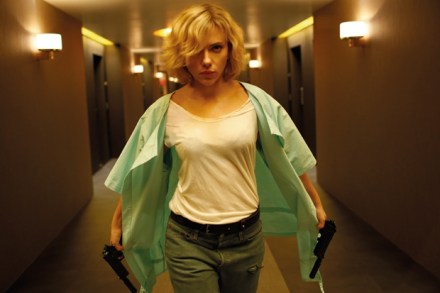
Here’s an idea for an article: The Tree of Life (2011) is the most influential film of the past decade. There’s quite a strong case to be made. Everything from car adverts to Hollywood blockbusters seems to have a touch of the Terrence Malick. They all span from cornfield to cosmos, from ant-hill to apocalypse, while characters breathe epigrams at each other about love and beauty and rebirth. This was true of last year’s Gravity and Man of Steel. It also looks true of Christopher Nolan’s forthcoming Interstellar. Just find a few more examples, work them into 1,000 words, and I’m sure The Spectator will pay a couple of hundred quid for it. The reason I mention this is Luc Besson’s latest movie, Lucy.

A comic drawn by Bob Monkhouse in which a superhero battles giant penises? Yes, it’s all here

From our UK edition

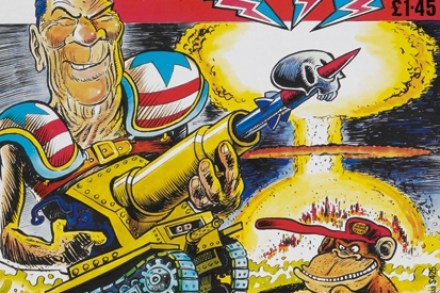
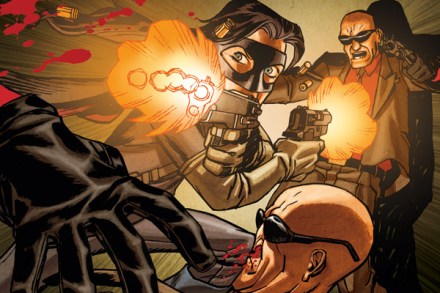
Fwoooosh! That, were someone to write a strip about it, would be the sound of a thousand comic books going up in flames. They used to do that, you know; burn comics. It was mostly in America, in the late 1940s, after these DayGlo fictions, with their monsters and superheroes and suggestive curves, were declared bad for children’s health. But it spread to Britain too. Parents and teachers would search drawers and desks. Any comics they found would be gathered in small piles outside. A responsible adult would pull out some matches. And then, like I said: fwoooosh! Of course, comics are now treated with greater respect.

I suspected Maleficent would be terrible from the very first shot

From our UK edition

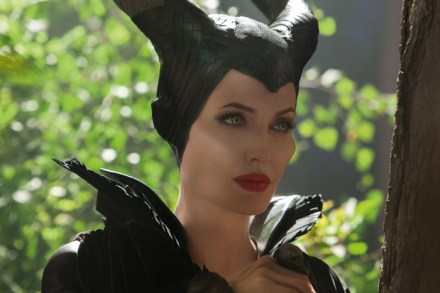
If a gang of knife-wielding toddlers ever presses you for the name of the best Disney film, Sleeping Beauty (1959) is a pretty good answer. It has everything you expect from those features animated during Walt’s life: a simple story translated from a fairy tale; beautifully painted castle and forest scenes; a baddie that you can really root against, and all that. But it also has more: widescreen; a wild and luminous colour palette; and a score borrowed from some bloke called Tchaikovsky. Today’s animators are given to cooing about its invention and daring. I’d join them if I had a switchblade raised to my knees. Even if I didn’t. Which brings us bloodlessly to the latest film from Walt Disney: Maleficent.

Batman: from midnight monster to pop-tacular star. Kapow!

From our UK edition

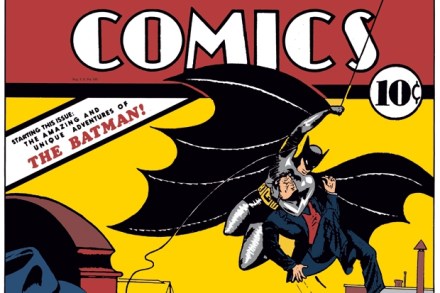
‘Well, Commissioner, anything exciting happening these days?’ Those were the first words — all seven of ’em — spoken by a new character introduced in the May 1939 issue of Detective Comics. That character was a chap called Bruce Wayne. You may know him better as the Batman. And, if you subtract May 1939 from now, you’ll realise that he is three quarters of a century old this year. So, yes, Bruce, there is something exciting happening these days. It’s your 75th birthday. Mr Wayne is sprightly for a septuagenarian — particularly given that he was hardly fresh-faced and spring-limbed at birth. When the writer Bill Finger and the artist Bob Kane designed this new comic-book hero they took inspiration from plenty of old non-comic-book heroes.

The Amazing Spider-Man 2: Too much bang-bang, not enough kiss-kiss

From our UK edition

Have you seen that pizza with a cheeseburger crust? If not, just imagine a normal pizza, except where the pizza ought to end — and civilised society begin — there’s a ring of about ten miniature burgers, all encased in dough. On top of each of those burgers is a greasy discharge of cheese. There’s also an option to add bacon. I mention this because the opening of The Amazing Spider-Man 2 feels much the same. It serves up pizza: a pre-credits flashback in which the parents of Peter Parker, aka Spider-Man, struggle to upload data to YouTube, or wherever, while battling a gunman on board an exploding plane.

Bury every copy of Monuments Men in mines across Europe, so George Clooney can try again

From our UK edition

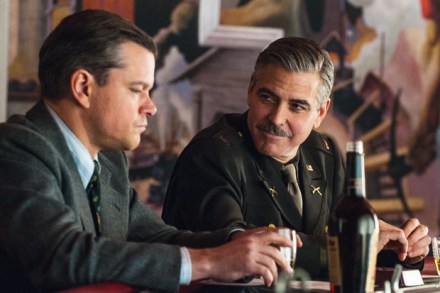
You know that old quip ‘I’m not just a pretty face’? I always thought it was meant to be said tongue-in-cheek, with an undertone of self-deprecation. Surely it’s not for those literal instances when a really beautiful person does something really, really smart. It’s for when those of us on the middle-to-lower rungs of the loveliness ladder have flashes of minor inspiration. And so, ‘I’m not just a pretty face.’ Like a joke. Hahahahaha. But what would it mean if George Clooney — ol’ salt-and-pepper-spit-curl George — said ‘I’m not just a pretty face’? The reason I ask is that he, or at least the character he’s playing, does just that in his latest film The Monuments Men.

Is Hollywood finally waking up to the talents of women? Nah

From our UK edition

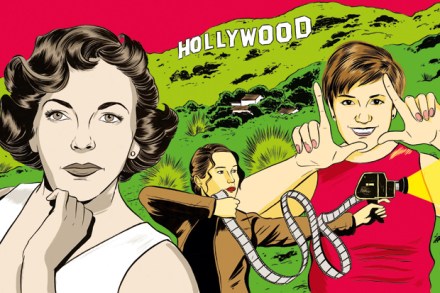
There is, we all know, only one anniversary that matters this year: 20 March 2014, 50 years since The Twilight Zone episode ‘The Masks’ was first beamed into America’s cathode-ray tubes. Bunting will be stretched from television screen to television screen in celebration. Champagne will be spilt over remote controls. After all, ‘The Masks’ isn’t just a particularly fine episode of a particularly fine show. It is also the only episode — of 156, if we don’t count the two revival series made in later decades — to be directed by a woman. Ida Lupino.

Jennifer Lawrence is plain brilliant in The Hunger Games: Catching Fire

From our UK edition

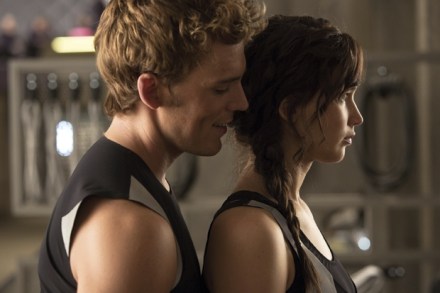
In the future, everyone will have silly names. Some people will be called Haymitch Abernathy. Others will be Effie Trinket or Finnick Odair. And they’ll all live in various districts, numbered from one to 12. And because those districts rebelled against the ruling regime that one time, their children might be selected for an annual televised extravaganza called the Hunger Games. It’s a bit like school sports day, only bloodier. The kids have to kill each other with an excruciating variety of sharp implements. The winner is the one who doesn’t end up with a spear through their neck — and all glory be to them. Or at least that’s what I learnt from The Hunger Games (2012).

How I learned to start screaming and love the horror movie

From our UK edition

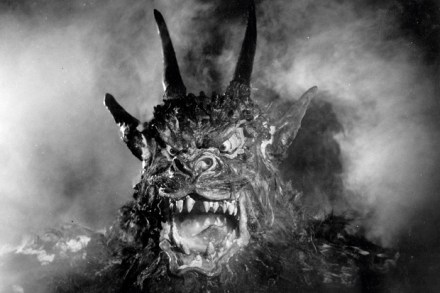
Buddy, you can keep your Christmases and your Easters, your Hanukkahs and your Eids. For someone like me, the annual celebration that really matters is the one that falls on 31 October — Halloween. This isn’t because I’m an inveterate trick-or-treater, out for candy and larks. It isn’t because I own shares in a pumpkin patch. It’s because I am a film fan, grateful for any excuse to indulge in horror movies as night’s dark curtains draw closer. No other time of the year offers such a perfect alignment of occasion and genre. ’Tis, after all, the season to be scared. And this season is shaping up better than most.

No rest for Diana – the biopic of the late princess is so inept it’s not even hagiography

From our UK edition

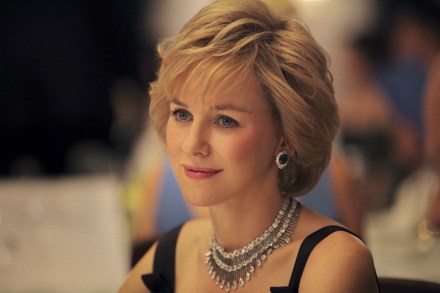
Someone who knows their Dianaology will have to fill me in – did this actually happen? The late Princess Di is walking through central Portofino in Italy. She’s being jostled on all sides by an insistent public and an even more insistent swarm of photographers, when, suddenly, the crowds part. There, huddled by his family, is a thin blind man. She reaches out to him and he reaches back, taking her hands. Then he presses at her face as though it’s Braille; trying, as movie blind-people are wont to do, to read her soul. Sunlight streams down from the heavens. We never see the man’s sight restored — perhaps that’s for the spin-off, Eyes Wide Open: The Diana Miracles — but we get the point.

Another Self-Portrait isn’t just for the Bobsessives

From our UK edition

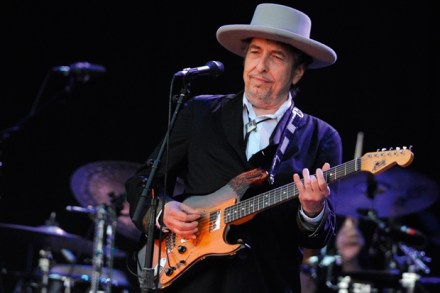
So, there’s this guy called Bob Dylan and, across just seven years in the 1960s, he’d released nine albums that were already legendary. The Times They Are a-Changin’, Highway 61 Revisited, Blonde on Blonde… yeah, you know them all. But then, at the start of the 1970s, came his Self Portrait. With a title like that, it promised to be mythic and definitive, except it wasn’t. It was a pick ‘n’ mix of country standards, concert snippets and Simon & Garfunkel covers. Dylan subsequently distanced himself from this weird confection. But, through these hindsight goggles I’m wearing, Self Portrait doesn’t look half so bad now.

White House Down is Roland Emmerich’s Hedda Gabler

From our UK edition

Just do it, quoth the Nike advert — and these men just did it. Grass, asphalt, fear, pain, doubt and limitation; all surpassed in the pursuit of human excellence. The racing driver James Hunt and the baseball player Jackie Robinson may have practised different sports, but they were both champions. And, with Rush and 42, they both have fine-looking films dedicated to them this week. Cinemagoers who want to tread the contours of greatness, and understand its peaks and troughs, need look no further. Hollywood has it covered. But for those of you who just want to see some stuff blow up and some bad guys capped, then how about the movie I actually ended up watching? Roland Emmerich’s White House Down.

Climb aboard the runaway train

From our UK edition

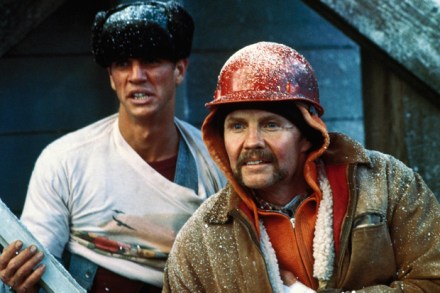
Brother, can you spare me a train? Or maybe just a Pullman carriage or two? There are so many brilliant films set on trains that I’d love to screen some of them in loco locomotive, as it were. Shanghai Express (1932), The Lady Vanishes (1938), The Narrow Margin (1950), Night Train (1959)… I’ll stop there. Just grab a ticket and scramble aboard. Andrey Konchalovsky’s 1985 film Runaway Train, which has just been released on Blu-ray and DVD, would certainly be included on the programme. It has the qualities of other rail-bound films: the heavy sense of momentum, the restrictiveness of the carriages, and so on. But it’s several times gruffer than the rest.

Chronicle of a Summer: Reality TV decades before it had a name

From our UK edition

Here’s a documentary called Chronicle of a Summer. Which summer? Why, the summer of 1960, in Paris, when fag-end colonial struggles were burning away in Algeria and other parts of Africa. And how is it chronicled? An anthropologist and a sociologist, Jean Rouch and Edgar Morin, put cameras on the streets and ask questions of the people they find. Who are you? Are you happy? The usual French existential stuff. The results are gripping, even from a distance of more than 50 years. Rouch and Morin focus on the personal; the everyday lives of factory workers, artists, immigrants, models and students. But when France’s present and recent past break into shot, it’s as dramatic as could be.

Film review: Before Midnight is a perfectly crafted movie

From our UK edition

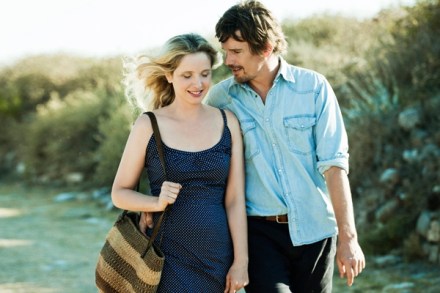
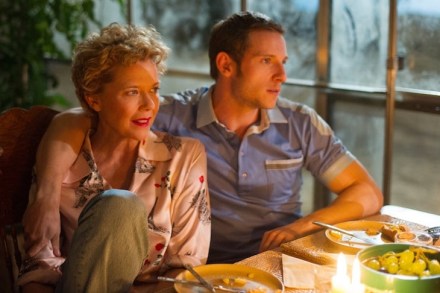
To quote the watch adverts, here’s a timepiece that will last a lifetime: the Doomsday Clock. And the reason it will last that long? Because when it stops, so will your life. This is the figurative clock that has been maintained by a bunch of Chicagoan atomic scientists since 1947. The closer its hands are to midnight, the closer we are to nuclear annihilation. It started off at seven minutes to midnight. But now, as any paranoiac will tell you, it is two minutes further on. We are, in this one specific sense, five minutes away from The End. Did Richard Linklater have this in mind when he named his new film Before Midnight? Probably not. This isn’t, in truth, a film about death by fission and fusion, but a simple middle-aged love story.

Comic-book writer Mark Millar interviewed

From our UK edition

In purely demographic terms, Mark Millar isn’t too different from the rest of us. He’s a middle-aged, wiry-haired, churchgoing Scot with two kids. He subscribes to The Spectator, and enjoys his ‘weekly treat’ of reading the latest issue in the bath. So, unless you have excavated this copy from the yellowing stack in your dentist’s surgery, he could even be scanning these words at the same time as you — right now. But demographics, often inadequate, are practically useless when it comes to Millar. He may tick the box marked ‘Spectator reader’, but he actually spends most of his time on bizarro worlds in distant corners of the multiverse. He’s surrounded by assassins dipped in blood and sadists wrapped in capes.

Knightriders on DVD

From our UK edition

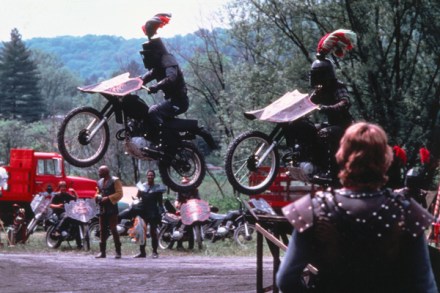
A knight and his lady awaken, naked in the forest. She pins up her embroidered gown while he begins his ablutions in a pond. Thwack! Thwack! Thwack! He plants a stick between his shoulder blades before getting dressed himself. On goes his tunic, gauntlets and plated armour. And then they both climb on to his motorbike before riding out into the morning mist. Hang on a second – a motorbike?! It sounds ridiculous, but that’s how it is in George Romero’s Knightriders (1981), now out on DVD for the first time in the UK. Our knight in the forest is actually Ed Harris’s Billy, the leader of a troupe of men and women who travel around America putting on shows in small towns.

Caitlin Rose’s The Stand-In: a fantastic album from a fantastic girl

From our UK edition

Caitlin Rose, Caitlin Rose, Caitlin Rose. I’d feel awkward admitting that I’m rather obsessed with this Nashville chanteuse, were it not for a mitigating truth: you should be, too. Her debut album Own Side Now, released in 2010, was proof enough of her sweltering talent. And now we have a follow-up, The Stand-In, that’s superior in many regards. Her voice, already aspiring to the heights of Cline and Lynn, has become rounder, more chocolate-y. Her songs, already a stunning catalogue of broken love, sound even more heartfelt. Her… … Oh, I don’t want to embarrass myself, so let’s get down to cold, musical facts. Perhaps the main difference between this album and its predecessor is the texture.