Paul Robinson

Is Canada’s foreign policy making the country any safer?

From our UK edition

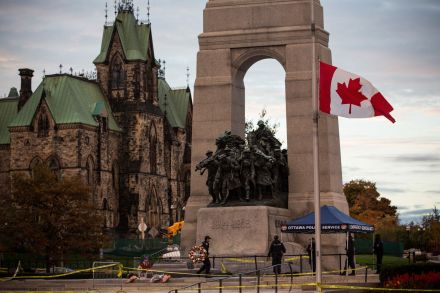
We Canadians like to think that we are a boring and peaceful nation, that nothing much ever happens here, and everybody likes us. It therefore comes as a shock when we are attacked, as we were this week in Ottawa. Yet terrorism is not a new phenomenon for Canada, as demonstrated by the assassination of one of the fathers of the confederation, Thomas D’Arcy McGee, in 1868; by the murderous behaviour of the Front de Libération de Québec in 1970; and by the destruction of Air India Flight 128 in 1985. Our legislative institutions have been regular targets of attack. A Loyalist mob burned down the Parliament of Lower Canada in Montreal in 1848.
The generals must share the blame

From our UK edition

It’s fashionable for military top brass to attack politicians when things go wrong. But, says Paul Robinson, many of the army’s problems are of their own making In recent years, failure to ‘support the troops’ has become the ultimate political sin. The Conservatives’ soon-to-be defence adviser, General Sir Richard Dannatt, blasted Brown a few weeks ago, letting it slip that his brave plea for 2,000 extra troops had been ignored by our callous PM. But has Gordon Brown really ‘betrayed’ the troops in the field? A good degree of cynicism is in order.

A sense of proportion

From our UK edition

The Israeli Defence Forces’ ethical standards are different from, and in some ways higher than, the British army’s, says Paul Robinson, but in the end the question is not whether IDF actions are moral, but whether they are wise This week David Cameron joined his shadow foreign secretary William Hague in denouncing elements of Israel’s operations in Lebanon as ‘disproportionate’. This view has not gone down well with some on the hawkish Right, but it has been met with approval among the Conservative Arabists and lefty humanists who think that everything Israel does is disproportionate. Very few of the hawks, or lefties, or Arabists, however, seem to know what proportionality in war really means, or how Israel, in particular, understands it.

Putin plays the market

From our UK edition

I don’t believe that I can be alone in having spent a Russian or Ukrainian winter with the windows of my room wide open. Many buildings in that part of the world are dreadfully overheated, for the simple reason that energy is so cheap. Soon, however, Ukrainians will have to learn to close their windows. Until this week, the Russian gas company Gazprom charged Ukrainian consumers $50 for every 1,000 cubic metres of gas they used. On Sunday Gazprom demanded that they pay $230. The Ukrainians’ first response was to refuse, and the Russians turned off the gas. The choice, it seemed, was expensive fuel, or no fuel at all. On Wednesday, the Ukraine agreed to pay $95 per 1,000 cubic metres for a mixture of Gazprom supply and cheaper gas from Central Asia.

The return of White Russia

From our UK edition

‘Unbelievable,’ the professor told me. It was hard to disagree. We had just laid flowers on the grave of the anti-communist Russian philosopher Ivan Alexandrovich Il’in. Just a short time ago, mere possession of one of Il’in’s books would have brought six years in prison. Now the Russian state has reburied the philosopher in Moscow with all the pomp and ceremony it could muster. Earlier this month the Patriarch of the Russian Orthodox Church, Alexei II, presided over a service of reburial at the Donskoi monastery in Moscow for not only Il’in but also his far more famous contemporary General Anton Denikin, head of the anti-Bolshevik White forces in southern Russia during the Russian civil war.

Are we wasting money on defence?

From our UK edition

Backing the Americans in Iraq has not served the national interest, says Paul Robinson; we’d be more secure if we adopted a less interventionist foreign policy and reduced our military capacity Soldiers are not social workers. They fight and they kill — that is what they are trained to do. They are not trained to ‘do good’. Yet turn to the Ministry of Defence website and you will see that the very first words on the ‘Army Jobs: Army Life’ recruiting page are, ‘The British Army is a force for good.’ The site then goes on to stress the army’s activities ‘around the world’. Defending the UK barely gets a mention.

Thought police

From our UK edition

When the remaining flotsam of 20 or so Conservative MPs wash up on dry land after the next general election, they may do well to consider why it was that during this Parliament, every time the credibility of Prime Minister Tony Blair sank further into the depths, the credibility of their own party sank with it. If Tony Blair is George W. Bush’s poodle, the Conservative party is the poodle’s poodle or, as Jonathan Swift might have put it, the flea’s flea: ‘Naturalists observe, a flea/hath smaller fleas that on him prey,’ he wrote, ‘And these have smaller fleas to bite ’em,/and so proceed ad infinitum.’ Blair’s genius has been to make his political opponents complicit in his own crimes, so that when he suffers for them, so do they.

Identity crisis

From our UK edition

Bossy-boots Blunkett’s plans must be resisted, says Paul Robinson, who has acquired five new cards in recent months, and it’s been a pain in the pocket for him I recently had my fingerprints taken for an identity card. If our autocratic Home Secretary, David Blunkett, gets his way, this will in the next decade or so become a universal rite of passage. Mr Blunkett has made it clear that he considers the issue of ID cards a ‘defining moment’ in Britain’s future. I agree, for his plans will define a new Britain which has turned its back on its traditional freedoms and adopted a new persona entirely out of keeping with that we have always held dear.

Code comfort

From our UK edition

The influential American journalist Robert Kaplan recently commented that the real shapers of his country's foreign policy are junior and middle-ranking military officers. When an engineer captain in Afghanistan mobilises his men to de-mine a road, or a major in Baghdad oversees the training of competent new policemen, the 'Global War on Terror' (GWOT) moves one step further towards a successful conclusion. But when their colleagues violently raid houses and carry off the wrong Afghans to detention, or gun down innocent civilians in Iraq, Osama bin Laden and his kind garner another handful of followers. Much depends on what individual American officers in the field consider to be acceptable behaviour.

Sword of honour

From our UK edition

If you are looking for some fun, and have a research grant to spend, try this. Visit an American university, bump into random students in the corridor and loudly call each one 'asshole'. Then measure their reactions. This is what a team of psychologists did in a controlled experiment at the University of Michigan. The results were most interesting. Students from the southern part of the United States reacted far more violently and aggressively than those from the North, were shown to have much higher levels of cortisone and testosterone, and in tests regularly suggested more belligerent solutions to problems.

Land of the free

From our UK edition

Paul Robinson says we can learn a lot about decency and independence from plucky Canada You've probably heard that story about the Inuit having 50 words for snow? Well, the sign of a genuine Canadian is that he has 50 words for doughnut. When a glacial wind is howling through Moose Jaw and Medicine Hat and it has been dark for five months in Tuktoyaktuk, Canadians head for Tim Horton's, Dunkin' Donuts, Robin's Donuts, Country Style, Coffee Time, Baker's Dozen, and all the rest of them. When it comes to the perfect doughnut, Canada is the unquestioned world leader. In the less important matters of world politics and military strategy, Canada is rarely seen as a leader. Indeed, Canada-bashing is now very much in vogue, especially in right-wing circles in Britain and America.

The people must decide their fate

From our UK edition

In 1825 Russian Decembrist revolutionaries in St Petersburg tried to inspire the peasant masses with the slogan 'Constantine i constitutsia' (Constantine and a constitution) as they pressed for Tsar Nicholas I to abdicate in favour of his brother Constantine. Unfortunately, their pre-spin audience simply assumed that Constitutsia was Constantine's wife, and failed to see the advantage of a different Romanov and his lady over the one already reigning. Here today, Britain is about to get its first ever written constitution, drafted by the obliging Eurocrats of the Convention on the Future of Europe, and binding on us all. Yet 'we the people' in whose name this document is being produced have not been asked for the slightest whisper of a comment.

A dodgy constitution

From our UK edition

I once heard of an Ivy League professor who had written 50 constitutions. All of them collapsed, including the one for the college boat club. If that gentleman is not now advising the Convention on the Future of Europe, someone very like him surely is. On the opening day of the convention in March 2002, its president, ValZry Giscard d'Estaing, bravely compared the congress to the Philadelphia Convention, which wrote the US constitution in 1787. One might equally make a comparison with the conferences which created the Dominion of Canada. Unlike the constitutions of the Ivy League professor, the products of those meetings have stood the test of time.