Nik Darlington

Wine and The Spectator: how little has changed since 1860

From our UK edition

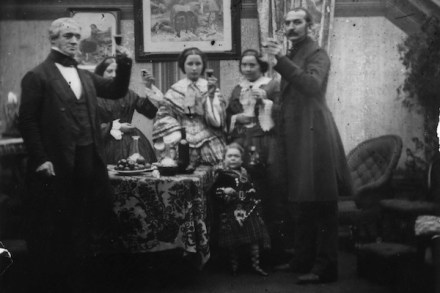
What are the big themes in wine today? High rates of duty loom large, as does their impact on prices. There are some concerns for consumption, but no one seems too keen to keep a lid on it (not least among the Fourth Estate). Discovering the next big thing becomes ever more competitive as the wine world expands too; and we are (rightly) living through a fetish for rare grape varieties. The bravura new Spectator Archive, cataloguing every magazine from 1828 till 2008, tells us little has changed. Wine duty was a hot topic in Victorian times. In March 1860, a correspondent wrote: 'Of all the articles in the long lists of Customs and Excise, there is not one which has so often, and to such a degree, been experimented upon, as the single item of wine.
Readers’ review: Darling’s ripping memoir

From our UK edition

When Gordon Brown became Prime Minister in 2007, the Labour party was split into three camps: those who genuinely adored Brown, those who believed he could change (elected as New Gordon, govern as New Gordon?) and a deflated Blairite rump that had given up the ghost.  It is not immediately clear which of these camps is most reprehensible. But the most culpable were those who knew that a Brown premiership would be a disaster and still allowed it to happen, including Tony Blair, who, as Alistair Darling reveals in this brilliant autobiography, said at the beginning of his premiership that working with Gordon Brown was “like facing the dentist’s drill without an anaesthetic”.

In Birmingham, dreaming of opposition

From our UK edition

The intrigue of the Liberal Democrats’ conference has centred on the party’s split personality. A Sunday Times/YouGov poll disclosed that as many as 50 per cent of Lib Dems believe that it was wrong to go into coalition in the first place, leading one to assume that only the small clique of ‘conservatives’ around Nick Clegg is keeping the Lib Dems in government. There is a still a strong feeling that going into coalition was the right thing to do for party and country. Lib-Dems who think otherwise, I’m told, “should seriously question [their] logic” because there was no alternative. However much that is true, Lib-Dems still miss opposition.

The mysteries of spin

From our UK edition

Close the nominations. Unless someone publishes proof of Shergar pulling a plough in the Yemen, it must be a good bet for William Hill Sports Book of the Year 2011. Twirlymen is the absorbing maiden work by Amol Rajan, a journalist at the Independent.  His aim is to celebrate spin bowling’s impressive survival in the face of change and the often unjust machinations of cricketing authorities; to remind us of spin bowling’s past dominance; to explode myths; to raise off-spin, ‘an ugly ducking in cricket’, to its rightful plinth; to extol the mastery of the basics over the capriciousness of mystery; and to celebrate the great Twirlymen.

Supermac in eight anecdotes

From our UK edition

The hardback edition of D.R. Thorpe's Supermac is 626 pages in length (not including endnotes and index), 24cm x 16cm x 6cm in girth, and weighs in at more than one kilogram – on first appearances, not a book for a beach holiday. Or so I thought, because despite the corporeal hardships of reading this on a sunbed in mercury-popping heat, I was transfixed. And now I have the forearms to prove it. Thorpe gravitates between dextrous prose and a judicial exposition of evidence, such as when taking the reader through the controversial Cossacks repatriation episode, or the quandary of royal prerogative during the handover to Lord Home.

Don’t blame Brando, blame the historians

From our UK edition

Turning it over with my bare toes, it had the look and feel of finely ground coffee, typical of the island’s volcanic black beaches. I could not help but smile to myself: even the white coral sand was a myth. As a youngster, I fell in love with a 1930s book series called The Bounty Trilogy, by Charles Nordhoff and James Norman Hall.  They introduced me to the greatest true story ever told.  The narrative is swift and vibrant, the characterisation sublime.  The book inspired the 1935 Oscar-winning film starring Charles Laughton and Clark Gable, and the 1962 remake, with Trevor Howard and Marlon Brando. But Nordhoff & Hall, by their own admission, were not bound by historical truth. Like countless plays and books before them, they made most of it up.

Nicholls’ touch of magic

From our UK edition

It is an old cliché that films of books must be inferior to the books themselves. It is not always true. For instance, read Michael Crichton’s Jurassic Park and see whether you disagree (the writing is pedestrian and the plotting is incoherent, which is why the movie has a different storyline). Then of course there is David Nicholls’ first novel, Starter For Ten, which was fun but nothing like as good as the film adaptation (in no small part thanks to James McAvoy). The adaptation of David Nicholls' One Day, a coming-of-age novel about love and fulfilment, hits our cinema screens this autumn. But clichés are not clichés for nothing. Unlike Starter For Ten, which began life as a screenplay, One Day does not feel as cinematic.

Spotify Sunday: Calmly Magnificent

From our UK edition

Here let us sweep The boundless landscape; not the raptur’d eye, Exulting swift, to huge Augusta send, Now to the sister-hills that skirt her plain To lofty Harrow now, and then to where Majestic Windsor lifts his princely brow. In lovely contrast to this glorious view, Calmly magnificent. James Thomson, ‘Summer’ from The Seasons, 1727 Everyone has a favourite piece of London.  Mine stands along the Terrace Walk, on the north-west prospect of Richmond Hill, the ‘glorious view’ so little changed in nearly three centuries. In the foreground are the bucolic, sloping Terrace Fields and Petersham Meadows.  A diminutive ait, Glover’s Island, floats upon the Thames.