Niall Ferguson

Niall Ferguson

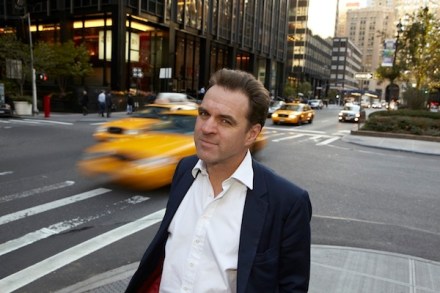
Niall Ferguson is the Milbank Family Senior Fellow at the Hoover Institution, Stanford University and a Bloomberg Opinion columnist

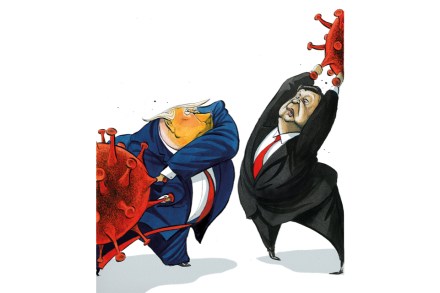
Who will win the corona wars?

The COVID-19 pandemic came along just as Cold War Two was getting under way between the United States and the People’s Republic of China — the superpowers of our time — with the European Union and a good many other US allies quietly hoping to be non-aligned. Far from propelling Beijing and Washington towards détente in the face of a common enemy, the new plague has only intensified the Cold War. For the first time, China’s campaign of disinformation has been on a Russian level, with wild anti-American conspiracy theories being disseminated by senior Foreign Ministry officials.
corona wars

The people’s decade: how will history come to define the 2010s?

From our UK edition

The 1960s were swinging. The 1970s were stagflationary. In the 1980s we made loadsamoney and greed was good. The 1990s were dot.commy. And the 2000s were the boom and bust decade. Characterising ten-year periods in this casual way is something journalists love to do. It’s deplorably unscientific and yet pleasingly decentralised. A consensus simply emerged that the 1960s were swinging, even if the overwhelming majority of human beings did not turn on, tune in and drop out. The overall quantities of love and war were roughly the same as in the 1950s. Historians shouldn’t object. Such epithets give us something to argue against. (‘Far from being “swinging”, for most people the 1960s were indistinguishable from the previous decade…’ and so on.

Diary – 27 June 2019

From our UK edition

I spent the early part of last week in London, filming what are known in the television trade as PTCs (‘pieces to camera’). These will form the connecting tissue for a three-part documentary series loosely based on my most recent book, The Square and the Tower. Ten years ago, I did a lot of this kind of thing. A series of books, beginning with Empire, started life as television scripts, in an effort on my part to bring history to a wider audience. (The effort was quite successful but earned me the disdain of a certain kind of academic prig.) In those days, PTCs were delivered on location, and the more exotic the better — I have an especially stomach-turning memory of dangling from a helicopter over the Victoria Falls.

Silicon Valley made Trump. Will it now confront him?

From our UK edition

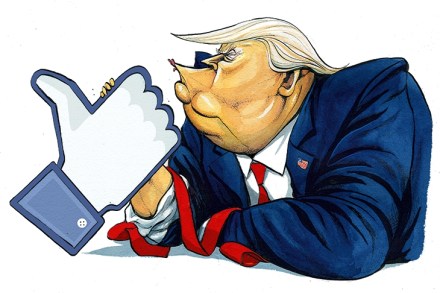
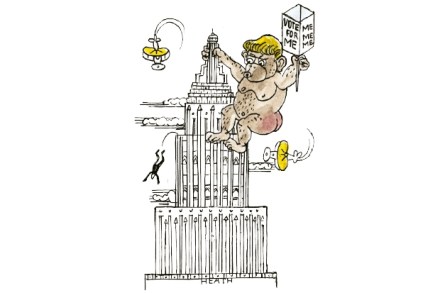
In the 1962 Japanese sci-fi classic King Kong vs Godzilla, the two giant monsters fight to a stalemate atop Mount Fuji. I have been wondering for some time when the two giants of American social media would square up for what promises to be a comparably brutal battle. Finally, it began last month — and where else but on Twitter? ‘Facebook was always anti-Trump,’ tweeted the President of the United States on 27 September. Mark Zuckerberg shot back hours later (on Facebook, of course): ‘Trump says Facebook is against him. Liberals say we helped Trump. Both sides are upset about ideas and content they don’t like. That’s what running a platform for all ideas looks like.’ A platform for all ideas? Well, maybe. Others see Facebook differently.

Take it from a divorcee: Brexit will cost you dear

From our UK edition

I suppose there are such things as amicable divorces. Mine wasn’t. Like the First World War, it was fought for more than four years, and ended with the Treaty of Versailles (by which I mean that it imposed territorial losses and the payment of annual reparations for a very long time). Which brings me to Brexit, the ultimate divorce. Leave aside the arguments based on economics. Leave aside history, too. Instead, permit me to get personal. You want to get a divorce from Europe? Very well, let me explain what divorce is like. Now, I get how you feel. You’ve reached the point when you just can’t stand the EU any more. You can’t stand the nagging (regulation). You can’t stand the way the EU keeps inviting her friends round (immigration).

Diary – 2 June 2016

From our UK edition

In 1873, when Jules Verne published his Around the World in Eighty Days, it seemed worth betting that a circumnavigation of the globe could be achieved in less than three months. Having just completed the feat in roughly three weeks, I feel like a slowcoach. (I gather it can be done on scheduled flights in 32 hours.) First stop was Los Angeles for Mike Milken’s annual conference, an extravaganza of West Coast networking and notworking (the two go hand in hand) held in Beverly Hills. One of the year’s best one-liners was Jamie Dimon’s back in January, when he defined the Davos World Economic Forum as being ‘where billionaires tell millionaires what the middle class feels’.

Sorry, America, but it looks like Joe Biden is your next president

From our UK edition

I have a sinking feeling that Joe Biden might be the next president of the United States. In a brilliant essay published by the American Spectator in 2010, Angelo Codevilla of Boston University foresaw a popular revolt against ‘America’s ruling class’. What he calls ‘the Country party’ repudiates the co-option of the mainstream Republican party by the bureaucratic behemoth that is Washington, DC. You cannot understand the popularity of Donald Trump until you grasp the essential characteristics of this Country party. White, male, ageing Americans are sick of political correctness. They are sick of carefully calibrated talking points. They are sick of immigrants. They are sick of wars in faraway places of which they know nothing and care less.

Pedant’s revolt

From our UK edition

It used to be that the most annoying thing in academic life was political correctness. But a new irritant now threatens to supplant it: the scourge of correct politicalness. The essence of correct politicalness is to seek to undermine an irrefutable argument by claiming loudly and repetitively to have found an error in it. As with political correctness, which seeks to undermine arguments by declaring the person making them a bigot, correct politicalness originated in the US. But it now has its exponents here, too. Foremost among them is Jonathan Portes. Portes’s career recalls that of the character Kenneth Widmerpool in Anthony Powell’s Dance to the Music of Time.

The lesson of the 2015 election? No good deed goes unpunished

From our UK edition

It was Clare Booth Luce, the witty and glamorous wife of the publisher of Time magazine, who coined the phrase that no good deed goes unpunished. It is all you need to know about British politics today. The UK had the best performing of the G7 economies last year, with a real GDP growth rate of 2.6%. In 2009, the last full year of Labour government, the figure was -4.3%. The coalition formed five years ago by Conservative leader David Cameron and the Liberal Democrat leader Nick Clegg inherited an almighty mess from Gordon Brown, who had presided over feckless public sector expansion and reckless disregard for bank leverage and mismanagement. Five years ago, according to the Bank for International Settlements, the UK’s fiscal and financial trajectories were the worst in Europe.

The rise of the BRICs and the fall of the JUUGs

From our UK edition

It was back in 2001 that my good friend Jim O’Neill of Goldman Sachs coined the acronym ‘Bric’, short for Brazil, Russia, India, China. These were the emerging markets that were going to surpass the developed economies. And so they have. Well, nearly. I, too, am partial to a good acronym and it has always seemed to me very unfortunate that there isn’t a matching one for the four biggest established economies. According to the International Monetary Fund, these are currently the United States, Japan, Germany and the United Kingdom (based on last year’s GDP figures). I therefore propose ‘Juugs’. The rise of the Brics and the fall of the Juugs has a good ring to it.

Niall Ferguson’s diary: Brazil is overtaking us – but it no longer feels like that

From our UK edition

 São Paolo It was back in 2001 that my good friend Jim O’Neill of Goldman Sachs coined the acronym ‘Bric’, short for Brazil, Russia, India, China. These were the emerging markets that were going to surpass the developed economies. And so they have. Well, nearly. I, too, am partial to a good acronym and it has always seemed to me very unfortunate that there isn’t a matching one for the four biggest established economies. According to the International Monetary Fund, these are currently the United States, Japan, Germany and the United Kingdom (based on last year’s GDP figures). I therefore propose ‘Juugs’. The rise of the Brics and the fall of the Juugs has a good ring to it.

Niall Ferguson: Why Paul Krugman should never be taken seriously again

From our UK edition

It's an ill wind that blows no one any good. The financial crisis that came to a head five years ago with the failure of Lehman Brothers has been especially beneficial to the economist Paul Krugman. In his widely read New York Times column and blog, Krugman regularly boasts that he has been 'right' about the crisis and its consequences. As he wrote in June last year: 'I (and those of like mind) have been right about everything.' Those who dare to disagree with him -- myself included -- he denounces as members of the 'Always-Wrong Club.' He wrote back in April: 'Maybe I actually am right and maybe the other side actually does contain a remarkable number of knaves and fools. ...

Yes, my remarks on Keynes were stupid. But I’m no homophobe, and here’s why

From our UK edition

Last week I said something stupid about John Maynard Keynes. Asked to comment on Keynes’s famous observation 'In the long run we are all dead,' I suggested that Keynes was perhaps indifferent to the long run because he had no children, and that he had no children because he was gay. This was doubly stupid. First, it is obvious that people who do not have children also care about future generations. Second, I had forgotten that Keynes’s wife Lydia miscarried. I was duly attacked for my remarks and offered an immediate and unqualified apology. But this did not suffice for some critics, who insisted that I was guilty not just of stupidity but also of homophobia. I have no doubt that at least some students were influenced by these allegations.

Friedman’s century

From our UK edition

Milton Friedman would have been 100 later this month. As well as being one of the great economists, if not the greatest economist, of the 20th century, he was also what the Americans call a public intellectual. He was a regular on PBS, the American equivalent of the BBC, writing and presenting Free To Choose, a ten-part series that aired in the late 1970s. He also wrote a column for Newsweek for an astonishing 18 years. Among today’s public intellectuals, it is extremely fashionable today to say that the financial crisis has proved Friedman wrong. You can read that on an almost weekly basis in the New York Times or the Guardian: that deregulation was the problem. But it is extremely hazardous to say in public that anything has proved Milton Friedman wrong.

On being called a racist

From our UK edition

My ‘literary spat’ with the London Review of Books Economic history is not politically correct. Many on the left therefore struggle with its findings. It is indeed astonishing that, from the beginning of the 16th century until the third quarter of the 20th century, the West (Europe and its settler colonies) did much better than the rest of the world and came to rule over it. But that’s what happened. By the 1970s the average American was roughly 20 times richer than the average Chinese. The average Briton was at least 12 times richer than the average Indian. In the first half of the 20th century, westerners had life expectancy nearly twice that of non-westerners. Europeans and North Americans even grew taller than Asians.

Britain first

From our UK edition

Niall Ferguson says that Tony Blair and George W. Bush are perfect partners — Christian soldiers armed with Bibles and bazookas — but Britain now has more in common with Europe than with the United States ‘I kind of think that the decisions taken in the next few weeks will determine the rest of the world for years to come. As primary players, we have a chance to shape the issues that are discussed. Both of us will have enormous capital and a lot of people will be with us.’ — Tony Blair to George W. Bush, March 2003. Barring some act of God — an authority both men are known regularly to consult — Tony Blair and George W. Bush are now safe. Politically (and what else matters?) they have survived the Iraq war.