Mervyn King

Mervyn King was Governor of the Bank of England from 2003 to 2013. He is the author of The End of Alchemy (2016) and (with John Kay) Radical Uncertainty (2020).

The Bank of England has to act to prevent higher inflation

From our UK edition

To Windsor for Garter Day, the first since 2019. With a strong voice and smiles for us all, the Queen presided over the investiture of three new Knights – Tony Blair, Baroness Amos and, as a Royal Lady of the Order, the Duchess of Cornwall – in the small Throne Room. After luncheon with the royal family in the Waterloo Chamber, we processed to St George’s Chapel for a service during which the new Knights were formally installed. It is a splendid pageant appreciated by the large crowd of onlookers who look with amazement at our outfits. We wear morning dress, garter star, a dark-blue velvet mantle, a rather heavy gold collar and a black velvet hat with a plume of white ostrich feathers. The British do like dressing up.
The ideological bankruptcy of modern monetary theory

From our UK edition

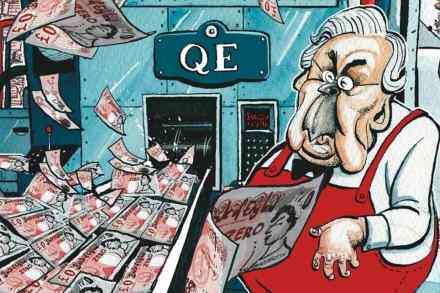
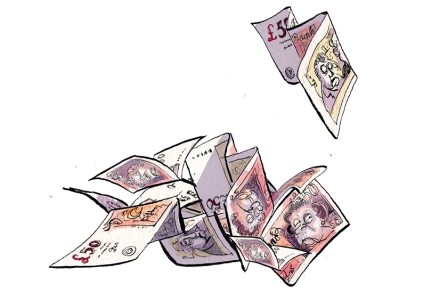
If you can’t explain something, try an abbreviation. The latest in economics is MMT — Modern Monetary Theory or, in other words, a magic money tree. It’s a simple idea. It costs almost nothing to print money: the cost of printing banknotes is negligible compared with their face value, and even lower when the Bank of England creates money electronically through its so-called ‘quantitative easing’ programme (QE). That money could be given to the public — either directly or indirectly via the government — to enable people to spend more, so raising output and employment. We are all better off. Why didn’t we think of this before? Well, of course we did.

Mervyn King: The one picture I would love to own

From our UK edition

We asked friends of The Spectator which picture they’d choose to own. Here is Mervyn King's response: In the centre of our drawing-room, I would install the ‘Wilton Diptych’. From the Middle Ages, it shows Richard II being presented to the Virgin and Child. We do not know who painted it, or why, and the mystery is reinforced by Dillian Gordon’s discovery that the orb on the English banner contains a tiny image of a green island set in a silver sea. Shakespeare’s Richard II portrays England as ‘this precious stone set in the silver sea’. Would I own a painting Shakespeare saw?

We’re heading for a ‘worst of both worlds’ Brexit

From our UK edition

If as a country we cannot take a big decision about whether or not we should be in the European Union, which is based on sovereignty, which is based on controlling our borders; there are arguments on both sides. We ought to be able to have a reasonable and civilised debate on that, and then have a vote. What we are now getting is not a reasonable or civilised discussion. It is a discussion where both sides seem to be throwing insults at each other. And I find that deeply depressing; and frankly, if a government cannot take action to prevent some of these catastrophic outcomes – whatever position you take on the EU – it illustrates a whole lack of preparation that doesn’t tell us anything about whether the policy of staying in the EU is good or bad.

The Bank of England’s life has been remarkably eventful

From our UK edition

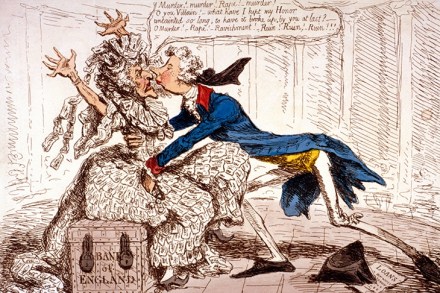
This piece first appeared in the Christmas issue of The Spectator.  Hamilton, created by the remarkable Lin-Manuel Miranda, has brought the financial musical to the London stage: a serious biography of a great man translated into rap. What comes next? Now we know. It is the story not of one individual but of a national institution — the life and times of the Bank of England. I can’t wait for David Kynaston’s new history to reach the stage. We may have to call on Tim Rice, a revolutionary himself in the world of musicals, to generate a libretto from the long original text. But there is a wealth of material in this fascinating book.

Murder, fraud and bankruptcy

From our UK edition

Hamilton, created by the remarkable Lin-Manuel Miranda, has brought the financial musical to the London stage: a serious biography of a great man translated into rap. What comes next? Now we know. It is the story not of one individual but of a national institution — the life and times of the Bank of England. I can’t wait for David Kynaston’s new history to reach the stage. We may have to call on Tim Rice, a revolutionary himself in the world of musicals, to generate a libretto from the long original text. But there is a wealth of material in this fascinating book. Often seen as a rather traditional and staid institution, the Bank of England’s more than 320-year life has been remarkably eventful.