Melanie McDonagh

Melanie McDonagh

Melanie McDonagh is an Irish journalist working in London.

Karen Bradley’s bid to break Stormont’s deadlock could pay off

From our UK edition

Karen Bradley, Secretary of State for Northern Ireland, would not, perhaps, win prizes for her in depth knowledge of sectarian politics in her patch – in an interview for the House magazine she said she had never realised that nationalists don’t vote for unionists, and vice versa (though that, actually, may change, given how Sinn Fein’s pro abortion, pro gay marriage gives Catholic voters the creeps) – but she’s on the ball in one respect.

Aimee Challenor and the danger of transgender politics

From our UK edition

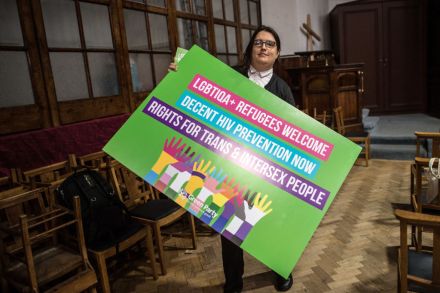
Aimee Challenor – in case you haven’t heard – has just stepped down as equalities spokesperson for the Green Party. I say Aimee – he was, until the age of 16, Ashley, whereupon he decided to challenge his gender by going to the school prom in a dress. From this point his career took a dynamic turn, as he became a Green Party candidate (spurned, alas, by the electorate), a runner for deputy leadership of the party, a member of Stonewall’s Trans Advisory Group, leader of Coventry Pride and subject of upbeat pieces in the Guardian as the fresh face of transgenderism. 'Yes, I’m trans, but I’m a Green Party politician and proud of it', was the headline of one such profile.

Pope Francis asks forgiveness for ‘abuses’ in Ireland

From our UK edition

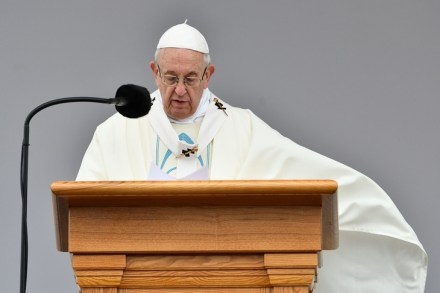
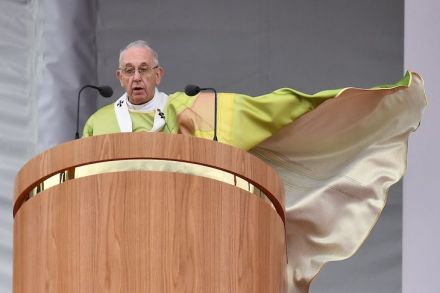
Well, he’s said it. At the exuberant closing mass in driving rain of his visit to Ireland, the Pope has asked, off script, forgiveness for the wrongs committed by the church. Specifically he asked forgiveness for ‘the abuses in Ireland; abuses of power, conscience, and sexual abuses perpetrated by members with roles of responsibility in the church… in a special way we ask pardon for all the abuses committed by members with roles of responsibility… for all the abuses committed in various types of institutions run by male or female religious and by other members of the church. We ask forgiveness of those cases of exploitation through manual work that so many young women and men were subjected to. We ask forgiveness.

Pope Francis has his work cut out to appease the church’s critics

From our UK edition

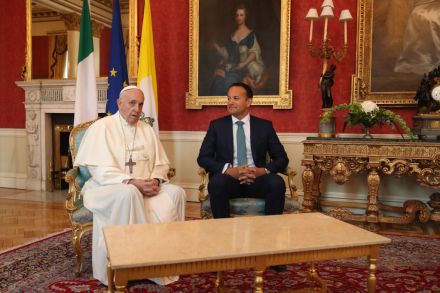
No one on earth could fulfil the expectations that have been invested in the visit of Pope Francis to Ireland. He is meant to  respond to the crisis of clerical child abuse and institutional self preservation within the global church during his first official address at Dublin Castle in a fashion that appeases the church’s critics in Ireland, who are, frankly, in no mood to be appeased. What he did do in his speech was express once again perfectly decent sentiments of abhorrence at the violation of children by members of the clergy.

Adventures with robots

From our UK edition

Imagine a world where we’re all hooked to our individual electronic devices, which feed us our music, communicate with our friends and know our needs; imagine a tech company that dominates an entire city, where your social pecking order is reflected in the devices you possess. Actually, you don’t have to imagine. It’s all there already… Apple, Google, Facebook. So Jinxed, by the young Canadian Amy McCulloch (Simon & Schuster, £7.99), is very much of the moment. It’s set in a city in Canada dominated by a tech corporation: ‘The final goal of Moncha Corp is to make life better... And to make people happier.’ Its academy is where every bright teenager wants to go.

Why the Supreme Court’s ruling on vegetative patients worries me

From our UK edition

The Supreme Court ruling yesterday that a man in a vegetative state could have his feeding and hydration tubes removed so as to bring about his death was, obviously, redundant in his case. The man concerned, a banker in his fifties, is already dead – having earlier suffered a heart attack which left him brain damaged – but the wheels of justice ground inexorably on anyway. But the striking thing about the ruling, delivered by Lady Black, that food and hydration can be withdrawn from a patient in a persistent vegetative state, PVS, without the consent of the Court of Protection, is that we have absolutely no idea how many people it could apply to in the future. Could be 3,000 at any one time; could be more. We just don't know.

An unhappy marriage shouldn’t be grounds for an instant divorce

From our UK edition

It is wrong to dwell on the misfortunes of others, but was there anything in the news more riveting than the Supreme Court hearing which ended with Hugh and Tini Owens, 80 and 68 respectively, being told they were going to stay married after her bid to end her 40 year marriage was thrown out. Naturally, Lady Hale, president of the court said that she was only reluctantly persuaded that the case should be dismissed; the ruling has been met with near-universal calls in the commentariat for the introduction of no-fault divorce. There were details that would probably strike a chord with lots of married people, chiefly the fact that the things that drove Mrs Owens nearly insane were mostly the small stuff.

If Trump picks Amy Coney Barrett tonight, prepare for all hell to break loose

President Trump has confirmed that tonight, at 9 pm EST, he will announce his choice of candidate for the Supreme Court following the departure of Justice Anthony Kennedy. And what, do you reckon, are the chances of his critics here being mollified if it turns out his candidate is in fact a woman, and a working parent? It would bring the Supreme Court almost into gender balance, with four women and five men. I mean, when President Obama added a further woman to make it a measly four women out of 113 Supreme Court judges who have served to date, that was seen as proof of his essential soundness. But if President Trump does so, well, that’s another matter.

The Church of England is wrong to rethink confession

From our UK edition

God knows one tries, but there are times when it’s difficult to take the Church of England entirely seriously. And the news that it is considering doing away with the seal of confession, whereby clergy are absolutely prohibited from disclosing the sins penitents bring to them in confession, is just such an occasion, even if the proposal gets nowhere. In the run-up to the General Synod (you did realise it’s happening today, didn’t you?), the bishop at Lambeth, the Rt Rev Tim Thornton, reported that there were “differences of view about the retention or abolition of the Seal” among bishops.

The real Tolkien

From our UK edition

To no one’s surprise, the Tolkien: Maker of Middle-earth exhibition at the Bodleian in Oxford, where J.R.R. spent so much of his time, has been a huge success. Were tickets on sale, it would be a sell-out, but the Bodleian has made it free. The visitors book is peppered with observations such as: ‘It made me cry with joy… sensationally splendid’.There’s also a less hyperbolic view, in a childish hand: ‘It was interesting to see how he made The Hobbit and Lord of the Rings.’ It is rather a small show, a remarkable feat of compression on the part of the curator, Catherine McIlwaine, who had to pare down 500 boxes of Tolkien holdings to produce it, and was instructed by advisers that her captions mustn’t exceed 70 words each.

Thank goodness liberals haven’t tried to spoil musicals

From our UK edition

There was a standing ovation from the audience at The King and I at the London Palladium on Tuesday night, but then, audiences at musicals are invariably rather a sweet crowd, way less critical than opera goers. The musical’s heroine, Kelli O Hara, who plays the feisty feminist British governess, was in the papers yesterday declaring that there was no better time to be doing the show because of its themes of understanding across the religious divide; the writers, she said, were “ahead of their time and somehow it seems they are still right ahead of their time”. Come again? The King and I is entirely reflective of its time, viz, 1951, but it says everything about ours that our heroine feels obliged to present the piece as an exercise in cross cultural understanding.

Feminist children’s books

From our UK edition

A friend of mine who commissions book reviews has added a sub-category to the list of titles coming up: ‘femtrend’, books about the female condition from a feminist perspective. ‘Grit lit is over,’ she says wearily, referring to edgy books about the marginalised. ‘Now publishers can’t get enough of the feminist trend about women who for centuries have been airbrushed out of history by toxic masculinity and oppressive patriarchy. Airbrushing the toxic white male. Female tribes. Modern courtesan. Now it’s draining down into children’s books too.

How Balkan politics dominated the Switzerland-Serbia game

From our UK edition

Enjoying the football? The politics of it, obviously. The Switzerland-Serbia game was a cracker in this context. The innocents in the BBC box obviously bought the fiction that this was a Swiss team though the two Swiss goals should have put paid to that notion. The hand gesture from Shaqiri when he scored his goal, replicating the more subtle version by Xhaka may have escaped the unfortunate pundits who were focused solely on the sport, but it was, obviously, the Albanian eagle – flapping fingers, got it? And the gesture certainly wasn’t lost either on Serbian observers or on the crowds going nuts over the game in Pristina.

The question is not whether upskirting is gross, it’s whether it requires a new criminal offence

From our UK edition

About three days ago, most of us wouldn’t have had much notion what upskirting was; now we are, I think, all very alive to the reality that there are creeps, pervs and predators who like to put their mobile phones up women’s skirts or dresses and take pictures of their crotch. And I think we are all at one in considering this is an outrageous thing to do. Nem con, so far, I’d say. Mrs May, for her part, has made clear that she’s very down on this sort of thing too, which is always nice to know. The question is not whether upskirting is gross; it’s whether it requires an entirely new criminal offence, potentially punishable by two years’ imprisonment and/or a place on the Sex Offenders register, or whether the existing laws will cover it.

In defence of Christopher Chope’s ‘upskirting’ objection

From our UK edition

Sir Christopher Chope is not, perhaps, a household name, but he is a man of quite considerable courage. By raising an objection to the preposterous private member’s bill, brought by Wera Hobhouse, a LibDem MP, to make upskirting – taking pictures up girls’ skirts -  a specific criminal offence, he has seen off a bill which was a preposterous waste of time. The Government and Wera H has been hoping to get through the bill on the nod but it could only happen if no one in the chamber had the bad taste to object to it being passed without debate.

Corporate puritans want to kill off flirting

From our UK edition

Quite a long time, five seconds, when you count it. And ever since Netflix reportedly warned its employees not to stare at a colleague for longer than that, the paradoxical effect is, inevitably, to make you stare and count. The company’s new guideline is, of course, all part of corporate America’s response to the #MeToo scandal and if the Netflix directive is anything to go by, it’s going to result in the human race dying out in the US, because no one will be able to make a pass at anyone else, ever. It’s not that the individual prohibitions are onerous or particularly unreasonable; it’s that the collective effect can only be to make men – because it’s not aimed at women, is it?

In praise of Paul Dacre

From our UK edition

Eamon de Valera used to say that if he wanted to know the true feelings of the people of Ireland he needed only to look into his own heart. You could say the same about Paul Dacre, shortly to step down as editor of the Daily Mail. When it comes to the sentiments of Middle England, or at least quite a bit of it, he knows what it loves and fears because those are his own sentiments. He doesn’t second guess his readers; he is properly authentic. I knew him from his brief, two year stint at the Evening Standard, and he was the best editor I have ever worked for, and I say as much even though I got my only ever written warning from him (deservedly). He knew exactly what he wanted and he was clear about how to get it.

Shami Chakrabarti can’t have it both ways on Northern Ireland

From our UK edition

Never one to shy away from a platitude, the shadow attorney general, Shami Chakrabarti, has declared that the PM must reform abortion law in Northern Ireland on the basis that women there “have been let down by privileged women and men for too long” and that, so far as Theresa May is concerned, “the test of  feminists is whether they stick up for all women”. So far as this woman is concerned, I’ve been trying to work out the logic of these observations in terms of the abortion question and failing, so let’s just give up and cut to the chase.

What really happened in Ireland’s abortion referendum

From our UK edition

The Irish prime minister, Leo Varadkar, had declared that there would not be celebrations if and when the Yes side won in yesterday’s referendum on liberalising the abortion laws. But there’s a decidedly celebratory aspect to his side, now it turns out that nearly 70 per cent of voters voted for change. ‘Democracy in action,’ is what he now says. ‘It’s looking like we will make history.’ Or as Miriam Lord, the Irish Times’ sketchwriter, says with the unconcealed partisanship that characterised that paper’s approach to the poll, and incidentally channelling When Harry Met Sally: ‘Yes, Yes, Yes; a resounding, emphatic Yes. Suffocating old certainties, unrepresentative lobby groups and celibate clergy all swept aside.

Changing Ireland’s abortion laws would be a backward step

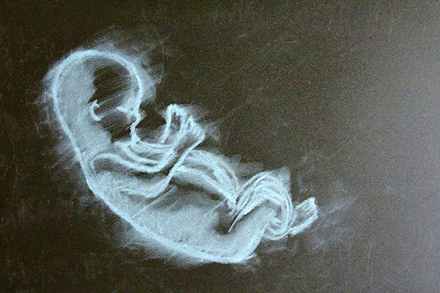
It will, as one pro-life campaigner told me, take an act of God to swing the Irish referendum for the No side tomorrow. I’m all for referendums but this one has been so wildly unbalanced as to make the Brexit campaign look almost effete in its regard for impartiality and fair play. The polls suggest a win for the Yes side, on repealing the eighth amendment to the Irish constitution which protects the right to life of the unborn – something around the 44-32 per cent margin, according to the last Irish Times poll. It’s a big deal, abortion. But there is not one political party that represents the No side, other than a tiny outfit called Renua which doesn’t have a single MP. There is no newspaper that represents this quite hefty minority.