Matthew Parris

Matthew Parris

Matthew Parris is a columnist for The Spectator and The Times.

The fact no one likes to admit: many gay men could just have easily been straight

From our UK edition

Long-suffering Spectator readers deserve a seasonal break from yet another Remoaner diatribe from me. My last on this page, making the outrageous suggestion that the populace may sometimes be wrong, is now being brandished by online Leaver-readers of my Times column as proof that I am in fact a fascist; so there isn’t anywhere much to go from there. Instead, I turn to sex. There is little time left for me to write about sex as the thoughts of a septuagenarian on this subject (I turn 70 this year) may soon meet only a shudder. But I have a theory which I have the audacity to think important.

Never trust the people

From our UK edition

It was late, and a friend and I were left to talk Brexit. He’s a keen and convinced Tory Brexiteer MP but to stay friends we have tended to steer off the topic. This, however, felt like a moment to talk. The conversation taught me nothing about Brexit, something about him, and a lot about myself and the strain of Conservatism I now realise I’m part of — and which is part of me. Oddly, then, this column is not really about Brexit, but about trusting the people. I don’t. Never have and never will. Our conversation forced me to confront the fact. My friend knows well enough why I’m a Remainer, but guessed correctly that I’ve puzzled about why he isn’t. I had not quite expected what I heard.

Out of the mouths of babes

From our UK edition

For any bosses from the Singapore education department reading this, I have a message. It comes from (I’d guess) most of your schoolchildren. They detest their education system. They burn with resentment at the way their schooling tries (they think) to shackle their imaginations, their individuality, their free spirit. They hate being forced to compete, and are made miserable about what they see as learning by rote. That’s the bad news. But the good news is this. However they may chafe at the way they are taught, these children are anything but broken reeds. Imaginative, rebellious, thoughtful, original, poetic, these winning boys and girls (often of Chinese origin!) write English like little angels. How do I know?

What does it mean to be moved?

From our UK edition

Catching a train last week at London’s St Pancras I encountered a man playing a piano. You can do this at St Pancras: there’s an old Yamaha chained to the ironwork just by the lift serving the upper platforms for Sheffield and Nottingham. The instrument is somewhat out of tune but serviceable, and placed there for anyone who wants to play. The facility is generally respected: it’s not for buskers collecting money but just for pleasure — the player’s pleasure, and that of the random, changing audience who pause, hurry or amble by. I was hurrying yet in no hurry: there was plenty of time. But you just get a bit tense in London sometimes, and hurry for the sake of hurrying. And of late, politics has got me down.

Is there a moral difference between blackmail and an NDA?

From our UK edition

Reader, may I call you John? Now imagine, John, that you are my employer and I know (or claim) that you made an inappropriate sexual advance towards me in the workplace. So I approach you. ‘John,’ I say, ‘you groped me in the lift. Give me £5,000 or I’ll make this public.’ That is blackmail. It’s blackmail whether or not the allegation is true. You can go straight to the police and I will very likely be charged with a serious criminal offence. Now imagine a different scene. You, John, aware that I have been saying this about you, approach me first. ‘Matthew,’ you say, ‘I know what you’re saying about me.

In defence of Nick Clegg

From our UK edition

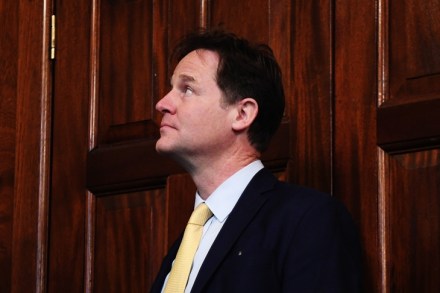
As I write, the sneering at Nick Clegg has started. The first cuckoo I’ve heard in this chorus is calling from the left. Last week Nesrine Malik in the Guardian launched a scornful attack on Mr Clegg’s decision to quit public life in Britain and join Facebook in America. ‘Thanks for nothing,’ she says. I feel sad about the paper Ms Malik writes for. The Guardian took an historic wrong-turning when in 2010 it decided not to be interested in the possibilities for centre/-centre--left co-operation. These days the paper often sounds like the voice of the Labour left: rasping and angry rather than the open-minded and inquisitive liberal voice it once was.

What a demented dog teaches us about life

From our UK edition

I met the late Darcy ten years ago, and wrote about him. I was 59 and he was 12. I was a Times columnist, and he was an Australian sheepdog. ‘Kelpies’ they call them: black and tan, in build and temper not unlike our border collies, energetic, intelligent, irrepressible but trainable, and occasionally neurotic. Darcy was not neurotic except in one pitiable respect, and I shall come to that. I studied him and wrote about him, but in the decade since have come to understand more deeply what his condition teaches about my own, and human, nature. I wrote about this dog as an oddity. I now see that Darcy was an illustration, not an aberration: an illustration of what can go wrong in the circuitry of the brain. Here is Darcy’s story.

Don’t dismiss McDonnell as a loony

From our UK edition

‘Wherever Sir Stafford Cripps has tried to increase wealth and happiness,’ wrote the Conservative Scottish journalist Colm Brogan, ‘grass never grows again.’ But Roundup has its uses. When Brogan made this comment, Sir Stafford was Britain’s postwar ‘austerity’ chancellor of the exchequer, a post he held from 1947 to 1950. Dry as dust, Cripps had rejoined the Labour party only two years previously, having served as ambassador in Moscow, then in Churchill’s war cabinet. A leading voice on the hard left, he had been expelled from Labour for his advocacy of co-operation with communists in 1939, but his judgment had proved shrewd.

Must ‘the will of the people’ always be respected?

From our UK edition

I’ve always respected Alistair Darling and cannot imagine him saying anything ill-considered. But listening to him interviewed last Monday on the Today programme I heard him offer, as though it were obvious, an assumption so much less obvious than he appeared to recognise, that it set me thinking: not about the admirable former chancellor but about a real divide among civilised people that our age is perhaps insufficiently aware of. The presenter, Nick Robinson, had asked Mr Darling if he supported a second (or ‘people’s’) referendum on Brexit. No, said Darling: ‘You ask people what they think and clearly you’ve got to live with it.’ Seconds later, still speaking about Brexit, he said: ‘We’ve made a profound mistake.

Corbyn has made criticism of Israel impossible

From our UK edition

If I were Benjamin Netanyahu (and I’m not) I would be thanking whatever gods there be for sending me, at a tricky time, the most useful ally it is possible to imagine in UK politics. To Bibi’s aid has come probably the only man in Britain capable of single--handedly silencing public criticism of the Israeli government’s disturbing new Basic Law, entitled ‘Israel as the Nation-State of the Jewish People’. If I were a British crusader for the Palestinian cause (and I’m not) I would be cursing whatever gods there be for sending — at a time when it might have been possible to rally critics of this unpleasant eruption of ethno-nationalism in Israeli politics — the most effective British voice available to hamper my argument.

Obsessed with politics? Your life’s gone wrong

From our UK edition

Timeless in its wisdom, the book Parkinson’s Law is of course famous for Parkinson’s law itself: that ‘work expands to fill the time available for its completion’. But scattered through the now 60-year-old book’s pages of tongue-in-cheek social science and cod-mathematical equations are remarks that lodged themselves deep in my thoughts when first I read the book as a young man. Stray observations keep resurfacing as being funny — yes — and flippant, I suppose, but these thoughts are more than flippantly funny: they contain too the germs of deep truths. ‘It is now known,’ wrote C. Northcote Parkinson, ‘that men enter local politics solely as a result of being unhappily married.

Ukip should return – our politics depends on it

From our UK edition

‘The return of Ukip’ declared the headline on our cover story last week. The polling boffin Matthew Goodwin to whose analysis this referred was in fact more careful. Professor Goodwin did argue, however, that the potential may be there for a Ukip revival. So it may. But the figures for new recruits that he cites are modest. The doubt he describes as surrounding Nigel Farage’s chances of a comeback is real. Ukip’s present stance under its latest leader Gerard Batten (who has developed links with the campaign for the disgraced and imprisoned former leader of the English Defence League, Tommy Robinson) looks crazier by the week.

We can delay Brexit – and we must

From our UK edition

Omissions can be as instructive as inclusions. I noted a curious example in a column Nick Timothy wrote last month for the Daily Telegraph: ‘Why Dominic Grieve’s push for a “meaningful vote” really would mean stopping Brexit.’ Until he left Downing Street, Mr Timothy was jointly principal adviser to Theresa May. He wrote the following: ‘According to ministers, the choice Parliament will face is to leave on the terms negotiated by the government, or leave with no deal. And they are right: the European treaties assert that the withdrawal process can last no longer than two years…’ This is not the case. Mr Timothy seems to have overlooked a key provision laid out in Article 50 of the relevant treaty (my italics): ‘3.

The term ‘marriage’ needs to be untangled

From our UK edition

Rebecca Steinfeld (37) and Charles Keidan (41) have a moral objection to marriage. They’ve been together since 2010, have two very small children, but haven’t tied the knot. This, they say, is because the law doesn’t offer a knot they’re comfortable tying. ‘Charlie and I see each other as partners already in life, and we want to have the status of being partners in law,’ says Rebecca. They hold (and you may agree or disagree but it’s not a crazy view) that the concept described by the word ‘marriage’ is asymmetrical between the man and the woman, and inextricably tangled with religion and with cultural attitudes this couple (and others) may not share.

Lost in the NHS maze

From our UK edition

Next month the National Health Service turns 70. The institution is greatly loved, and not for nothing. The fear of ill-health runs deep in most of us and is ineradicable; but the fear of not being able to afford treatment, which must haunt most of the world’s population, has been abolished in Britain — and for that inestimable benefit we have the NHS to thank. It is, of course, possible to overrate the quality of this country’s health care. Many do. All things considered, and in a world of first-, second-, third-, fourth- and fifth-rate medical provision, I’d say we British get a second-rate health service for the price of a third-rate one. However, funds are not unlimited, and second-rate isn’t bad.

The sorrow that turns sweet

From our UK edition

It was the phrase ‘sad sweet feeling in your heart’ that arrested my attention. But who would have thought it would have been Abraham Lincoln who found those words? I’ve been searching for an adequate description of something we’ve all experienced but which is rarely discussed. Many years ago, beachcombing for pithily disobliging quotes for Scorn, my anthology of insult and invective, I was arrested by a remark of Samuel Johnson’s. ‘Depend upon it,’ Boswell quotes the great man as saying, ‘that, if a man talks of his misfortunes, there is something in them that is not disagree-able to him; for where there is nothing but pure misery, there never is any recourse to the mention of it.

Is ‘woman’ now an offensive word?

From our UK edition

I do not know whether the Speaker of the House of Commons called the present Leader of the House a ‘stupid woman’. It certainly wouldn’t have been a nice thing to say, but I’ve found it hard to decide whether MPs should boot him out. Many Tory friends seethe with dislike for the man; there are plenty of allegations of partiality or vindictiveness towards individuals, and one does get the impression he doesn’t much care for the present government. Yet few Speakers in recent decades have stood up to ministers more resolutely, or done as much as Bercow in opening up the building and its institutions to a wider public.

Brexit has driven me mad, but I can’t let it go

From our UK edition

Rosé wine is, I know, considered naff. Were you unaware of this you’d fast conclude as much from the incidence of lifestyle commentary informing us that rosé is newly smart. As with those columns advising that everyone is drinking sherry now, or that some prosecco is actually OK, or that men will be wearing skirts this summer, it’s usually a safe assumption that the opposite is true but an enterprising journalist aims to surprise us with an amusing unlikelihood. Anyway, I love rosé wine and we had brought a case of pretty inexpensive stuff back from Rioja, of all places. The bank holiday weather was glorious, the llamas were frolicking and blackbirds sang in the wood as I sat outside in the Derbyshire sun and sipped. But there was a shadow.

They say Enoch Powell had a fine mind. Hmm

From our UK edition

Enoch Powell has been in many minds this month. It’s the 50th anniversary of his famous ‘Rivers of Blood’ speech and I took part in a BBC radio programme discussing this — and hearing the speech itself read superbly by the actor, Ian McDiarmid. The small campaign against the very broadcasting of the speech fizzled out — not least, I think, because the ghastly text does Mr Powell no favours, and many of us who had never read it in its entirety were shocked not only by its tone but by its careless inaccuracy and faltering logic. Yet there’s been a widespread popular view that, agree or disagree with him, the man had a fine mind, a fastidious regard for facts, and courage.

I can never resist a trip to the rubbish dump

From our UK edition

I was back at the tip on Sunday. I cannot help it. What art galleries or rock concerts or online porn are to some, Derby-shire County Council’s dump at Rowsley is to me. I can’t keep away. Any excuse will do, and on Sunday it was a bit of cardboard and a broken fan heater. Yes, yes, I know, they could have been saved up until there was enough rubbish to fill the bed of my old pickup truck, but … well, the stuff was already in the back and I was driving down the A6 anyway and the pull as I came within the magnetic field of this state-of-the-art recycling centre was just too much to resist. An invisible hand nudged mine into an indicate--left tweak on the lever, and we peeled off down the service road, my rubbish and I. The place was packed with addicts.