Matthew Parris

Matthew Parris

Matthew Parris is a columnist for The Spectator and The Times.

Stopping the boats shouldn’t require magical thinking

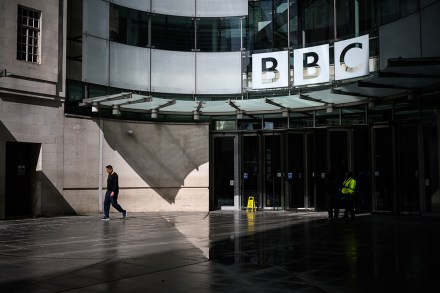
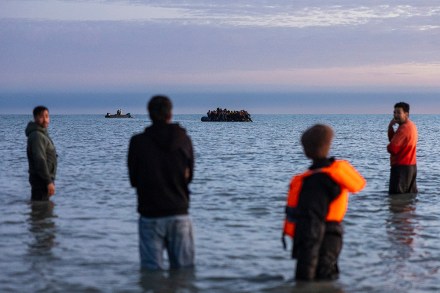
The BBC’s tracking-down of Kardo Ranya as a people-smuggling mastermind is a triumph of investigative journalism. But anyone who thinks this will seriously help ‘smash the gangs’ is deluded. As the drugs trade illustrates, where there is demand there will be supply. What’s to be done? Imagine you were the party leader of a mainstream British political party. Daydreaming, you see a vision – pouffe! A bang and a flash, and there stands the Fairy Queen herself. ‘What, oh party leader,’ she demands, ‘is your heart’s desire?’ Your reply is unhesitating but – you suppose – hopeless. ‘A winning strategy for the next general election,’ you wail. ‘I ask only for that.

With a shudder, I’m voting Labour in the local elections

You may be disturbed by a column urging whites (among others) to vote as a bloc in the coming local elections in the London borough of Tower Hamlets. Tactical voting, but not as we’ve known it. I realise this is delicate. But I’ve been conscious of a dilemma over where to put my cross on the ballot for mayor, which would normally be with the Conservative. And it’s with a shudder that I say that, using my postal vote, I have just voted Labour. For a single, simple reason. Non-Bengali-speakers in the borough must unite if the rascal who has established himself as a favourite son among the Bangladeshi community is to be confounded.

Tomorrow belongs to the vegetarians

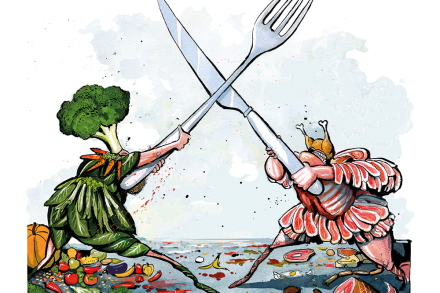
Can there be any thinking person who has passed a lorry filled with live animals peering out through the slats on their way to slaughter, without a momentary shudder? How many of us would take an opportunity to inspect what happens there? Be honest: you recoil from the thought. ‘Slaughterhouse’. So unpleasant we frenchify it as ‘abattoir’. Hunting leaves me cold yet has an honesty about it: you see and choose your prey, and kill it yourself: morally a million miles from the systematic industrial slaughter of creatures we never look in the eye, couldn’t bear to see killed, and so turn away, pay others to do the killing, and deny our own agency. There are things we’d rather not think about. Take note of them. They’re the first signs of rejection.

Lisa Haseldine, Matthew Parris, Damian Thompson, Peter Pomerantsev, Chas Newkey-Burden & Catriona Olding 

41 min listen

On this week’s Spectator Out Loud: Lisa Haseldine reports from Svalbard; Matthew Parris reflects on the Iran crisis during Holy Week; Damian Thompson assesses how Pope Leo XIV is quietly reshaping the Vatican; Peter Pomerantsev reviews Jack Watling’s Statecraft; Chas Newkey-Burden provides his notes on marathons; and finally, from Provence, Catriona Olding reflects on comfort and companionship. Produced and presented by Patrick Gibbons.

Iran’s secret weapon of self-sacrifice

Much has been made of the adjective ‘asymmetric’ when discussing warfare in recent years. The word enjoys a renewed currency now that Israel and America are engaged in combat with enemies who, unable to match them with comparable armed forces, instead disperse, hide and strike at the soft underbelly of their foe. David and his sling, I suppose, when David met Goliath thousands of years ago, was a forerunner of this strategy. But I want to discuss another kind of asymmetry, and another Old Testament hero, Samson. Alone, captive and blinded, Samson reached for a secret weapon unavailable to his captors: the weapon of self-sacrifice. The Islamic Revolutionary Guard Corps and their forces do not fear death.

Can the special relationship survive Trump?

Since this calamitous Iran war began, there’s been endless talk in Britain about our ‘special relationship’ (often capitalised) with the United States. People who declare this relationship to be important are almost always those who also believe that, come what may in the war, we British should stand shoulder to shoulder with Donald Trump. Those, on the other hand, who think we should distance ourselves from him, tend to disparage the special relationship as unimportant. This column therefore breaks new ground. I think the special relationship is very important. But I don’t believe we should stand shoulder to shoulder with this president. Our special relationship is with America. Mr Trump is not America.

Is this Starmer’s finest hour?

A friend met Mary Wilson on the Isles of Scilly, where she and her husband, Harold, had a home. She confided in him that Harold, now in the grip of senile dementia, was slipping away from her; and she felt the lonelier because in the eyes of the world his achievements as prime minister were slipping away as well. My friend rehearsed with her the list: the Open University, etc. Then he added this: there is a kind of achievement in high office which by its very nature is unlikely to burn brightly in the world’s imagination after a leader has gone, but is no less luminous for being forgotten. I mean (he said) declining to do something foolish. On behalf of our country (he said), your husband politely declined Washington’s invitation to join the Vietnam war.

Britain is not ready for war – and Labour isn’t doing enough

38 min listen

Britain is defenceless, declares the Spectator's cover piece this week. From the size of the armed forces to protection against cyber warfare, the government is not spending fast enough to meet the UK's security challenges. But is the public ready to choose warfare over welfare? And can we blame the young people who don't want to fight for their country? For this week's Edition, host William Moore is joined by opinion editor Rupert Hawksley, columnist Matthew Parris, and Whitehall editor of the Financial Times Lucy Fisher. As well as meeting Britain's defence challenge, they discuss: whether the Mandelson scandal is bigger than the Profumo affair; the organised gangs terrorising rural farmers in the UK; and, why some people just can't get enough of conspiracy theories.

Britain is not ready for war – and Labour isn’t doing enough

My Epstein confession

Is this Britain, 2026, or Spain, 1478? Our era begins to feel horribly like the latter. So, as the flames of the Epstein Inquisition burn higher, let me get my general confession into the public domain before the guardians of public morality come for me. Here begins my deposition. I, Matthew Francis Parris, do solemnly confess that I know slightly and have been on mostly friendly terms with Peter Mandelson; and continue to believe him to have been a far-sighted force in the creation of a sane and successful Labour government such as we so notably lack now.

What Catholics get wrong about assisted dying

The Catholic Church has always been remarkably relaxed about sin. It becomes distinctly jumpy, however, when it encounters any challenge to the Church’s designation of what is sinful. Human beings (it suspects) are and always will be sinners. The Church has no problem in dealing with sinners: they should confess. Absolution may be available, dispensed by a priesthood who have privileged access to the Almighty, and can intercede. It isn’t really the commission of a sin that worries the Church. It’s the rejection of a doctrine ‘We will tell you what’s unclean in the eyes of God. We also offer a laundry service to which we hold the monopoly.’ To a cynic it might occur that this a shrewd way of drumming up trade.

Lima’s monument to memory

In the pantheon of South America’s great hotels, the Gran Hotel Bolivar’s place is assured. Stand anywhere in the Plaza San Martin, one of Lima’s historic central squares, and the proud art deco 1924 building – all 300 rooms and five storeys of it – glistens dazzling white over the promenaders, tourists and hawkers below. These days it feels almost marooned, an island of elegant, old-fashioned opulence set in a sea of fuming traffic. The rich and sophisticated have deserted the old part of town for the cool condominiums and plate glass of modern Miraflores, but Miraflores has no memory. The Bolivar – every stone, every pane of stained glass, every monogrammed brass doorknob, even the black Model T Ford standing beside the reception desks – remembers its glory days.

In praise of the climate ‘emergency’

All this winter, until New Year’s Eve, and for the first time since I started keeping llamas, Vera, Ann and Lynn were happily grazing on grass that was still growing. They were managing without hay. Something seems to be happening to our climate. Global warming alarmism is not for me. I’ve never pitched in, fists flying, to this fray. One would want scientific expertise or new information – and I lack both. I’ve grown to distrust the wildly divergent prophecies of the climate change warriors as much as I distrust their adversaries in the ‘nothing to worry about’ camp.

Why we are all solipsists

I once tried to write a novel but lacking any ear for dialogue or skill at characterisation, I abandoned the attempt. The plot, though, was quite good. A couple on a smallholding are facing hard times. Their farm is failing. Daily life is shot through with anxiety, and they retreat increasingly into their interior worlds. Alone at night the husband keeps dreaming he’s in another place, a farm where he and his wife are happier, things go better, and life is crowded with incident. Gradually he finds himself living for nightfall, retreating from domestic misery and awaiting only the next episode in a different life unfolding in his dreams: a life marred only by the nightmare that afflicts him when he goes to sleep: a recurring story about a failing couple on a failing smallholding.

Benefits Britain, mental health & what’s the greatest artwork of the 21st Century?

23 min listen

‘Labour is now the party of welfare, not work’ argues Michael Simmons in the Spectator’s cover article this week. The question ‘why should I bother with work?’ is becoming harder to answer, following last week’s Budget which could come to define this Labour government. A smaller and smaller cohort of people are being asked to shoulder the burden – what do our Spectator contributors think of this?  For this week’s Edition, host Lara Prendergast is joined by opinion editor Rupert Hawksley, arts editor Igor Toronyi-Lalic and columnist Matthew Parris.

The mind-body conundrum

I’m committed this winter to too many expensive building projects at once. As the balloon of my bank balance drifts ever lower towards the waves, and the crests of red ink lick the wicker of my basket, I’ve realised something has to be thrown out. Thus it was that last week I found myself in London’s Hatton Garden. Tucked into my little knapsack was my passport and a couple of one-ounce mini bars of gold I had bought after the last banking crisis, and stored in an old kettle. It was late afternoon, and dark.

Was the BBC’s Trump edit outrageously wrong?

I should begin by making something clear. Splicing together two parts of a speech to give the impression they were one unbroken excerpt is a grave professional error, and would be viewed as such by any broadcaster in the business. The error would be egregious even if there were no suggestion it reinforced the accusation that Donald Trump was inciting riotous behaviour, simply because what viewers thought they witnessed did not occur. There is no excusing what Panorama did to Donald Trump’s 6 January 2021 speech. Nobody in the senior ranks of the BBC is to blame for not knowing about this at the time; but once it did become known, an immediate and unconditional apology should have been made.

The engine’s pitch has changed

On a long flight there’s an instant, and perhaps you’ve noticed it, when a very slight alteration in the pitch of the engine occurs. Some considerable time remains before the ‘prepare for landing’ announcement, but from this point on the plane’s trajectory will be gently back to earth. Within the cabin we sense no sharp adjustment of tilt, but something has changed. From the moment when, in Nicosia in 1955, General Sir John Harding spoke to me at the Christmas party he gave for British children in Cyprus, I had wanted to be, like him, the governor of a colony. I was six. My head was bandaged. The governor seemed concerned.

The lost art of the insult

Imagine I were to begin this column by remarking that a woman preaching is like a dog walking on its hind legs. It is not done well, but you’re surprised to find it done at all. Dear me, that would never do, even in as cheeky a magazine as The Spectator. Then try instead: ‘Dr Johnson was no admirer of the female sex. “A woman’s preaching,” he said, “is like a dog’s walking on his hinder legs. It is not done well; but you are surprised to find it done at all.”’ I could get away with that. An antiquated opinion, safely attributed to an 18th-century writer, enclosed behind quotation marks and decorated with a few cobwebs, can still be sneaked past our 21st-century censors. But how about a more recent offensive remark?

In defence of Chris Cash

Can you be a spy by mistake? If, with no treacherous intent, without ever intending to disadvantage your own country, you share information which might give another country advantage over yours, are you spying for that country? In ordinary usage I’d answer these questions with a firm no. Spies operate for many reasons – reward, blackmail, ideology or as a profession – but they do know they are spies. It’s intentional behaviour. If I’ve ever met or communicated with Chris Cash, I don’t remember it. He has, however, been described to me by mutual friends whom I trust. Their descriptions concur. Nothing I’ve learnt about this young man, who worked at Westminster on research into China, suggests it’s likely he can justly be accused of being ‘a Chinese spy’.

Matthew Parris, Stephen J. Shaw, Henry Jeffreys, Tessa Dunlop and Angus Colwell

31 min listen

On this week’s Spectator Out Loud: Matthew Parris reflects on the gay rights movement in the UK; faced with Britain’s demographic declines, Stephen J. Shaw argues that Britain needs to recover a sense of ‘futurehood’; Henry Jeffreys makes the case for disposing of wine lists; Tessa Dunlop reviews Valentine Low’s Power and the Palace: The Inside Story of the Monarchy and 10 Downing Street; and, Angus Colwell reviews a new podcast on David Bowie from BBC Sounds.  Produced and presented by Patrick Gibbons.