Matt Ridley

Matt Ridley is the author of How Innovation Works: And Why It Flourishes in Freedom (2020), and co-author of Viral: The Search for the Origin of Covid-19 (2021)

Matt Ridley’s diary: My undiscovered island, and the Met Office’s computer problem

We’ve discovered that we own an island. But dreams of independence and tax-havenry evaporate when we try to picnic there on Easter Sunday: we watch it submerge slowly beneath the incoming tide. It’s a barnacle-encrusted rock, about the size of a tennis court, just off the beach at Cambois, north of Blyth, which for some reason ended up belonging to my ancestor rather than the Crown. Now there’s a plan for a subsidy-fired biomass power station nearby that will burn wood (and money) while pretending to save the planet. The outlet pipes will go under our rock and we are due modest compensation.

Losing the ashes

I’m pessimistic about the ash trees. It seems unlikely that a fungus that killed 90 per cent of Denmark’s trees and spreads by air will not be devastating here, too. There is a glimmer of hope in the fact that ash, unlike elms, reproduce sexually so they are not clones — uniformly vulnerable to the pathogen. But it’s only a glimmer: tree parasites, from chestnut blight to pine beauty moth, have a habit of sweeping through species pretty rampantly, because trees are so long-lived they cannot evolve resistance in time. The Forestry Commission’s apologists are pleading ‘cuts’ as an excuse for its failure to do anything more timely to get ahead of the threat, but as a woodland owner I am not convinced.

Where there’s smoke

Rachel Carson’s Silent Spring, published 50 years ago this month, effectively marked the birth of the modern environmental movement. ‘Silent Spring came as a cry in the wilderness, a deeply felt, thoroughly researched, and brilliantly written argument that changed the course of history,’ wrote Al Gore in his introduction to the 1994 edition. Mr Gore reprised this theme on his website earlier this year, proudly comparing Carson’s call to arms over pesticides to his own campaigning on the issue of climate change. He frequently compares the resistance he meets, and Carson met, to that which impeded the battle to establish the link between cancer and cigarette smoking.

The windfarm delusion

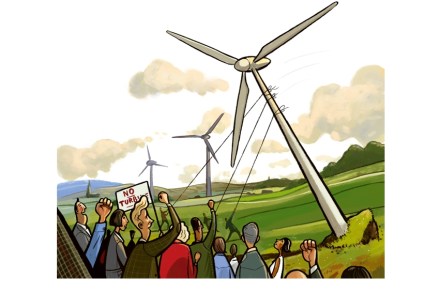
The government has finally seen through the wind-farm scam – but why did it take them so long? To the nearest whole number, the percentage of the world’s energy that comes from wind turbines today is: zero. Despite the regressive subsidy (pushing pensioners into fuel poverty while improving the wine cellars of grand estates), despite tearing rural communities apart, killing jobs, despoiling views, erecting pylons, felling forests, killing bats and eagles, causing industrial accidents, clogging motorways, polluting lakes in Inner Mongolia with the toxic and radioactive tailings from refining neodymium, a ton of which is in the average turbine — despite all this, the total energy generated each day by wind has yet to reach half a per cent worldwide.

Seeing red

With each passing year it becomes clearer that the cure for global warming is worse than the disease. While wind power and biofuels devastate ecosystems and economies, temperatures and sea levels rise ever more slowly, just as the greenhouse theory— minus feedbacks — predicts. As James Delingpole acutely observes, the true believers are left with a version of Pascal’s wager embodying a ‘dismally feeble grasp of cost-benefit analysis’: that, however unlikely it is, the potential cost of global warming is so high that anything is justified. Not only does this argument apply to the cure as well as the disease; it also applies to every small risk of something big happening.

Say no to wind farms: Shale of the century

The arguments for wind farms just became obsolete. We’re entering an era when gas will be cheap, plentiful – and green Which would you rather have in the view from your house? A thing about the size of a domestic garage, or eight towers twice the height of Nelson’s column with blades noisily thrumming the air? The energy they can produce over ten years is similar: eight wind turbines of 2.5 megawatts (working at about 25 per cent capacity) roughly equal the output of an average Pennsylvania shale gas well (converted to electricity at 50 per cent efficiency) in its first ten years. Difficult choice? Let’s make it easier. The gas well can be hidden in a hollow, behind a hedge.

The polar bear problem

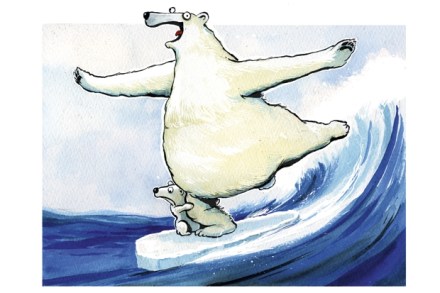
They’re thriving – and they’re hungry The terrible story of the boys mauled by a polar bear in Spitsbergen has sparked a debate about the risks of adventure travel. But what does it tell us about polar bears? Some have claimed that this month’s tragedy is evidence that they are getting hungrier and more desperate as Arctic ice retreats. More likely, it shows that they are getting ever more numerous as hunting pressure relents. For years there was a skin of a bear hanging on the wall of the cafeteria in Longyearbyen, Spitsbergen’s capital village — maybe it is still there. By rights that bear should have eaten me, or my friend Charles Gillow.

A green dark age

The government’s new emissions target will despoil the countryside, rob the poor – and enrich landowners like me ‘Greener food and greener fuel’ is the promise of Ensus, a firm that opened Europe’s largest (£250 million) bio-ethanol plant at Wilton on Teesside last year, and has now shut it down for lack of profitable customers. This is actually the second shut-down at the plant — which takes subsidies and turns them into motor fuel — the first being a three-week refit to try to stop the stench bothering the neighbours. Welcome to the neo-medieval world of Britain’s energy policy.

Diary – 14 May 2011

A day in London for the launch of my new report ‘The Shale Gas Shock’, published by the Global Warming Policy Foundation. I argue that shale gas calls the bluff of the renewable energy movement in the same way that genetically modified crops called the bluff of the organic farming movement. Just as GM allows the organic dream of drastic cuts in pesticide use to come true without high cost, so shale gas promises gradually to displace both coal (in electricity generation) and oil (in transport), drastically cutting carbon emissions without needing subsidy. Since subsidy is the lifeblood of most of the busybodies in the energy business, and since good news is no news, few people turned up for my report’s launch.

Breaking the ice

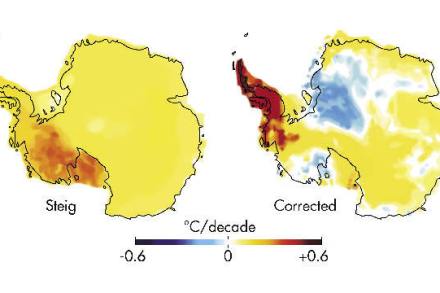
Has Antarctica been getting warmer? To the frustration of many environmentalists, it’s not an easy question. Manned weather stations have existed there for over 50 years, unmanned stations from 1980 onwards. Coverage is patchy both in space and time, with weather stations clustered in a few spots and records full of gaps from when sensors got buried in snow, breakdowns occurred or stations were closed. From 1982, satellites have measured the temperature over the continent but inaccurately, because of clouds and instrument inconsistencies. So taking Antarctica’s temperature involves considerable mathematical skill and leaves much room for statistical disagreement.

The global warming guerrillas

Journalists are wont to moan that the slow death of newspapers will mean a disastrous loss of investigative reporting. The web is all very well, they say, but who will pay for the tenacious sniffing newshounds to flush out the real story? ‘Climategate’ proves the opposite to be true. It was amateur bloggers who scented the exaggerations, distortions and corruptions in the climate establishment; whereas newspaper reporters, even after the scandal broke, played poodle to their sources. It was not Private Eye, or the BBC or the News of the World, but a retired electrical engineer in Northampton, David Holland, whose freedom-of-information requests caused the Climategate scientists to break the law, according to the Information Commissioner.

The real origin of Darwin’s theory

Last week, snorkelling into a small bay on Chatham Island (San Cristobal), I looked up from watching a sea lion twist and turn underwater between a novelist and a neuroscientist to see a large man dressed in an incongruous overcoat standing with his back to us on a rocky outcrop. I wiped my goggles and realised I was looking at a statue. Of Darwin, naturally. Lots of other people visited these islands — Herman Melville, for one — and Darwin was just the captain’s companion on a small naval survey vessel, but it is Darwin everybody remembers. Bays, birds and bushes all bear his name. The oddness of the Galapagos creatures cry out for his theory.

The origin of the theory

Darwin’s Sacred Cause, by Adrian Desmond and James Moore Darwin: A Life in Poems, by Ruth Padel In 1858, on the brink of publishing his theory of evolution, which I discussed here three weeks ago, Charles Darwin took a hydropathic rest cure at Moor Park, near Farnham in Surrey. While walking on the sandy heath, he caught a glimpse of ‘the rare Slave-making Ant & saw the little black niggers in their Master’s nests’. A certain species of red ant kidnaps the young of a smaller black ant and rears them as unwitting slave workers in the service of the red queen. Darwin had heard about this phenomenon but had not till then seen it. Darwin’s upbringing had been steeped in the anti-slavery movement.

The natural order of things

Matt Ridley says that Darwinian selection explains the appearance of seemingly ‘designed’ complexity throughout the world — not just in biology but in the economy, technology and the arts Charles Darwin, who was born 200 years ago next month, has spent the 150 years since he published The Origin of Species fighting for the idea of common descent. Though physically dead, he is still doing battle for the notion that chimps are your cousins and cauliflowers your kin. It is a sufficiently weird concept to keep Darwin relevant, revered and resented in equal measure. But in some ways it is less radical and topical than his other, more philosophical legacy: that order can generate itself, that the living world is a ‘bottom-up’ place.

The genetic code genius failed to kill faith

On one day last year, when I was in Princeton to give a lecture, I separately bumped into three scientists writing books about God. Lee Silver’s Challenging Nature is about the parallels between Christian fundamentalism in America and eco-fundamentalism in Europe; Dean Hamer’s The God Gene was written (he told me) to pay off a credit-card debt left him by a profligate boyfriend; and Bob Wright’s book on the Almighty is still unpublished. They are not the only ones. The philosopher Dan Dennett has recently published Breaking the Spell while Richard Dawkins’s eagerly awaited (by friends and enemies) The God Delusion is now in the bookshops. This fascination with God does not imply a mass conversion among the typically agnostic scientific ranks.

Science & Nature SpecialThe humbling of Homo sapiens

Scientists are not interested in facts. What they like is ignorance. They mine it, eat it, attack it – choose the metaphor you prefer – and in the process they keep discovering more ignorance. Every answer leads to a set of new questions. The past few years have seen a once-in-an-aeon explosion of new knowledge about the human body and mind, as a consequence of our becoming the first creature in four billion years to read our own genetic recipe. Even more, they have seen an explosion of newly discovered ignorance. Most people now know the humiliating news from the Human Genome Project that we have the same number of genes as a mouse. There is no special set of 50,000 genes for making human brains, as was being seriously mooted just a decade ago.