Mary Wakefield

Mary Wakefield

Mary Wakefield is commissioning editor of The Spectator.

The dangerous cult of ‘toxic parents’

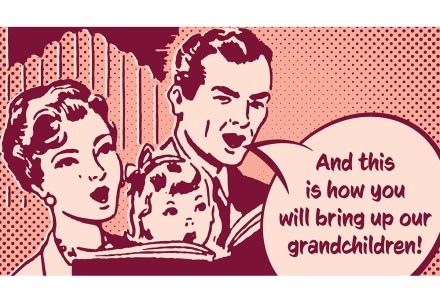
Complaining about ‘toxic parents’ has been a viral hit on TikTok with videos on the topic racking up several billion views. Only one of those views is mine and there won’t be another because it was like peering through a window into a cross between a padded cell and a charnel house. In video after video, boys and girls across the English-speaking world – aged roughly 15 to 25 – share the trauma of what they’ve had to endure, courtesy of their terrible mothers and fathers. Many children suffer at the hands of the people who should protect them, but in this case what the kids find intolerable would, to anyone sane, look like normal, even responsible, parenting.

Freddy Gray, Mary Wakefield, Gareth Roberts and Rachel Johnson

28 min listen

This week (01.13) Freddy Gray, on why Ron De Santis is no longer ‘de future’ in the race for the Presidency, (09.50) Mary Wakefield recounts the train journey from hell,(16.10) we hear from Gareth Roberts about the screenwriters and actors striking over AI potentially taking their jobs and (22.24) Rachel Johnson shares her diary of SAS adventures and mishaps in New Zealand.

Why your summer holidays might be doomed

The first LNER train I booked on Sunday from Durham to London was cancelled due to ‘action short of a strike’. I hadn’t heard the phrase before, but I instantly admired it. It’s so impressively confusing. With a strike, you know whose side you’re on. You can look up the salary of a train driver, for instance, discover that it’s £70,000 after only a few years of training, and become icily indifferent to their plight. But action short of a strike? What is it? ‘Action short of a strike’ turns out to be an ingenious way of screwing your boss while still getting paid Action short of a strike, ASOS, turns out  to be an ingenious way of screwing your boss while still getting paid.

The narcissism of Gavin Newsom

Back in the late 1990s, when I lived in Dallas, Texas, I became fascinated by television evangelists. They were hucksters to a man, offering healing or ‘financial blessings’ in exchange for donations – usually a very specific sum that the Lord had revealed to them. ‘Sow a $73 seed into my ministry, and you will be rewarded a hundredfold. Hallelujah.’ What interested me was how they had the brass neck to do it, to take cash from the poor and spend it on mansions and NetJets, and it was a while before I understood. They genuinely believe their own hype. That’s the secret. They think of themselves as chosen, and being chosen feel entitled to behave as they like. Can you self-identify as poor and still keep a fleet of Teslas?

Should we ban drones from our national parks?

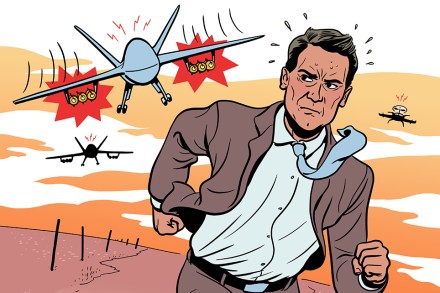
I have a plan for my old age. Now that we all might live for a century or so, feeling redundant and bemused, it’s important to prepare and I have. In my eighties I will be a destroyer of drones. All drones will fall within my remit but my speciality will be hobby drones, the remote-control quadcopters that whine over the English countryside, up and down the coast and round and round above our national parks. To any passerby I will seem innocuous; just your average rambling octogenarian. But tucked away beside my Freedom Pass will be a catapult and the case containing my varifocals will be heavy with 6mm steel ball bearings. I turned and saw the little horror skimming the waves, a blot against the bright sky The plan came to me a few days ago as I was floating in the North Sea.

The kids aren’t ‘trans’ – they just don’t want to grow up

If we rule out the notion that people have ‘gendered souls’ at odds with their biological sex – and we do, absolutely, rule that out – then there still has to be some explanation for the unstoppable rise in the numbers of young people who call themselves trans. A survey of secondary school teachers in England has found that nearly 75 per cent say they now have at least one trans pupil. What’s behind it? Well here, to celebrate Pride month, is my theory. I’ve spent many terrible rubber-necking evenings in the online trans world and my strong impression is that the whole phenomenon is (amongst other things) a desperate desire to remain childlike.

Dr Jean Twenge: Gen Z aren’t OK

There’s never been an older generation that didn’t complain about the younger one. Parents tut and fuss over errant youth. That’s the way of it. But in the end the kids come around. Swingers grow into Karens. The wild child pays his bills. But kids these days… they do seem different. It’s not just that we, the older generations, are worried about them, but that they’re desperately worried about themselves. And according to Dr Jean Twenge, a psychologist at San Diego State University who studies generational changes, we’re right to worry. Almost 30 per cent of American girls have clinical depression and it’s the same across the Anglosphere. The suicide rate for ten- to 24-year-olds has tripled.

I know how AI will bring us down

On the smooth marble concourse by the exit doors at Heathrow Airport I met my first cleaning robot. It was purple, made by a company called Mitie and about waist-height – the size and shape of a park bin. It ran on wheels, dragging a grubby mop behind it, and it was polite. As my small son and I stumbled into its path, it backed off smoothly like a well-trained butler. I apologised to it instinctively, after which it appeared to follow us. My son said: ‘Mum, it likes us!’ Then, when we reached the door: ‘Mum, can we take it home?’ Then: ‘Mum, wait! I don’t think it wants to sweep any more. It needs a rest!’ Last month I wrote about deepfake technology and my newfound fear of AI.

Here’s why the NHS is broken

I was having tea with my neighbour in her second-floor flat when a man, a stranger, appeared in the room. This is quite a regular occurrence at Alice’s. She’s deaf and she can’t really walk so any number of agency staff have access to her front-door key. They materialise wearing gloves and usually a face mask, and because Alice relies on lip-reading she hasn’t a clue what they’re about to do to her. Is it bath time? Injection time? Oh, it’s fun to be housebound and old. This time the man had a clipboard which he consulted, then said: ‘We’re going to hospital.’ Alice turned to me: ‘What did he say?’ Over the years, she and I have worked out a decent way of communicating, mostly though eyebrow raises: ‘What’s the world coming to?

James Heale, Mary Wakefield and Gus Carter

15 min listen

This week: James Heale says the gloves are off as Labour campaigning takes a bitter turn (00:54), Mary Wakefield worries that she’s raising a snowflake (17:47), and Gus Carter tells us about the colourful history of the green man (31:34).  Produced and presented by Oscar Edmondson.

Lessons in parenting – from the French

I am actively contributing to the decline of the West and to the collapse of our civilisation. I realised this last week when I found myself standing behind a metal turnstile in the French Alps watching my smallish son, on the other side of the turnstile, step into a bubble lift going up the mountain to the nursery slope. He was with an instructor from the French Ski School, the ESF, surrounded by other children and entirely safe. He’s just turned seven, yet I behaved like a distressed cow watching her calf hauled off to market. I weaved and bobbed trying to keep him in my line of sight; craned over the barrier with mad, staring eyes. My son’s class was les flocons, the snowflakes, and each child had a large snowflake printed on his yellow bib.

Beware the AI voice thieves

After years of blissful indifference, finally I’m scared of AI. I’ve been complacent, slept soundly beside my husband as he stares and mutters, sleepless with anxiety about robots. But now I’m frightened too. What happened was this. The sound of a person you love goes straight to your heart. You respond instinctively and emotionally A few weeks ago a friend received a phone call from her son, who lives in another part of the country. ‘Mum, I’ve had an accident,’ said the son’s voice. She could hear how upset he was. Her heart began to pound. ‘Are you OK? What happened?’ she said. ‘I’m so sorry Mum, it wasn’t my fault, I swear!’ The son explained that a lady driver had jumped a red light in front of him and he’d hit her.

Why trans kids are now ‘coming out’ as animals 

It was announced last week that another gender has been added to the list: nominalgender. Most news sites reported this in the sort of proud way a zoo might announce the birth of an exciting animal, a baby Komodo dragon maybe – as if the gender had somehow hatched and was waiting to be adopted. You are nominalgender ‘if your gender is so much just you that no one else can even experience it’, I read. You’re xenogender if you feel more akin to animals or plants or foods than humans A gender no one else can experience? That sounds almost appealing.

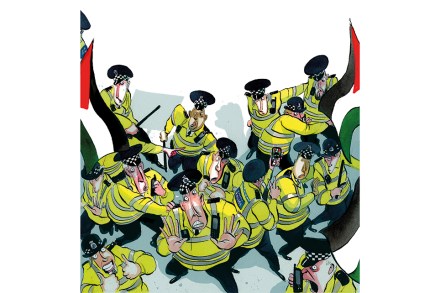
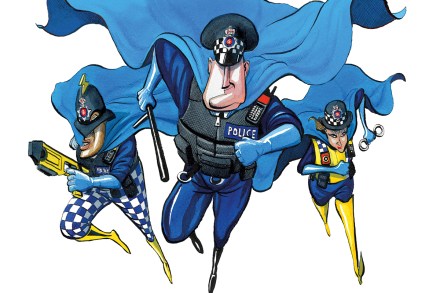
I know where the Met police are going wrong

I have a puzzle for the Metropolitan police – a mystery that only they can solve. Why, if the Met is so short-staffed, do they hang around in groups? Why do officers clump? Why are some crimes completely ignored, but at other minor incidents the Met appear en masse? In London side streets I come across police vans, bumper to bumper, full of officers just sitting, doing nothing, like large unhappy children on a school trip. It’s demoralising for me. I can’t imagine how depressing it must be for them. If you’re in the business of finding decent, non-rapey officers, it’s clearly a good idea to look them in the eye Sir Mark Rowley, the new Met Commissioner, has announced what he calls the ‘Turnaround Plan’ for transforming the Met.

Your child isn’t trans, she’s just a tomboy

When the mist lifts and we can see clearly the carnage caused by the trans madness, and we blink and wonder what in God’s name we did to our kids, I hope we recognise the true heroes of the saga. By this I don’t mean the Jordan Peterson types or even J.K. Rowling, so much as the parents who somehow found the courage to stand up to their own children. Any child who makes the fashionable decision to identify as another gender is instantly surrounded by a supportive gang of fellow trans travellers – a ‘glitter family’, they call themselves – who’ll insist that it’s ‘literally dangerous’ for them to stay in touch with doubters. To question your child, when they tell you they’re trans, is to risk them rejecting you for good.

Stuart Ritchie, Mary Wakefield and Toby Young

This week: Stuart Ritchie asks whether we should worry about declining sperm counts (0:29). Mary Wakefield wants to end the term ‘making memories’. (9:00), and Toby Young shares his disastrous Airbnb winter break (15:10). Produced and presented by Natasha Feroze.

Real memories aren’t ‘made’

If I could make a new year’s resolution for everyone in the English--speaking world, it would be that we all agree never to use the phrase ‘making memories’ again, or to think about life in terms of making memories, let alone post a photo with the hashtag #makingmemories. All of a sudden, all across the internet, it seems to me, merchandise has sprung up encouraging us to think of life as a ‘memory--making’ project: frames, filters and albums designed to capture and enhance every breathing moment. There are mats for lying babies on next to their age in months for memory-making photoshoots, though none I’ve seen yet for the other end of life: look how Granny changed through her nineties!

How Pope Benedict persuaded me to become a Catholic

I grew up in a traditional English family, surrounded by cousins, chivvied by aunts, presided over by my grandmother, who insisted on Sunday church. We weren’t religious but Anglicanism (of a 19th-century sort) was in the air. We read the Revd Charles Kingsley’s Water Babies, C.S. Lewis’s Narnia books and if I thought about Jesus it was in an English setting. I imagined him barefoot walking through fields, rescuing the lambs that had fallen into cattle grids. Our family viewed Catholicism with suspicion. For us it was voodoo: foreign and crowded with unnecessary intercessors.