Martin Vander Weyer

Martin Vander Weyer

Martin Vander Weyer is business editor of The Spectator. He writes the weekly Any Other Business column.

Manchester won’t raise a statue to Andy Burnham

Already heard enough of ‘Is Manchesterism a thing and did Andy Burnham invent it?’ I’m afraid you’ll hear a great deal more between now and the Makerfield by-election – and long afterwards if Burnham wins the seat and the subsequent Labour leadership contest. So here’s a reminder that he defined Manchesterism in an interview last year as ‘consensual, business-friendly socialism that seeks to retake public control of all essential services’ – though in nine years as Greater Manchester’s mayor he achieved that latter objective only to the extent of imposing integrated fares and timetables on privately run buses. My own definition of Manchesterism, in response to his, was ‘manoeuvring shamelessly for power on the strength of other people’s achievements’.

How private equity changed the world

The 50th birthday of New York private-equity giant Kohlberg Kravis Roberts – founded with $120,000 by the cousins George Roberts and Henry Kravis and now holding $758 billion of assets under management – is a moment to ask whether the modus operandi the firm pioneered has been good or bad for the world. Private-equity buyouts of underperforming public companies have certainly been a catalyst for sharper corporate performance across every western economy. But with what impact on society? Some buyouts also provide cover for ‘sin’ businesses that harm the planet or deny workers’ rights. KKR itself will never live down the book title Barbarians at the Gate, referring to its ruthless 1988 takeover of RJR Nabisco.

Don’t blame Trump for food price hikes and cancelled flights

In the hierarchy of factors that will make consumers curse politicians and company bosses this summer, food price inflation probably ranks higher than holiday flight chaos. But both will contribute to an ugly mood that will manifest everywhere from Question Time audiences and airport voxpops to outbreaks of mass shoplifting. And only the last blip of both irritants can truly be blamed on what’s happening in the Strait of Hormuz. A thinktank report grabbed headlines on Monday with the claim that UK food prices could be 50 per cent higher by November than they were at the onset of the cost-of-living crisis in 2021. But that’s not a particularly startling figure, given that ONS statistics for the five years to November 2025 already showed a 38.

I’ll dare to say what Andy Haldane doesn’t 

A sandwich with Andy Haldane, the former Bank of England economist, now president of British Chambers of Commerce, is the intellectual equivalent of a lunchtime workout with an ultra-fit personal trainer – or so I imagine, having never submitted to the latter experience. When his BCC role was announced in February, Haldane spoke of ‘a fighting chance’ that UK growth would beat expectations for the coming year. But that was before the closure of the Strait and the resurgence of global demons. The purpose of the sandwich was to find out if he had tempered his upbeat tone. The Iran conflict is ‘the last thing anyone needed, least of all the UK’, he began.

People need to calm down about Nigel Farage’s bitcoin wheeze

There’s a Tube strike in the old-fashioned style as I write – and you’ll understand the irritation, mine and that of restaurateurs across London, when I add that I’ve just cancelled a table at Noble Rot in Greek Street because my companion can’t face struggling into town. The loss of trade on these days, of which more are planned for May and June, is immeasurably damaging for an already fragile urban economy. More irritating still is the fact that behind the disruption is disharmony between unions: RMT members, just under half the driver workforce, are striking against Transport for London’s proposal of a four-day week (plus extra days off in return for other minor changes) which their Aslef brethren are keen to accept.

A private credit crash is coming

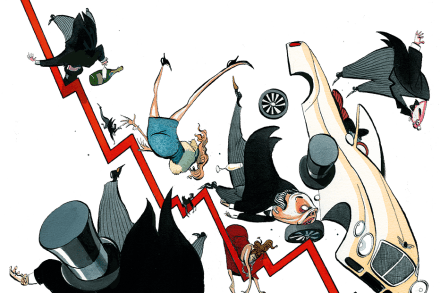
What with headlines focused on the Strait of Hormuz and scare stories about out-of-control AI, forecasts of a storm in the less vivid field of ‘private credit’ have dropped down the news agenda. But thunder continues to rumble since the collapse in London of the short-term property lender Market Financial Solutions, now being investigated for fraud – and there are connections between private credit, Iran and AI that could turn a storm into a hurricane. Governor Andrew Bailey of the Bank of England first talked of ‘alarm bells’ in the US private credit sector last October. The latest indicator is a stampede of investor withdrawals from Blue Owl, a prominent New York private lender.

Making Tax Difficult: another Whitehall farce

Welcome to the new tax year, with its overflowing hamper of half-baked, growth-eating, enterprise-crushing Labour measures. And if you happen to be one of the 4.4 million self-employed who scrape an independent living despite rising costs and red tape, welcome to what must surely be one of Whitehall’s longest-running but least funny sitcoms, Making Tax Digital (MTD). If your income from self-employment (or rents as a landlord) exceeds £50,000 a year, you must henceforth submit quarterly digital updates to HMRC; next year the threshold will drop to £20,000. You’ll have less time to pursue your trade but your costs will rise, because you’ll need new software and more professional advice.

Hong Kong is the new Dubai

I had forgotten, if I ever knew, that National Savings and Investments (NS&I) began life in 1861 as the Post Office Savings Bank and is still an offshoot of HM Treasury. It survives as a supposedly low-risk choice, in an increasingly hard-sell marketplace, for those who wish to put money aside for old age or their heirs. So it is peculiarly disappointing to learn that NS&I has been caught mishandling some £476 million of savings belonging to 37,500 deceased customers.

Never mind bashing ‘profiteers’, slash fuel taxes and green levies

As chairman of the value-for-money Iceland frozen-foods chain, Richard Walker might be expected to know what he’s talking about in his newly ennobled role as the government’s ‘cost of living champion’. But he was also one of the few recognisable names on the list of 121 ‘business leaders’ who endorsed Labour’s clueless economic programme ahead of the 2024 general election. So we should be wary of his intervention on Rachel Reeves’s behalf, warning ‘profiteers’ not to ratchet up prices in response to the Iran crisis, having already ‘hauled petrol retailers and energy producers into Downing Street’ to tell them ‘opportunistic rip-offs will not be tolerated’.

Has Rachel Reeves secured a rare victory for growth?

There’s very little to celebrate in Downing Street these days but it must have been vodka shots all round in Chancellor Rachel Reeves’s office last week when Revolut, the City’s glossiest fintech start-up, finally secured the banking licence it has been pursuing for the past five years. Founded as a currency payments app in 2015 by two tech entrepreneurs, Russian-born Nik Storonsky and Ukrainian Vlad Yatsenko, Revolut acquired customers at an explosive rate and first sought recognition as a UK bank – able to accept deposits under the umbrella of the Financial Services Protection Scheme – in 2021.

If oil prices stay high, you can bet on a recession

Shares everywhere dived for cover as missiles started flying. But one stock ahead of the pack, and responding to a different alarm, was Barclays, which has dropped 20 per cent since early February, having quadrupled over the preceding two years. I’ll declare an interest as custodian of a modest family holding – making me all the keener to understand what this rise and fall is telling us. All banks were deeply devalued after the 2008 financial crisis and remained so, long after their balance sheets were repaired in the 2010s. More recently, the market narrative was that they were behaving sensibly again and their shares were shiny bargains. Barclays – run since 2021 by C.S.

Brace for higher inflation

All eyes on the Strait of Hormuz, the 24-mile-wide choke point between Iran, the United Arab Emirates and Oman, through which moves, in normal times, around a fifth of the global supply of liquified natural gas and a quarter of all seaborne oil. But with Iran threatening to set fire to any ship in the strait, LNG production halted in Qatar after missile attacks, and gas stocks in user countries low at the end of winter, prices are soaring as they did at the outbreak of the Ukraine war. You may hear it said that the UK is relatively well placed for this supply crunch because we import only a small portion of LNG from the Gulf and much more from the US and Norway; and because almost half of UK electricity now comes from renewables, with wind to the fore.

The no.1 quango that deserves the axe

There are elements of economic life, such as the impact of President Donald Trump’s ever-changing tariffs, that are far beyond national control; others, including the supply of most consumer goods, that are best left to free markets; and others which naturally benefit from state intervention. New housing, wholly dependent on planning and building regulations, clearly falls into the last category. So we might well ask how the Labour government plans to solve a homebuilding crisis so extreme that its target of 1.5 million new homes within this parliament is likely to be undershot by 50 per cent or worse.

Is it last orders for BrewDog?

‘Nostalgia is not a strategy,’ declared Schroders chief executive Richard Oldfield after announcing that the investment firm, descended from a City banking house founded in 1804, is to be sold for £9.9 billion to Nuveen – which sounds like a brand of cooking oil but turns out to be a Chicago-based manager of retirement savings. The two together will hold £1.8 trillion of assets, placing them tenth in a global league headed by the giant American ‘passive’ investors BlackRock and Vanguard. Oldfield is right that there’s no point looking backwards in a tech-driven sector that’s rapidly consolidating to keep pace with those leaders.

Japan’s female leader is a bright beacon, but do her sums add up?

My scepticism towards soaring markets with unconvincing fundamentals was nurtured by working in Tokyo in the mid-1980s, when the Nikkei index took off like a rocket. Shamelessly boosted by traders and analysts alike, share prices rose to absurd heights before crashing in the early 1990s and taking with them any notion of Japan as the next great economic power. The Nikkei took 34 years to regain its 1989 peak of 38,916. Since passing that benchmark, the index has roared upwards again – despite Japan’s chronic problems of stagnant growth, ballooning public debt, sclerotic corporate leadership, expensively ageing population and fears of inflation.

The role of ABBA in the Ajax fiasco

‘It’s all about ABBA,’ a military acquaintance whispered when I mentioned the scandal of the British Army’s order of 589 Ajax armoured vehicles, for which -‘initial operating capability’ status has been withdrawn following multiple cases of soldiers suffering after-effects of intolerable noise and vibration. What could that possibly have to do with the great Swedish-songsters? Nothing, he explained: it is an acronym for ‘Anything But British Aerospace’, allegedly a mantra in defence procurement circles in a previous era.

Where have all the graduate jobs gone?

It’s a relief not to have been pressganged into joining the Prime Minister’s plane-load of business chiefs and reporters bound for Beijing this week. With Sir Keir Starmer are leaders of the likes of Astra-Zeneca, BP, HSBC, JLR and Rolls-Royce, and some billion-pound deals will no doubt be announced while they’re there – agreed in advance on the condition that Downing Street gave the green light for China’s Royal Mint Court mega-embassy-cum-listening-post on the edge of the City. The Chancellor is on the trip too, perhaps carrying a nice set of hunting prints as a housewarming gift for London ambassador Zheng Zeguang’s new office.

Bookshops deserve tax breaks

My Davos spy disguised as an Uber Eats driver sent word that this year’s World Economic Forum was rammed ahead of Donald Trump’s arrival. The Alpine resort was heaving with Saudis, Emiratis, AI snake-oil salesmen and US tech titans strongarmed into sponsoring USA House, the official showcase of America’s ‘unity, ingenuity and leadership’ that has its main venue in the town’s English church – ideal for Trump veneration. Attendance was so competitive that the market in fake VIP passes was hotter than precious metals and one African statesman was seen parting with €25,000 in cash for a rented apartment.

Trump’s attack on the Fed is a pivotal moment of hubris

The phrase ‘trumped-up charges’ dates from the 18th century, I learn, and derives from the Old French tromper, to deceive. It has certainly acquired new resonance with the threat of criminal indictment against US Federal Reserve chairman Jerome Powell, somehow relating to the cost of Fed building renovations. The President says this Department of Justice action has nowt to do with him, but it’s plainly another exercise of what some commentators are calling ‘the Maduro option’: sod constitutional niceties, just drag your opponent into the dock. For all his foreign-policy fireworks, Donald Trump knows November’s US midterm elections will largely be driven by domestic cost-of-living concerns.