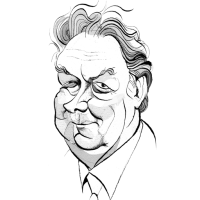
Martin Vander Weyer

Martin Vander Weyer

Martin Vander Weyer is The Spectator’s business editor

Reflections on the book trade from the man who wants his shops back

From our UK edition

The week in which HMV completed its £63 million takeover of Ottakar’s — and announced that Ottakar’s bookshops will be rebranded as Waterstone’s, which HMV already owns — seems a good moment to contemplate the future of the book trade in the virtual and digital age. There is something so unchangeably pleasing about the feel of a book in the hand and the ambience of a room full of books that it is hard to imagine the demise of the traditional well-stocked bookshop, what-ever alternatives technology may offer. And yet our own book-buying habits are the best indication of the speed of change.

The NatWest Three case lacks common sense, proportion — and a victim

From our UK edition

A head of steam is building up behind the campaign to halt the imminent extradition to the US of the NatWest Three, the trio who face trial (and two years in a tough Texas jail before trial) for an alleged $6 million ‘wire fraud’ against NatWest in connection with the sale of a joint venture between the bank and Enron. Attention has focused on the unequal extradition terms to which the Blair government agreed in its eagerness to be America’s best friend in the War on Terror, allowing US prosecutors to summon British suspects for trial without first having to present evidence against them.

Time for a naked protest against global cant and in support of Jeremy Clarkson

From our UK edition

Time for a naked protest against global cant and in support of Jeremy Clarkson I was all set to join some of my more liberated neighbours on York’s Naked Bike Ride last Friday, until I discovered that it was yet another protest against ‘global oil dependency’. The debate about climate change, carbon emissions and who is doing what to the planet has reached such a fever pitch of self-righteousness and middle-class guilt that it is time for sensible people to start backpedalling.

The art of chairmanship

From our UK edition

Listing page content here ‘We all have different ways of doing things,’ says David Jones, when I ask him what makes a good captain of a corporate ship. He certainly has his own way of preparing for a high-pressure day like the one he had last week at the annual general meeting of Wm Morrisons, the supermarket group where he is deputy chairman and troubleshooter-in-chief. ‘I generally wake up about 6 a.m. My body is stiff and I’m almost unable to move. If I’m at home, I ask my wife Ann to move my legs out of the bed and pull me up. If I’m away, I have developed a technique of rolling off the bed on to the floor, then getting on to my knees before making a supreme effort to stand up. This can take anything up to half an hour.

A philosopher rescued from politicians

From our UK edition

Listing page content here In February 2005 the then chairman of the US Federal Reserve, Alan Greenspan, travelled to Kirkcaldy on the windy shores of the Firth of Forth in the company of our very own Chancellor of the Exchequer, so that both could pay tribute to the town’s most famous son, Adam Smith, in their own distinctive way. For Greenspan, the stability and growth of free-market capitalism as seen in ‘today’s awesome array of international transactions’ could be attributed to a modern version of ‘Smith’s invisible hand’.

You’re hired — so long as you swear like they do on telly, and you don’t smoke

From our UK edition

Many of my friends were hooked on the latest series of The Apprentice Many of my friends were hooked on the latest series of The Apprentice — even our usually infallible television critic James Delingpole, who told me that he loved it ‘because it’s so awful’. Perhaps I should make more effort to master postmodern irony, but I’m afraid I found Sir Alan Sugar and his contestants just too irritating to watch for more than five minutes at a time.

Galbraith versus Friedman: the great debate is not over yet

From our UK edition

I would love to have been a fly on the wall — or a butler — at the US embassy I would love to have been a fly on the wall — or a butler — at the US embassy in New Delhi in March 1963 when Milton Friedman, champion of laissez-faire, came to lunch with J.K. Galbraith, high priest of higher welfare spending and at that time President Kennedy’s ambassador to India. Not only were the two economists lifelong intellectual opponents who found each other’s core beliefs morally reprehensible, but the magisterial Galbraith stood some 20 inches taller than the bantam-cock Friedman.

Thatcherism saved Ryton but globalisation killed it — and striking won’t help

From our UK edition

The demise of Peugeot’s Ryton factory came and went as a news story The demise of Peugeot’s Ryton factory came and went as a news story in little more than 48 hours, mutating swiftly from ‘shock closure’ to more measured explanations of inevitability. Though Peugeot is accused of welshing on promises that the plant would keep working until 2010, its French bosses never suggested that it would make a new model after the Peugeot 206, and the fact that cars can now be built cheaper in Slovakia than in Coventry comes as no news at all.

Weep not for Britain’s stake in Airbus, but watch what happens to BAE

From our UK edition

Let’s not come over all emotional about the sale of BAE Systems’s one fifth stake in Airbus to EADS, the Franco–German group that already owns the rest of it. For a start, the sale does not portend the death of a once-great industry, because Britain has not had much to be proud of in civil aircraft manufacture since before the second world war. The last all-British commercial aircraft any of us flew in was probably a modest BAe 125, but the division of the then British Aerospace that made it was sold to Raytheon of the US in 1993, and its successors are built in Wichita, Kansas.

Knock, knock! A toast to the City’s peerless chronicler and jokesmith

From our UK edition

Christopher Fildes’s City and Suburban column first appeared in June 1984 and notched up over a thousand appearances; before that, he served as business editor under Nigel Lawson in the late 1960s. As a chronicle of modern City life, the Fildes oeuvre has only one equal and that comes in the weighty form of A Club No More, the last volume of David Kynaston’s magisterial history of the Square Mile. In the lighter field of daily and weekly journalism, Christopher has been peerless in his combination of wit, learning, firmness of judgment, appetite for gossip and enthusiasm for lunch — preferably at the Savoy Grill before its tragic refurbishment.

Trying times on Easy Street

From our UK edition

The multibillionaire Warren Buffett, a folk hero of the age of affluence, once reminded disciples of his hugely successful investment techniques that ‘money can’t change how many people love you’. Avner Offer’s potent analysis of 50 years of socio-economic data makes a similar point in less folksy style: ‘Affluence breeds impatience, and impatience undermines well-being.’ As Oxford’s Chichele Professor of Economic History and a fellow of All Souls, Offer is scrupulous about defining terms.

Hedge funds, like cash gifts from Italy, carry a whiff of dangerous sophistication

From our UK edition

‘Pushing money into offshore hedge funds is not the Labour way,’ a left-wing MP commented last week on the savings habits of Tessa Jowell’s estranged husband, David Mills. Since this issue includes an Investment section, readers may be anxious to know whether putting money into hedge funds is or is not the Spectator way. But I think I must pass that buck to your financial advisers, and offer nothing more than words of caution. Hedge funds have had something of the night about their reputation ever since George Soros’s Quantum Fund harvested £1 billion from the speculative attack which drove the pound out of the European Exchange Rate Mechanism in 1992.

The prince of start-ups is entitled to speak louder than any big-ego business knight

From our UK edition

Every time Sir Alan Sugar fires a contestant on The Apprentice, the nation quivers in admiration; likewise whenever Sir Richard Branson launches another airborne publicity stunt. Serial entrepreneurs are accorded guru status, yet whenever Britain’s most prolific kick-starter of enterprise sticks his head above the parapet he is showered with abuse and told to get on with his real job, which is — as the comedian Marcus Brigstocke tastefully put it — ‘waiting for his mother to die’. The Prince of Wales, through the charity he set up when he left the navy in 1976, has helped more than 60,000 young people to start their own businesses.

Even Lassie gets to Yorkshire quicker than the Royal Mail these days

From our UK edition

Watching the charming remake of Lassie, I realised — stifling a sob — how easy it was to suspend my disbelief that a soulful collie could make a solo journey from the Highlands via Glasgow to a village in Yorkshire, arriving home just in time for Christmas. But I find it much harder to believe that a Christmas card posted in Sloane Street on 21 December could have taken until 8 February — almost seven weeks — to reach me in Yorkshire. Had the card, like Lassie, been impounded by pompous officials en route but bravely outwitted them? Had it tagged along with a good-hearted travelling showman in a caravan? That sounds far-fetched, I know, but no more so than the fact that the Royal Mail has just been fined £11.

Turning science into profit

From our UK edition

Sir Richard Sykes of Imperial College tells Martin Vander Weyer that Britain’s world-class scientists hold the key to future economic success Approaching Imperial College through the long tunnel from South Kensington station, I recalled that the last time I met the College’s rector, Sir Richard Sykes, he was chief executive of Glaxo, the drugs group, and we were lunch guests of the industrialist Lord Hanson. Our fellow guest (forgive the name-dropping) was the broadcaster Selina Scott, and it would be fair to say that glamorous Selina was served a rather larger portion of Hanson’s charm and attention than Sir Richard or me.

Labour tries its hand at privatisation — and hands John Major’s firm a fast buck

From our UK edition

QinetiQ, the business created out of the Defence Evaluation and Research Agency, is Labour’s first attempt at full-scale privatisation, and it has deservedly run into heavy flak. The Daily Telegraph is particularly agitated about the fact that private investors cannot apply for shares in next month’s £1.1 billion flotation, which is open only to institutions. Bankers handling the sale say QinetiQ is too complex to explain to ordinary punters without spending unjustifiably large sums on a marketing campaign. Spokesmen for small shareholders declare that every citizen should have the chance to benefit from the sell-off of state assets.

Who will be man enough to stand up for big business against Cameron and Brown?

From our UK edition

Everyone seems to be concocting their own shortlists for the most desirable job in London (I speak, of course, of the leadership of the Liberal Democrats), but the contest that catches my eye is the one to become the next director-general of the CBI — not least because, in a moment of whimsy, I once applied for the post myself. The present incumbent, Sir Digby Jones, will step down by the end of this year and the CBI’s intention is to announce his successor before the summer. The search is in the hands of former Cabinet minister turned headhunter Virginia Bottomley and the early spin suggests that, for the first time, a female candidate may be preferred.

Labour’s red tape turns running a small business into a pantomime

From our UK edition

It’s pantomime season here in Helmsley — Jack and the Beanstalk, seats available at all prices — but this year I’m not the dame. The ladies in charge said they wanted a wholesome family show, so that ruled out a re-appearance of the Les-Dawson-does-Dame-Edna persona I developed last year — to some acclaim from rowdier elements of the audience — as Cinderella’s ugliest sister. The consolation for being a resting actor, however, is that I am free to devote more attention to my other role as director of the arts centre in which these extravaganzas take place. I have held this voluntary part-time job for the past 12 years, in which the centre has grown into a thriving hub of creativity.

My solution to the pensions crisis: let’s fill the gap with grannies

From our UK edition

In the sixth form, I sat next to Adair Turner, now Lord Turner of Ecchinswell, the pensions prophet whom the Chancellor has left crying in the wilderness. Turner was cleverer than the rest of us, deeply serious and dedicated to his studies; a gifted loner who sat apart from the brutish cut and thrust of public school life. The description still seems to fit, except for ‘public school’ read simply ‘public’.

The UN and the internet

From our UK edition

The laptop on which I’m working tells me that it has sent 7,392 email messages to date, and if I knew how to reach its innermost parts it would probably provide a rather embarrassing list of every website it has ever visited on my behalf as well. Like most internet users, I have absolutely no idea how any of that traffic actually happened. I have a fantasy that it involves satellites in space and bunkers deep underground, full of scary professors and beautiful girls in lycra spacesuits dancing attendance on giant computers; and I sometimes wonder whether my cyber-correspondence is being monitored for key words (‘jihad’ perhaps, or ‘Galloway bank account’) at GCHQ Cheltenham or Langley, Virginia.