Answers to The Spectator Diary 2024 Quiz
From our UK edition
Mark Mason talks about trivia via books, articles, guided walks and the pub.
From our UK edition
From our UK edition
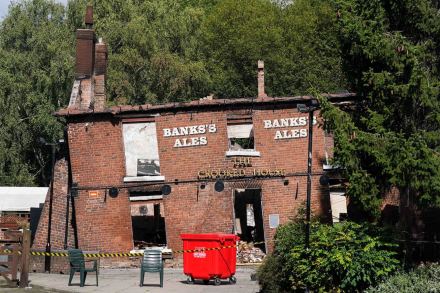
Farewell then, the Crooked House. The 18th-century pub, in the West Midlands village of Himley, hasn’t just stopped being a pub – it’s stopped existing, full stop. Just days after its sale to a private buyer for ‘alternative use’, the famously wonky building – where coins and marbles appeared to roll uphill – was gutted by fire and has now been demolished. Unsurprisingly this has given rise to suspicions aplenty, but we’re taking it as a chance to celebrate Britain’s oddest pubs. Step this way for underground tunnels, pubs without bars – and some very single-minded landlords… Oliver Cromwell spent a night here and Inspector Morse visited in a 1990 episode The Temple of Convenience, Manchester The clue’s in the name: this place used to be a public toilet.
From our UK edition
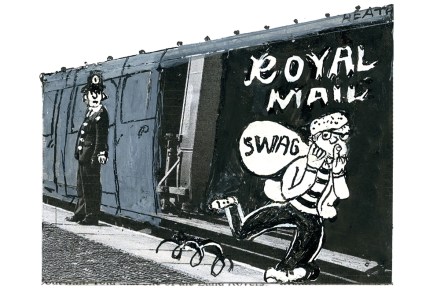
We don’t know if the two teenagers who attempted a train robbery in Scotland this week knew that it was the 60th anniversary of the most famous one in British history. Given their failure – nothing was stolen and the charges include ‘malicious mischief’ – it seems unlikely. Either way, the train robbery of August 1963 remains secure in its title of ‘Great’. Why did it fascinate us so much in the first place? Partly it was the zeitgeist timing (that year also saw Profumo, Beatlemania and JFK’s assassination); partly the amount stolen (£2.5 million, worth more than £40 million today); and partly the narrative of ‘plucky underdogs vs the police and banks’ – the last of whom were insured, except the Midland, which disdained the idea and so lost £500,000.
From our UK edition
Our monthly trivia round-up started with July, named after Julius Caesar – now we reach the segment of the year named after the emperor Augustus. It’s the month with the shortest war in history, the theft of the Mona Lisa, and the execution of William Wallace. You won’t believe what happened to his left leg… The Anglo-Zanzibar war takes place. It is commonly cited as the shortest war in history, lasting a mere 38 minutes 2 August 1932 – Birth of Peter O’Toole. The actor often wore two watches. Asked why, he replied that ‘life is too short to risk wasting precious seconds glancing at the wrong wrist’. 3 August 1919 – Birth of Helen Viola Jackson. She would live until December 2020, making her the last surviving widow of an American Civil War veteran.
From our UK edition
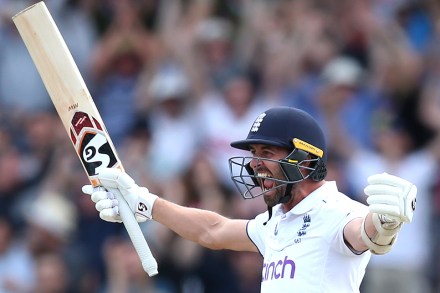
The current Ashes series is proving a once-in-a-generation classic, one of those contests that cricket fans spend decades dreaming about. How are some of those fans reacting? They’re refusing to watch. I’m talking about the ‘I just can’t stand the tension’ brigade. The ones who, when the run chase gets down to 30 with three wickets left, run from the room shouting: ‘It’s no good, my nerves won’t take it.’ They pace up and down, fingers in ears, determined to avoid learning the result until the match is over. Only then do they creep back in and discover the news. It’s madness. You wait years for the drama of a truly great sporting event – and then when it arrives, you shun it.
From our UK edition
In a new monthly series, Spectator Life will be bringing you facts, stories and items of general wonderment associated with the month ahead. Welcome to July – where we learn what ‘Twix’ is short for, why England’s World Cup-winning footballers painted white stripes on to their boots and how many times Charles and Diana met before their wedding… 1 July 1903: The first ever Tour de France gets under way. If you think the race has had its controversies in recent times, you should have seen it in the early years. Competitors sometimes had themselves towed along by cars, or simply got into the car for a lift. Others took the train.
From our UK edition
We live in an age of instant communication. But communication has never been less certain. Once in a while, WhatsApp takes several days to deliver a message to me. The first I know that someone contacted me on Friday is when my phone pings on Tuesday. Like when a friend let me know he and his partner were getting engaged. ‘Congratulations,’ I began, before noticing he’d sent the message four days previously. So then I had to add an apology to my response. Text messages can also fail. Another friend recently changed phones, and realised after a few days that some (though not all) of his contacts’ texts were going to the old phone, whose battery was drained. His theorising about why this might be included such phrases as ‘SIM card lag’.
From our UK edition
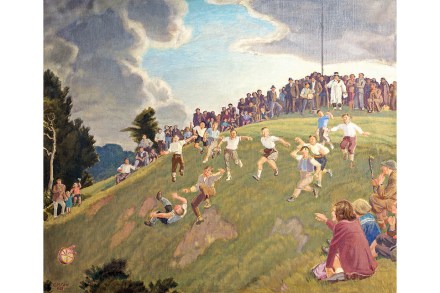
‘Two mobs of men fighting over possession of a ball in a freezing, muddy river in Derbyshire,’ writes Harry Pearson, ‘is the British equivalent of the Rio Carnival.’ He’s not wrong. Brazil may have the sun, but we’ve got the capacity for mindless violence. It’s a trait expressed in many of the folk sports covered in this highly entertaining book. The mass football games (such as the one in Ashbourne), which take place over pitches several miles long, aren’t quite as vicious as they once were. In a Georgian contest between the Men of Suffolk and the Men of Norfolk, nine players died. In Jedburgh, they used an Englishman’s severed head as the ball. Nevertheless, the modern contests are far from gentle.
From our UK edition
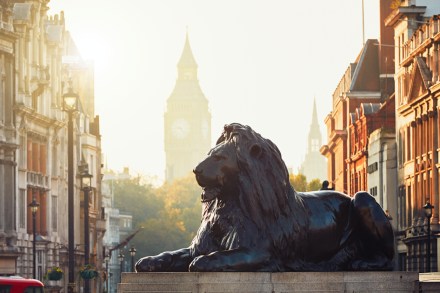
Our journey around London’s postcode areas has reached its final destination: WC. One of Evelyn Waugh’s female friends always insisted on referring to it in full as ‘West Central’, because she said ‘WC’ had ‘indelicate associations’. We’ll learn what happened at Spike Milligan’s memorial service, why Agatha Christie married an archaeologist and where you can find the official definition of an inch… York Place, just south of the Strand, used to be called Of Alley (the modern street sign still commemorates the fact). The name came about because when George Villiers, the Duke of Buckingham, sold the land to developers in 1672, he insisted that every element of his name be reflected in newly created streets.
From our UK edition
I have inadvertently built my own coffin. I’m rather chuffed with it. It wasn’t meant to be a coffin. It’s actually a boat. My son found a YouTube video on how to make one, and although these videos are normally created by practical men for other practical men (I am the world’s most impractical man), I watched it and thought: ‘Even I could do that.’ It’s essentially an open-top plywood box, eight feet by two feet by one foot, with a 45-degree angle at the front to make it look slightly less like a box. Needless to say, my son got bored after the third nail, but I soldiered on and, seven bathrooms’ worth of sealant later, I was the proud owner of a punt.
From our UK edition
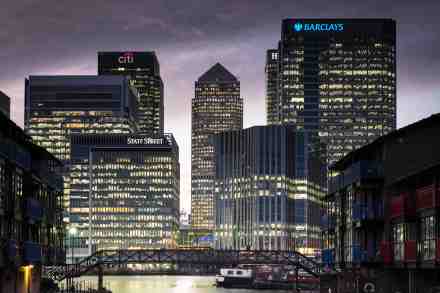
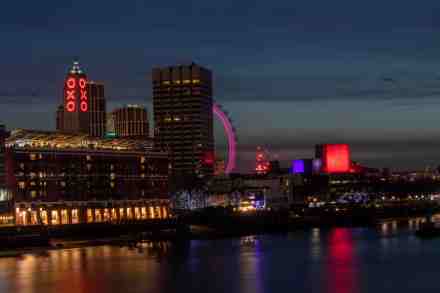
How Walford in EastEnders got its name, why Isaac Newton visited bars in disguise and what happened when the IRA parked on a double yellow line. Our tour of London’s postcode areas has reached its penultimate stop – who fancies an E? In the run-up to the 1997 general election, John Major visited the Mirror Group offices in Canary Wharf. One of the rooms he entered, high up in 1 Canada Square, was that of Kelvin MacKenzie, erstwhile editor of the Sun but by then boss of L!ve TV. Looking out of the window, the Prime Minister commented: ‘Incredible view you’ve got from here, Kelvin.’ ‘Yes,’ replied MacKenzie. ‘On a clear day, you can almost see a Tory voter.
From our UK edition
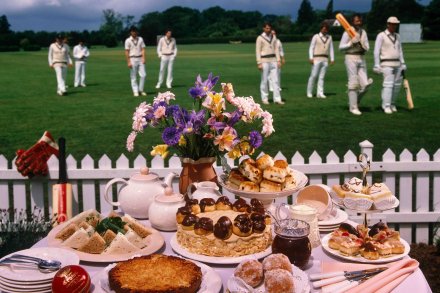
Fans of long-form sport, rejoice. April is here, and it is our month. Not only does it see the first four-day matches of the county cricket season, it’s also when snooker stages its world championship. Long-form sport is always the best. A four-day cricket match (five for Tests) has way more scope for drama than a T20. And the snooker at the Crucible Theatre in Sheffield, where even the shortest match is the best of 19 frames, gives space for the twists and turns that characterise true sporting excitement. Both games have sought to recruit new fans in recent years by offering shortened versions. Cricket has gone from 50-over games to 20 and now ten (with the 100-ball version in there as well).
From our UK edition
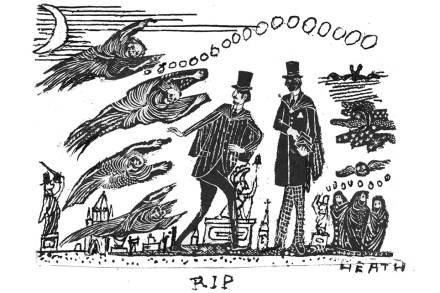
Things are hotting up at Highgate Cemetery. Or they’ll need to if the grander tombs are to survive. During one cold spell last year, the huge mausoleum to Victorian banker Julius Beer froze on the inside as well as the outside, breaking some of the glass tiles. Lead lettering is another weak point – water gets into cracks, expands as it turns to ice, and forces letters off. So electric heating is being considered. The charity that looks after the cemetery admits this seems bizarre, ‘but it could save us a lot of money’. The cemetery dates from 1839, one of London’s ‘Magnificent Seven’, which were opened to cope with the city’s expanding population.
From our UK edition
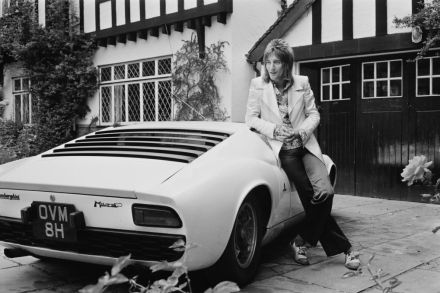
How Rod Stewart kept his hair in place, why the BBC gave its presenters electric shocks and what Paul Gascoigne shot with an air rifle: this month’s London postcode area is N – buckle up for another trivia-packed tour… The first run that cabbies have to learn for the Knowledge is Manor House Tube station to Gibson Square. Their task, as with any journey, is to take the most direct route possible – this is called being ‘on the cotton’, because the route will follow the straight line mapped by an imaginary piece of thread stretched between the two points on the map. The Great Northern Hotel at King’s Cross gets its unusual shape from the River Fleet.
From our UK edition
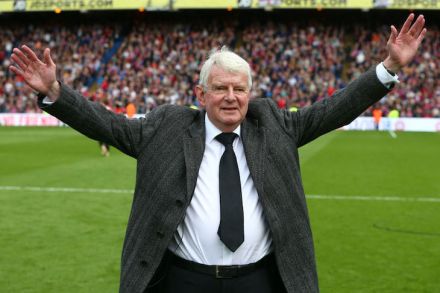
There’s a sheepskin coat hanging just inside the Pearly Gates. Yes, John Motson has died. That appears to be the case, Des. Very much so, in fact. Of that. There can be. No doubt. It’s normal, when a beloved commentator of Motty’s vintage dies, for viewers of a certain age to mist over and fondly recall the days when there was humour in sports broadcasting, when those behind the mike – and indeed in front of the camera (David Vine, David Coleman, the recently-departed Dickie Davies) – had a smile on the lips and a glint in the eye. ‘Not like the over-earnest, stat-obsessed presenter-bots of today,’ etcetera. But actually Motty was different. He was over-earnest. He was stat-obsessed. He was, in short, a nerd. And that’s why we loved him.
From our UK edition
Our tour of the trivia behind London’s postcode areas has reached SE, where we find rock stars being embalmed, P.G. Wodehouse reporting on cricket and Westminster Bridge being painted green for a very specific reason. Oh, and Winston Churchill gets a hat-trick of mentions… When Richard Burton played Hamlet at the Old Vic in 1953, Winston Churchill came to see him and sat in the front row. Within a few lines Burton heard a ‘dull rumble… it was Churchill speaking the lines with me. This was fairly disconcerting, so I tried to shake him off. I went fast, I went slow, but the old man caught up with me all the time’. Even in those days the play was routinely cut to make it shorter.
From our UK edition
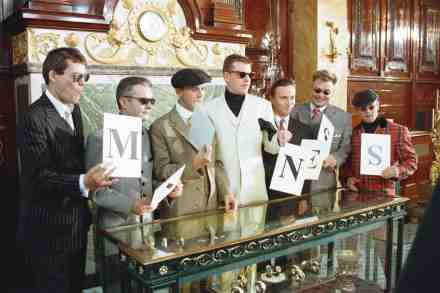
This month our trivia-inspired tour of London’s postcode areas reaches NW, where Tim Burton snored, Madness caused an earthquake and Desmond Tutu asked policemen for directions even though he knew where he was going… The Renaissance hotel at St Pancras station had the first revolving door in Britain. It was installed at the Midland Grand (as the hotel was then called) in 1899, by the device’s inventor Theophilus Van Kannel. (The door itself – or rather a modern replacement – is still in the same spot, at the entrance nearest the road, rather than the main one set further back.) Another innovation was the Ladies’ Smoking Room, the first in Europe where women could light up.
From our UK edition
Ferrets at Buckingham Palace, swearing at Wimbledon and the real-life incident that inspired Del Boy’s fall through the bar – it can only mean that our trivia tour of London’s postcode areas has reached SW… The Clermont was the first hotel in London to have lifts. The ‘ascending rooms’ (as they were known when the hotel opened in 1862) were powered by water pressure. Back then the five-storey building, next to Victoria station, was known as the Grosvenor and was a favourite of Sir Arthur Conan Doyle. So much so, in fact, that he included it in ‘The Final Problem’, the short story with which he first tried to kill off Sherlock Holmes.
From our UK edition
Golden pineapples, hotel rooms named after spies and the only curved piece of glass in the Gherkin – yes, it’s EC, the second in our series looking at the quirky history of London postcode areas. Step this way for some Square Mile trivia… There is only one curved piece of glass in the Gherkin – all the others are completely flat, the building’s famous shape achieved by the angles at which the panes are joined. The curved one is the horizontal one right at the top – if you want to see it up close and personal, book yourself a table at Searcys at the Gherkin, the restaurant and bar at the building’s summit. Having viewed the curved pane, look out of the flat ones for some incredible views of the capital. gherkinreception@searcys.co.
From our UK edition
Farewell, Truss’s twisty lectern. Last week in Downing Street Rishi Sunak used one with a straight column. If he follows recent Tory tradition, he’ll have one made to his own design, paid for by the party (£2,000-£4,000 a pop) and loaned to the government. [Getty Images] Each lectern (from the Latin legere, ‘to read’) has sent a message.