Mark Bathgate

Printing money is not the solution

From our UK edition

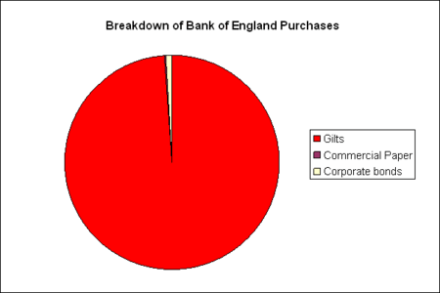
With another £40bn disappearing down the black hole known as the British Banking sector, the financial cost of the economic and banking collapse is now only rivaled by the two World Wars in it’s cost to the UK taxpayer. Rather than going to support credit to business or households, the further £25bn of “newly printed money” announced today is likely to go to help prop up the Government debt mountain.   The above chart shows how the Bank of England has been using quantative easing since March. 98.8 per cent has been used to purchase Gilts. As fast as the Debt Management Office “sells” Gilts to the “market”, the Bank of England shows up and buys them.
Failing to address the banking crisis is hampering recovery

From our UK edition

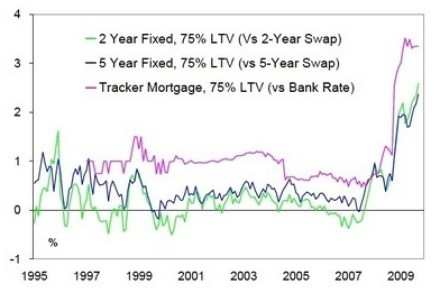
As another £30 billion of taxpayers’ money is handed over to banks, the role of banking sector in the continuing UK recession cannot be understated. 1990s Japan taught the world that developed economies with zombie banking systems don’t grow.  Crippled by bad debts, lending margins on solvent borrowers increase, credit availability declines and ongoing bailouts are needed. This hampers growth in the rest of the economy. The more indebted the private sector, the greater the damage a bust banking system inflicts. The above chart shows how margins on UK mortgages – the gap between borrowing from the Bank of England and what is then leant to mortgage holders – have soared since September last year.

The bills just keep coming in

From our UK edition

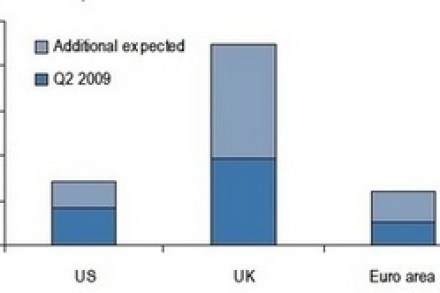
Two years after Northern Rock became the first bank failure of this crisis, another £30 billion of taxpayers’ money needs to be thrown at the banking system. Behind all the noise about improving competition and the European Commission lies one core fact: the UK banks have lost an astonishing sum of money. The above chart shows bank losses as a percentage share of GDP, and illustrates the scale of the crisis that has overwhelmed the banking system and the taxpayer. The IMF estimates that losses could be as high as 25% of UK GDP.   UK banks went on an orgy of lending around the world, becoming the biggest source of credit growth in many countries. RBS trebled its total lending in just three years, expanding its balance sheet to almost 1.5 times the size of the UK economy.

Deconstructing David Blanchflower

From our UK edition

What with his new column in the New Statesman and his articles for other outlets, David Blanchflower – a former member of the MPC – really does seem to enjoy laying into the Tories.  Problem is, much of what he says fails to convince – so much so, in fact, that I thought I'd bash out a quick fisk of his Guardian article from last Friday.  Here's the full article with my comments in bold: We are in the midst of the worst recession most people alive have ever experienced, or will probably ever experience. It is already worse than the 1980s and it isn't over yet. The only comparison is to the 1930s (my parents, now in their 80s, can remember how bad it was).