Marcus Berkmann

Marcus Berkmann’s Berkmann’s Pop Miscellany is out in June.

Sugar rush

From our UK edition

As in real life, it’s considered faintly reprehensible in music to have a sweet tooth. Greens are good for you, and so is The Velvet Underground, but right now I’m thinking about going up to the shop at the end of the road and buying a packet of Maltesers, having just listened to a Take That album. I can’t believe I have just written those words. If you had told me ten years ago that not only would I voluntarily listen to a Take That album in 2008, but that it would also be my own copy, which I had bought with my own money, I think I would have assumed that some form of early-onset dementia was about to take hold.

Aural danger

From our UK edition

The Guardian had an interesting — and, frankly, terrifying — piece the other day by Nick Coleman, the Independent’s long-serving and shamelessly cerebral rock critic. I used to know Nick slightly: we talked drivel on the same radio show for a while a dozen years ago, and he wrote a piece about my first cricket book, in which he described me as ‘faintly posh and indefatigably sunny’, a combination of words that makes my girlfriend fall about to this day. Actually, I liked him a lot: he has an incredibly dry sense of humour and loves music to his core. And a terrible thing has happened to him. Without warning, or apparent reason, he has lost his hearing in one ear.

Truffling around

From our UK edition

Where do you find your music? Yes, I know, you go to the CD rack and there it is. Or, if you are as obsessed as some of us, you go into almost any room in the house and there is a pile of the stuff, because you can’t get rid of any of it, even the long-unplayed mid-period Elvis Costello CDs of everyone’s worst nightmares. But that’s not what I mean. Where do you find your new music, the stuff you haven’t heard before? There’s a vast quantity out there, waiting to be discovered. Where do you go looking for it? If you have very mainstream tastes, of course, you’re fine. The major record labels, although collapsing in a heap around us, persist in launching new artists who they hope will appeal to millions and millions of people.

Reasons to be cheerful | 5 January 2008

From our UK edition

I am an idiot. Last month, in this space, I proffered the usual random selection of favourite albums of the year, not a single one of which had actually been released in 2007, for, like many people (I’d like to think), I can be a little slow on the musical uptake. A day or two after the column had been filed, I was listening to Wilco’s Sky Blue Sky (Nonesuch) for maybe the 78th time when I suddenly thought, ‘Hang on, this came out this year. And it’s as good as anything I’ve heard this year as well.’ Thus proving that I am appreciably slower on a far wider range of uptakes than I had previously suspected. To be fair, though, Wilco’s album could be an easy one to disregard.

Present thoughts

From our UK edition

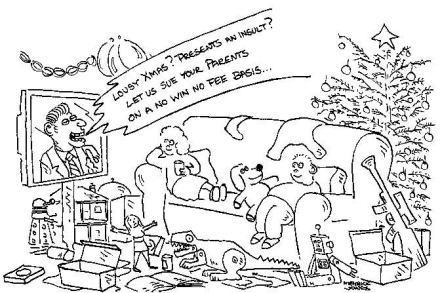
’Tis the season to be cheerful, especially if you like shopping. Which, obviously, as a heterosexual white middle-class male in his forties with no money, I don’t much, unless it’s for books or CDs. But at this time of year those of us of a non-shopping persuasion must bury our prejudices, venture out into the madness of pre-yule consumerism and buy lots of books and CDs for our friends and relatives. Or for ourselves, just to cheer us up. So here are a few seasonal recommendations. Such is the profoundly subjective appeal of all pop music that these recommendations may turn out to be completely useless to you — in which case, I should probably apologise now, just to save time.

Rock’n’roll, drugs and a good roast

From our UK edition

Eric Clapton lost his virginity to ‘a girl called Lucy who was older than me, and whose boyfriend was out of town’. Lucky chap, you immediately think, and indeed, he seems to have lived a charmed life, which he hasn’t enjoyed one bit. ‘Something more profound also happened when I got this guitar. As soon as I got it, I suddenly didn’t want it any more. This was a phenomenon which was to rear its head throughout my life, and cause many difficulties in the future.’ He first saw the Beatles in the audience at the Crawdaddy club in Richmond: ‘I suppose that it was only natural that I would be jealous, and think of them as a bunch of w***ers.

Pause for thought

From our UK edition

With ever longer gaps between albums, it’s becoming difficult to identify which rock stars are just having a quick lie-down, and which are actually missing in action. Retirement: now that is a bold career move. There must be a few old rockers currently eyeing the example of Joni Mitchell, who retired very noisily some years ago, saying she’d had it up to here with the music business, and is now back with a new album, a ballet, a new range of Joni action figures and maybe a fragrance or two to follow. It’s probably more sensible just to ease quietly out of the picture, which at least gives you the option of easing quietly back in again a few years later. In which case, what is going on with David Bowie?

The story behind the story

From our UK edition

And so we enter the Christmas books season, a phase in the publishing calendar so terrifying, so utterly without hope, that more sensitive bookbuyers may wish to hide in second-hand bookshops, or under their beds, until it’s all over. But amidst the piles of useless non-books in Borders and Waterstones, probably right at the back where they think we won’t find them, there will be a handful of genuinely good titles. They may not be very serious books, you may not necessarily buy them for yourself, but if you were given them for Christmas you would be more than pleasantly surprised. You might even read them all the way to the end. Tracking these books down, though, is the challenge. Why Not Catch 21?

Knowing when to stop

From our UK edition

One of the rudest things you can ever say about a pop record is that it’s overproduced. We have all said it at some point in our lives, often before the age of 20, when you must repeatedly demonstrate to your contemporaries that you can hear the subtle differences between, say, Deep Purple and Boney M. In the punk years and afterwards, ‘overproduced’ was often used to describe any record that had been produced at all. In the late 1980s, though, overproduction became the norm. Bands like Tears For Fears were famous for spending weeks perfecting a computerised drum sound, when really a long holiday on a beach somewhere would have done them more good. More recently, overproduced has become a euphemism for ‘this band is using considerable quantities of cocaine’.

Past perfect | 8 September 2007

From our UK edition

I see Squeeze have reformed and are touring again. In fact, there don’t seem to be many bands who haven’t reformed and aren’t touring again. Out there on the road: that’s where the cash is. There seems to be a particular process here. 1. Band splits up in a spirit of mutual enmity and recrimination. 2. Principals embark on solo careers of varying success. 3. World forgets about band. 4. Principals, interviewed in rock press, express undying hatred for each other. 5. Accountant has quiet word in ear. 6. Fifty-date world tour is announced. It’s strange to think that, 20 years or so ago, bands toured to promote the record. Now they make a record to promote the tour. Is anyone really interested in a new Rolling Stones album?

Perils of Poddery

From our UK edition

Oh, to be an Early Adopter. They are the marketing man’s friends. Oh, to be an Early Adopter. They are the marketing man’s friends. Early Adopters buy only the latest thing, they are up to the minute, maybe even up to the second, these crazed opinion-formers whose reckless compulsion to spend all their money on rubbish keeps the global economy ticking over. You can’t compete with an Early Adopter, and who would want to? Myself, I am a Late Adopter. I don’t own a mobile phone, I can’t drive and I only acquired a DVD player last Christmas. (And didn’t plug it in for six weeks.) In July it was my birthday. What did I want? An iPod, of course.

People power | 14 July 2007

From our UK edition

If this column has any overarching theme, it’s that critics know nothing and shouldn’t be trusted. (Which obviously applies to me as much as to anyone.) But this intransigent suspicion of mine does create difficulties. In the never-ending search for the next fantastic record I didn’t know existed, I will look anywhere and consult anyone for advice, which in practice often means scouring the reviews by punters on Amazon. Book reviews on this website, as all writers know, are usually contributed by our friends, our rivals, our enemies and our agents, but the record reviews are much more varied and informative.

The birth of structuralism

From our UK edition

Of all the sciences and pseudo-sciences that clamour for our attention, none is a tougher sell than pure mathematics. The British have never been noticeably keen on abstraction, but there’s something about algebra, analysis and, indeed, topological vector spaces that sends even the calmest and cleverest of us reaching for the gin. I think this is because each of us, bar the truly gifted, reaches a point with maths when we simply don’t get it. It may be the seven times table, it may be differential equations or differential calculus, and for me it was classical mechanics in my first year at university, but there it goes — whoosh! — straight over your head. After that lie only incomprehension and frustration, or in my case a Third.

Staying cool

From our UK edition

It’s always a problem, comparing a new band with others who have gone before. Critics have to do it, defining the new in terms of the old, because there has to be some way of describing the indescribable. But I can’t tell you how many times I’ve been caught, having read somewhere that someone was the new Squeeze or XTC or Nick Drake or Electric Light Orchestra or any of several others. Gullible fool that I am, I believe every word. You buy the CD without pausing to listen to the little 30-second snippet of each song they offer you on Amazon (because you know they never sound right and will only put you off), the CD arrives, you tear it open in a frenzy and it’s just the usual underwritten indie sludge that sounds a bit like The Velvet Underground.

Facing the music

From our UK edition

The Spectator’s pop critic looks back on 20 years It suddenly occurs to me, with a jolt, that I have been writing about pop music for The Spectator for 20 years. This makes me the fifth (or possibly sixth, since I am bound to have forgotten someone) longest continuously serving columnist on the magazine, which isn’t bad going, as one or two columnists I know have been carried out of here feet first, promising to file their next one by Tuesday lunchtime with their last worldly breath. It’s all the more bizarre as it stems from something said a quarter of a century ago by a friend of mine called Peter, who these days doubles as a highly respected indie rock guitarist and a rather more louche publisher of philosophy books.

Broadening the vision

From our UK edition

‘Popular science’: for some readers this remains a problematic category. I’m sure proper scientists look askance at civilians reading such books on public transport, imagining their own abstruse specialities dumbed down for the hard-of-thinking. And the vast mass of arts graduates, who hate and fear science, remembering the bad trousers and unfortunate hairstyles of science undergraduates in their day, happily admit that they know nothing of the subject and understand even less. Some people I know have been boasting for nearly 20 years that they gave up A Brief History of Time before the end. It’s all too sad for words. Stephen Hawking, though, has much to answer for.

Follow your muse

From our UK edition

How pleasant it has been to hear songs from the new Norah Jones album on the radio these past few weeks. Soft, deftly performed, vaguely jazzy in that way that everyone likes, these latest songs sound almost completely indistinguishable from the songs on her first two albums. And why not? Those first two albums sold 31 million copies between them. She might have recorded a thrash-metal album this time round, or a symphony for banjo and orchestra, but fortunately for EMI, whose share price depends almost wholly on the performance of this record, Norah has her shtick and she has stuck with it. Each new song wafts through your head like a warm summer breeze after half a bottle of wine on an empty stomach, and when it ends you suddenly wake up, feeling a bit sick.

Who said what and when

From our UK edition

‘Those who can, write. Those who can’t, quote.’ Well, I’m sure someone has said it, although I have just looked it up in these two vast, baggy new books of quotations and it’s not there. Truth is, the great English tradition of hurling quotations at other people to show how clever you are seems to have disappeared over the past couple of generations. Instead we have books of quotations; indeed I seem to have rather a lot of them, mainly because I have a tendency to wander into bookshops after a long lunch. Surely no one buys a book of quotations when sober. They are books you want but don’t need; later on you realise you need them but shouldn’t have them.

For portly old hippies

From our UK edition

I have been listening a lot to David Gilmour’s album, On An Island (EMI). We must now call him David, as he is a portly gent of a certain age who will probably get a knighthood the next time a Pink Floyd fan moves into No. 10. Obviously, though, we think of him as Dave, just as Jimmy Page will never be James Page and Robbie Williams will be Robbie Williams when he’s 95 and gaga. Many reviewers objected to the Dave...sorry, David Gilmour record because it’s unmistakably autumnal in theme and texture. The songs are quieter and slower, in the main, than even Pink Floyd fans are accustomed to, although they are also much more direct, and I believe it’s by some distance the best album to emerge from the extended Floyd family since The Wall, a mere 27 years ago.

Making sense of crazy times

From our UK edition

This is a huge book. Crikey, it’s a whopper. It’s impossible not to won- der, as you hold it in your hands and try your damnedest not to drop it on your foot, whether its author, for all his fame and eminence, is quite worth all this ink, paper, attention. And this is just the first volume. If, as seems reasonable to assume, several more collections are plan-ned, we could well end up with four such breezeblocks, between them covering 40 years of Michael Palin’s public and private life. It could take nearly as long to read them. Nonetheless, to comedy obsessives of a certain age, Palin remains an intriguing figure. The best actor of the six Pythons, and the peacemaker in the group, he has also enjoyed the most successful career after and apart from Python.