Luke McShane

Luke McShane is chess columnist for The Spectator.

No. 823

From our UK edition

Black to play. Dominguez-Shankland, US Championship 2024. Which move allows Black to escape perpetual check and win? Email answers to chess@spectator.co.uk by Monday 21 October. There is a prize of £20 for the first correct answer out of a hat. Please include an address and allow six weeks for prize delivery. Last week’s solution 1…Kd3! 2 f7 c2 3 Kb2 Kd2 4 f8=Q c1=Q+ gives Black a big advantage. 1…b2+? loses to 2 Kc2 as did 1…c2? 2 Kd2!

Rushed finish

From our UK edition

There’s a piece of chess clickbait which occurs with tiresome regularity. The players are deep in the endgame, but have so little time remaining that the game cannot be concluded with dignity. Pieces land in between squares, or get dropped and clatter across the board. In their final seconds, players will attempt to move before their opponent has completed their own move, which is just as farcical as it sounds. One should not blame the players: against a well-matched opponent, such situations are inevitable from time to time. The arbiters sometimes get flak for not intervening, but in the heat of the moment, nobody knows if a rook landed cleanly on a8 or just outside the lines, and interrupting the game to check would do nothing to improve matters.

No. 822

From our UK edition

Black to play. Mamedyarov-Maghsoodloo, Global Chess League, October 2024. Maghsoodloo chose wrongly here. Out of 1…Kd3, 1…b2+ and 1…c2, which one is the best? Answers should be emailed to chess@spectator.co.uk by Monday 14 October. There is a prize of £20 for the first correct answer out of a hat. Please include a postal address and allow six weeks for prize delivery.

Imminent disaster

From our UK edition

Mistakes in chess come in pairs. Last month, and not for the first time, that nugget of wisdom thumped me on the nose. Representing England at the Olympiad in Budapest, my game against Luca Moroni was proceeding rather pleasantly. It was clear the Italian grandmaster had underestimated my sacrifice of rook for bishop in the middlegame, and I was about to recover my material investment with interest. Alas, my return was diminished by an elementary tactical oversight, missing the move 25 Na4xb6 (see first diagram). No matter – I was still a pawn to the good. I moved my rook which was under attack, and he responded in the obvious way. One minor hiccup need not derail an otherwise agreeable game. Oblivious to any danger, my crude blunder on the very next move allowed 27 Nb3xa5.

No. 821

From our UK edition

White to play. Ciolacu-Khotenashvili, Fide Women’s Olympiad, Budapest, September 2024. How did White crown her kingside attack? Email answers to chess@spectator.co.uk by Monday 7 October. There is a prize of £20 for the first correct answer out of a hat. Please include a postal address and allow six weeks for prize delivery. Last week’s solution 1 Rxe7! Rxe7 2 Qd5+!

No. 820

From our UK edition

White to play. Kulaots-Kadric, Budapest Olympiad, September 2024. The Estonian grandmaster spotted a neat sequence to gain a decisive material advantage. What was his first move here? Email answers to chess@spectator.co.uk by Monday 30 September. There is a prize of £20 for the first correct answer out of a hat. Please include a postal address and allow six weeks for prize delivery.

Double gold for India

From our UK edition

The Gaprindashvili Cup, named after the Georgian former women’s world champion Nona Gaprindashvili, is awarded at the biennial Chess Olympiad to the country with the highest total standings between the open and women’s events. In Chennai in 2022, that honour went to India, who won the bronze medals in both sections. The 45th Chess Olympiad, which concluded last weekend in Budapest, saw Indian teams surpass themselves, winning gold in both events. Their victory in the open section was all but secured with one round to spare, and featured stratospheric individual performances from Dommaraju Gukesh and Arjun Erigaisi (aged 18 and 21 respectively).

Problem solved

From our UK edition

When I select puzzles to accompany this column, I stick to the plain vanilla. The stipulation must be short and sweet, and one move solutions must be accepted (though I like to include a few further words of explanation). Alas, a thousand such puzzles can never do justice to the wondrous ingenuity of chess composers. Longer mating problems and ‘studies’ (where the objective is to find a winning or drawing sequence) allow considerably more artistic scope. Then there are genres which maintain the rules of movement but subvert the players’ objectives. Those include helpmates (in which both sides choreograph their moves to engineer a checkmate) and selfmates (in which one side attempts to force the other to deliver checkmate).

No. 819

From our UK edition

Le-Sindarov, Budapest Olympiad, September 2024. White’s next move induced immediate resignation. What did he play? Answers should be emailed to chess@spectator.co.uk by Monday 23 September. There is a prize of £20 for the first correct answer out of a hat. Please include a postal address and allow six weeks for prize delivery. Last week’s solution 1 Qf6+!

Speed bumps

From our UK edition

‘I don’t think it will be decided on the chessboard… I broke him in the Sinquefield Cup… as long as I can look him in the eyes and understand that there is absolutely nothing he can do to even enter my mind space then I believe that victory will be mine.’ Thus spake Hans Niemann in a recent interview with the YouTuber Levy Rozman (aka GothamChess), referencing the notorious game in which he beat Magnus Carlsen in St Louis two years ago. He was anticipating his clash against Carlsen in the semi-final of the Chess.com Speed Chess Championship, which took place in Paris last week. Niemann’s bombast proved premature. Carlsen won with a convincing 17.5-12.

No. 818

From our UK edition

White to play. Niemann-Nakamura, Chess.com Speed Chess, Paris 2024. In this game from the third-place playoff match, Niemann crowned his attack in style. Which move did he play? Email answers to chess@spectator.co.uk by Monday 16 September. There is a prize of £20 for the first correct answer out of a hat. Please include a postal address and allow six weeks for prize delivery. Last week’s solution 1 Rf2! Depending on Black’s response, it’s 2 Bb6# or 2 Bf6#.

Too much and not enough

From our UK edition

Polishing an opening repertoire is essential for top chess players, who must have variations prepared to meet all the standard openings. Those may be selected on grounds of stylistic appeal or rarity, hoping to catch an opponent off-guard. There are standard responses in turn, and a well-prepared player will have counter-ideas locked and loaded. Vast trees of chess analysis are stored in databases on their laptops and swapped over the internet. If you have money, you can buy books or online courses in which grandmasters share their ideas. If you have time, you can turn on a powerful chess engine (such as Stockfish) and craft your own. The problem is that putting it on your computer is not the same as putting it between your ears.

No. 817

From our UK edition

White to play and mate in two moves. Composed by Dmitry Vasilevich Klark, La Stratégie, 1868. Answers should be emailed to chess@spectator.co.uk by Monday 9 September. There is a prize of £20 for the first correct answer out of a hat. Please include a postal address and allow six weeks for prize delivery. Last week’s solution 1 Rd5! b1=Q 2 Ra5+ Qxa5 3 Qxa5 Kb8 4 Qd8+ with a draw by perpetual check. Other moves are no better, e.g. 1…Ka6 2 Qa8+ etc.

Marathon

From our UK edition

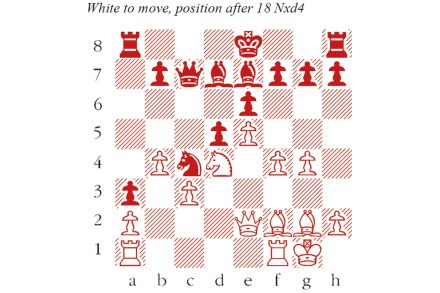
Earlier this month, at the Kingston Invitational, Peter Lalic won a game against 12-year-old Billy Fellowes in 272 moves. Published in full, it would take up most of this article and resemble a cryptographic message more than a game of chess. But it earns a place in the record books as the longest over-the-board game in history, eclipsing the game Nikolic-Arsovic, Belgrade 1989, which was agreed drawn after 269 moves. Billy Fellowes-Peter Lalic Kingston Invitational, August 2024 The first diagram, at move 18, sets the scene. With more space to manoeuvre, Black holds a clear strategical advantage.

No. 816

From our UK edition

White to play. Caruana-Firouzja, Sinquefield Cup, 2024. Caruana exchanged rooks, but soon ran out of checks and resigned before the b2 pawn could promote. Which move would have secured a draw here? Email answers to chess@spectator.co.uk by Monday 2 September. There is a prize of £20 for the first correct answer out of a hat. Please include a postal address. Last week’s solution 1 Qh8+!

Hans Niemann against the World

From our UK edition

For the irrepressible Hans Niemann, August is no time to chill. The 21-year-old American grandmaster began the month by defeating his compatriot Wesley So by 13-10 in the quarter-final of the Chess.com Speed Chess Championship. He gave a vitriolic interview after the match, railing against the ‘chess establishment’ and those he perceives as trying to ruin his career. Evidently, his relations with Chess.com, Magnus Carlsen and others have hardly thawed since last year’s conclusion of their legal dispute which arose in response to unsubstantiated cheating allegations after Niemann’s win against Carlsen at the Sinquefield Cup in 2022. ‘America’s brightest talent’ (by his own description), has complained of a lack of invitations to top-tier events.

No. 815

From our UK edition

White to play. Maghsoodloo-Nepomniachtchi, Fide World Rapid Team Championship, 2024. Maghsoodloo found a beautiful winning sequence here. What was his first move? Email answers to chess@spectator.co.uk by Monday 26 August. There is a prize of £20 for the first correct answer out of a hat. Please include a postal address and allow six weeks for prize delivery. Last week’s solution 1…Qf3+!

The depraved world of chess cheats

From our UK edition

Amina Abakarova, a 40-year-old chess player from Russia, supposedly tried to poison a younger rival at the Dagestan Chess Championship this month. Camera footage seems to show her furtively applying a substance to one side of a chess board before the start of the game. Her opponent later became unwell and a Russian news agency claimed that the substance contained mercury. I first saw the story on one of the many specialist chess news sites. Within 48 hours it was in most national newspapers. Two types of chess stories pop up time and again. First, the ones about child prodigies, which tend towards the formulaic – I know because they used to publish them about me in the 1990s.

Grandmaster Royal

From our UK edition

The British Championships, which concluded in Hull earlier this month, saw a notable achievement for 15-year-old Shreyas Royal, whose stellar performance was his third and final qualifying result to earn him the grandmaster title. He becomes the youngest British player to reach that milestone, beating David Howell’s record which had held since 2007 (and before that, my own!). Royal’s win against Howell was one of the best games of the event, although the Alexander Best Game Prize (named for C.H.O’D. Alexander, the Bletchley Park codebreaker and Spectator chess columnist) was awarded to Howell, for the precision in his endgame against Ameet Ghasi.

No. 814

From our UK edition

Black to play. Vidit-Al-Mudahka, Fide World Rapid Team Championship, 2024. The Qatari grandmaster landed a decisive blow here. What did he play? Email answers tochess@spectator.co.uk by Monday 19 August. There is a prize of £20 for the first correct answer out of a hat. Please include a postal address and allow six weeks for prize delivery. Last week’s solution 1 Nd5!