Luke McShane

Luke McShane is chess columnist for The Spectator.

no. 590

From our UK edition

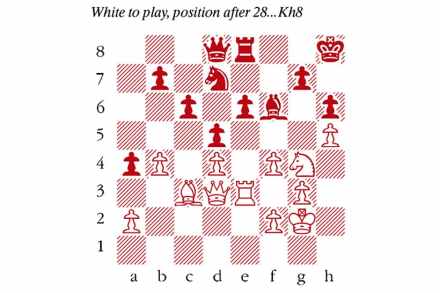
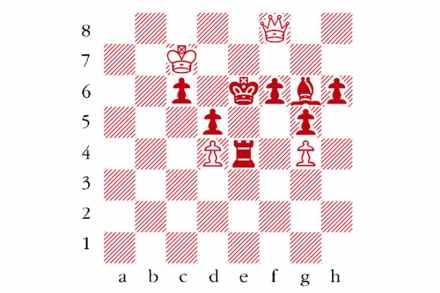
Black to move, Paravyan vs McShane, Isle of Man 2019. Here I intended 49…Bxd1. What had Paravyan planned after that move? Answers should be sent to ‘Chess’ at The Spectator by Tuesday 11 February or via email to victoria@spectator.co.uk. There is a prize of £20 for the first correct answer out of a hat. Please include a postal address and allow six weeks for prize delivery.   Last week’s solution 1…Rf3+! 2 Kxe4 Rxf7! wins.
no. 589

From our UK edition

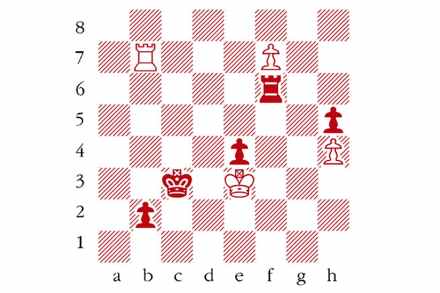
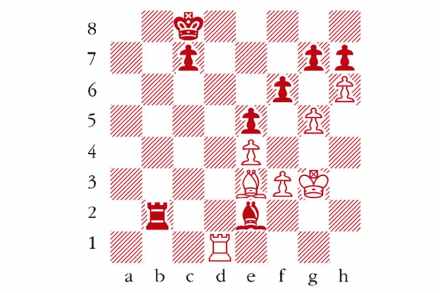
Black to move. Javakhishvili–Adams, Gibraltar 2020. Adams has a few plausible moves here, including Rf1, Rf3+ and Rxf7, but only one of them wins. Which is the right one? Answers should be sent to ‘Chess’ at The Spectator by Tuesday 4 February or via email to victoria@spectator.co.uk. There is a prize of £20 for the first correct answer out of a hat. Please include a postal address and allow six weeks for prize delivery.   Last week’s solution 1 Ng1! keeps everything secure. 1… Bg5 2 exd6 with a decisive advantage.

Women’s World Championship

From our UK edition

Looking at the first 12 games of the 2018 Carlsen-Caruana World Championship, which all ended in draws, I saw a statistical blip where others saw an ossified match format and the death of classical chess. But nobody could decry the drama at this year’s Women’s World Championship, in which reigning champion Ju Wenjun from China saw off a fierce challenge from 21-year-old Russian Aleksandra Goryachkina.   The early games saw Goryachkina willing to engage in protracted battles, but it was Ju who got the first win from a tricky queen ending in the fourth game. Undeterred, Goryachkina struck back immediately, and went on to take the lead herself in the eighth game. Ju was rewarded for several bold decisions in the ninth, leaving the scores level.

More than a game

From our UK edition

Cars, computers and cadavers: taking them apart is normally reserved for experts and the pathologically curious. In his new book, The Moves that Matter, Jonathan Rowson takes a scalpel to the game of chess itself, and finds abundant meaning in its cultural, psychological and metaphorical aspects. Or as he puts it: ‘Chess is just a game in the way that the heart is just a muscle.’ It’s ambitious stuff, but we’re in good hands. Dr Rowson is a three-time British champion (2004-2006), writer, philosopher and co-founder of Perspectiva, a research institute that examines the relationship between complex global challenges and the inner lives of human beings.   The Moves that Matter is unusual in that Rowson has written a chess book with a general audience in mind.

no. 588

From our UK edition

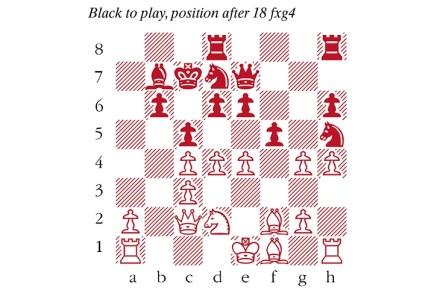
Rowson-Yermolinsky, World Open 2002. This position arose after a tactical skirmish. White has only one good way to meet the threat to the rook, which had to be seen well in advance. What is it? Answers should be sent to ‘Chess’ at The Spectator by Tuesday 28 February or via email to victoria@spectator.co.uk. There is a prize of £20 for the first correct answer out of a hat. Please include a postal address and allow six weeks for prize delivery.   Last week’s solution 1 Qg8+!

no. 587

From our UK edition

Sanguineti–Najdorf, Mar del Plata 1956. White to move. White played 1 Kd8?, to threaten 2 Qe7#. Black resigned, overlooking 1…Rxg4 to prepare Ke6-f5. White should have chosen a queen check instead. Which one? Answers by Tuesday 21 January to ‘Chess’ at The Spectator or victoria@-spectator.co.uk. There is a prize of £20 for the first correct answer out of a hat. Please include a postal address and allow six weeks for prize delivery.   Last week’s solution 1 Rxh7+! Kxh7 2 Qh5+ Kg8 3 Ne7 mate.

12 rules for chess

From our UK edition

As backhanded Christmas gifts go, a copy of 12 Rules for Life, must be up there with wrinkle cream or a nose-hair trimmer. One generous soul decided that Jordan Peterson’s bracing self-help book, published two years ago, was just the tonic I need to improve my life and character.   Who knows what advice to take, when feedback from the game of life is so wickedly fuzzy? Most decisions are inconsequential, and some which look good will come back to haunt you. But in the game of kings, results are unambiguous: win, lose or draw, and then you get reincarnated. So in the spirit of January resolutions, this is how those dozen rules might apply to chess.   1. Stand up straight with your shoulders back. A good start: sit up straight at the board.

chess-110120

From our UK edition

‘Every day is different’, people like to say about their jobs. For the world’s best chess players, that’s only partly true. The game will be different, but the day will look much the same, and so will the international hotel room. In fact, professional players love a routine: they keep their energy for the game, not on deciding where to eat. That monastic focus can’t be taken for granted, especially when you’ve already achieved the highest goals. When Vladimir Kramnik, the former world champion who defeated Garry Kasparov in London in 2000, announced his retirement from chess last year, he put it down to a drop in motivation. The results of his games had stopped mattering quite so much to him.

no. 586

From our UK edition

Carlsen–Nakamura, December 2019. In the decisive playoff game, Carlsen played 1 Nxf7+ and won quickly. But there was a mate in 3 available. What is the first move? Answers should be sent to ‘Chess’ at The Spectator by Tuesday 14 January or via email to victoria@spectator.co.uk. There is a prize of £20 for the first correct answer out of a hat. Please include a postal address and allow six weeks for prize delivery. Last week’s solution 1…Qd5! (idea Qxg2#) 2 Qxd5 Rxf1+ 3 Kh2 Nxd5 4 Bxd5 d3 wins.

no. 585

From our UK edition

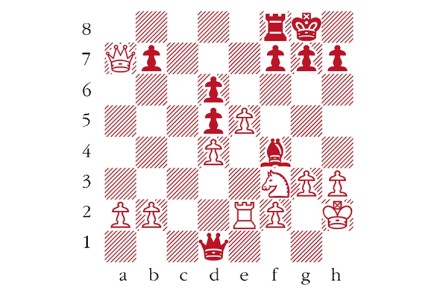
Black to play. Ilfeld & Vachier-Lagrave–Picot & McShane. Pro-Biz Cup, London 2019. My move. White threatens checkmate with Qc4-g8, so I exchanged rooks on f1 to divert the queen. We won in the end, but what would have been a stronger move? Answers to ‘Chess’ at The Spectator by Tuesday 7 January or via email to victoria@-spectator.co.uk. There is a prize of £20 for the first correct answer out of a hat. Please include a postal address and allow six weeks for prize delivery.   Last week’s solution 1 Qe7! threatens mate on h4. 1…Rxg3+ 2 hxg3 g5 3 Qxh7+ Kg4 4 Qh3 mate.

A multitude of contests

From our UK edition

Besides the Grand Chess Tour final, an abundance of chess was played at this year’s London Chess Classic. More than 2,000 children visited the festival, which was organised by the charity Chess in Schools and Communities. Fittingly, two talented youngsters shared first place in the Fide Open event — 14-year-old Rameshbabu Praggnanandhaa from India and 18-year-old Anton Smirnov, from Australia.   Michael Adams added another title to his collection by winning the British Knockout Championship. He had a close shave in the quarter finals, narrowly surviving an Armageddon game against the promising young player Marcus Harvey, who sailed through a qualifying tournament with 8.5/9 the previous day.

no. 584

From our UK edition

White to play. Aronian–Carlsen, December 2019. Carlsen won the third-place playoff, but Aronian found a nice finish in this game. What move prompted Carlsen’s resignation? We regret that owing to print deadlines this is not a prize competition.   Last week’s solution  1…Qa7!! wins, as 2 Bxa7 Rxg2+ 3 Kh1 Rxh2+ 4 Kg1 Rag2 is mate.

Ding’s wings

From our UK edition

Ding Liren, from China, was a convincing winner of the 2019 Grand Chess Tour, which reached its climax in London last weekend. The Grand Chess Tour Finals, a four-player knockout, was the flagship event at this year’s London Chess Classic. The match format was a blend of classical (slow), rapid and blitz games. Although the slower games held more weight in the scoring, the very inclusion of faster time limits reflects their increased status in the modern game.   The first semi-final, between Magnus Carlsen and Maxime Vachier-Lagrave, went to a tiebreak. The Frenchman won a topsy-turvy game in his beloved Najdorf Sicilian, as Carlsen went astray amid wild complications. In the second semi-final match Ding defeated Levon Aronian with a dominant performance in the rapid games.

no. 583

From our UK edition

Black to play. This is a variation from McShane–Van Foreest, Bundesliga, November 2019. I avoided this position, and the game was later drawn. What move for Black was I afraid of? Answers via email to victoria@spectator.co.uk by Monday 9 December. There is a prize of £20 for the first correct answer out of a hat. Please include a postal address and allow six weeks for prize delivery.   Last week’s solution 1… Bg3+!

The Saric Supremacy

From our UK edition

There is a gritty fight scene in The Bourne Supremacy, in which Jason Bourne (played by Matt Damon) faces down his adversary Jarda at an apartment in Munich. Both men are skilled assassins, but they aren’t wielding their weapons of choice. The villain’s hands are tied, but he lands the first blow with his elbows. He somehow turns up a kitchen knife, and frees his wrists on some shattered glass furniture. Bourne rolls up a magazine and you know he could kill with it. You wish someone would answer the shrieking telephone. They’re soon back to bare knuckles and slamming into the tables. At last, Bourne throttles him with an electric power cord, and the audience breathes a sigh of relief.

no. 582

From our UK edition

Black to play. Zelcic–Melkumyan, Tournament of Peace, November 2019. Melkumyan enjoys a big endgame advantage, and he found a cute way to finish the game off. What did he play? Answers to ‘Chess’ at The Spectator by Tuesday 3 December or via email to victoria@spectator.co.uk. There is a prize of £20 for the first correct answer out of a hat. Please include a postal address.   Last week’s solution 61…Rg6! 62 d7 Black plays 62…Kf5! 63 d8=Q Rh6+!

A good year for Carlsen

From our UK edition

Magnus Carlsen is the star attraction at this year’s London Chess Classic. The festival, now in its 11th edition, runs from 29 November to 8 December at the Olympia Conference Centre in Kensington. The World Champion will play in the final leg of the Grand Chess Tour, in a four-player knockout event with a $350,000 prize fund which begins on Monday 2 December. He will be joined by Ding Liren, Levon Aronian and Maxime Vachier-Lagrave.   ‘The Classic’ as the festival is affectionately known, features a wide variety of events, including a Fide-rated Open tournament, weekend events, and a ‘Super Blitz Open’ on the final Sunday.

no. 581

From our UK edition

Bagi–Zvjaginsev, Montenegro 2019. Black to play. 61... Ke6 looks obvious, but Zvjaginsev preferred 61... Rg6! and White resigned instead of playing 62 d7. What had both players foreseen? Answers to ‘Chess’ at The Spectator by Tuesday 26 November or via email to victoria@spectator.co.uk. There is a prize of £20 for the first correct answer out of a hat. Please include a postal address and allow six weeks for prize delivery.   Last week’s solution 1 Bb3! threatens Qc6-a4#. (1…Bd7 2 Qc1+ Kxb3 3 Qc2+ Ka3 4 Qa2 mate.

A fresh approach

From our UK edition

Reimagine democracy. Reimagine capitalism. Reimagine education. For all the reimagining thrown at big ideas, they don’t seem much perturbed. You can reimagine a problem too, but it probably won’t be fruitful. It won’t help you find the end of the Sellotape, or balance the books (unless you worked for Enron).   But some problems really are amenable to a fresh perspective. According to legend, the mathematician Carl Friedrich Gauss was tasked at primary school with adding up the numbers from 1 to 100. The obvious approach is (to quote the King of Hearts from Alice in Wonderland) ‘Begin at the beginning, and go on till you come to the end: then stop.’ Gauss saw the problem in a different light.

no. 580

From our UK edition

Dubov-Svane, White to play. Later in the event, Dubov played another masterpiece, sacrificing a rook to reach this extraordinary position. It takes one more delicate sacrifice to conclude the attack. Which one? Answers to ‘Chess’ at The Spectator by Tuesday 19 November or via email to victoria@spectator.co.uk. There is a prize of £20 for the first correct answer out of a hat. Please include a postal address and allow six weeks for prize delivery.   Last week’s solution 1…Rxe6!