Lucy Vickery

Competition: Cooking the books

From our UK edition

In Competition No. 2743 you were invited to submit a recipe as it might have been written by an author of your choice. Kafka’s Soup, a complete history of world literature in 14 recipes by Mark Crick gave me the idea for this challenge. It contains such gastronomic delights as Cheese on Toast à la Harold Pinter and Fenkata à la Homer and is a masterclass in literary impersonation. You gave Mr Crick a run for his money. This was another cracking entry and competition was stiff for the top spots. Commendations to unlucky losers Alannah Blake, Frank Osen and W.J. Webster. The winners are printed below and are rewarded with  £25 each. Mike Morrison pockets the bonus fiver.

Competition: Eastertide

From our UK edition

In Competition No. 2742 you were invited to take as your first line ‘Dear Lord the day of eggs is here...’, which is the opening to Amanda McKittrick Ros’s poem ‘Eastertide’, and continue, in a similarly bad vein, for up to 16 lines. Described in the Oxford Companion to Irish Literature as ‘uniquely dreadful’, McKittrick Ros, who died in 1939, nonetheless boasted devotees among the literary elite. Aldous Huxley wrote an essay on her extraordinary use of language, highlights of which include ‘globes of glare’ (eyes), ‘bony supports’ (legs) and ‘southern necessary’ (pants). Congratulations, all round. It was a magnificent entry and there are too many honourable mentions to list individually.

Competition: Town lines

From our UK edition

In Competition No. 2741 you were invited to submit an extract from the libretto of an opera that pays homage to the town of your choice. The Lottery-funded operatic venture Swindon: the Opera, which inspired the comp, catapulted that unlovely town into the cultural spotlight, and this assignment was meant to be an exercise in doing the same thing for other, unfairly perhaps, mocked parts of the country. But as I didn’t make that clear enough in my brief, Aldeburgh and London share the stage with Milton Keynes and Walthamstow in the winning line-up below. Susan Therkelsen’s Woking, Janet Kenny’s Lewes, Chris O’Carroll’s Bognor and Josh Ekroy’s Guildford were unlucky losers. The victors nab £30 and Noel Petty takes the bonus fiver.

Competition: Second thoughts

From our UK edition

In Competition No. 2739 you were invited to submit a poem lamenting an impulse buy on eBay. A hair from Justin Bieber’s chest; a colossal concrete brontosaurus; a lifesize poster of Albert Einstein; Franz Kafka’s shirt (with an authenticating Post-it note by Max Brod). These were just a few of the regrettable but hugely entertaining online purchases that featured in a large and lively entry. Honourable mentions go to Shirley Curran, Mae Scanlan, Gerard Benson and Melissa Balmain. I also liked W.J. Webster’s eBay Blues: ‘Woke up this morning, heard a click inside my head....’ Chris O’Carroll’s magnificent all-singing, all-flopping wall-mounted rubber bass narrowly lost out to Brian Allgar, who nabs the extra fiver.

Competition: Hard sell

From our UK edition

In Competition No. 2738 you were invited to concoct a government ad that bravely attempts to attract applicants to an especially unappealing job of your invention. Some time ago a reader brought to my attention an ad for the position of ‘Band 3 Process Developers in the VOA2015 Process Team’. Such was its mind-boggling impenetrability (‘The VOA2015 Programme is redesigning the Agency’s processes to create a simplified process model that will better support the new structure of the Agency as it moves into Business Streams...’) that it brought me to wondering who would conceivably apply for such a job and whether the ad could perhaps have been written in a more beguiling way — which is where you come in. Derek Morgan gets the extra fiver.

Competition: Double dactyl

From our UK edition

In Competition No. 2737 you were invited to submit a double dactyl. This popular and, judging by the size of the entry, extraordinarily compulsive poetic parlour game was invented in the Sixties by the celebrated poets Anthony Hecht and John Hollander and is described in the blurb of Jiggery-Pokery, their magnificent compendium of the form, as a ‘devilish amalgam of rhyme, meter, name-dropping and pure nonsense’. The challenge generated a quirky parade of double-dactylic notables. I especially liked Bill Greenwell’s double dactyl as it might have been written by that mangler of meter William McGonagall; commendations, too, to Mike Morrison, Luci Thomas, Christopher Greening, Roger Munson, Alannah Blake and Penelope Mackie.

Competition: Funny valentine

From our UK edition

In Competition No. 2735 you were invited to take as your first line ‘My love is like a [fill in blank]’, and continue, in light verse. Amid the ailments — ‘a drippy nose’, ‘a whooping cough’; the animals — ‘a three-toed sloth’, ‘a sea urchin’; and foodstuffs galore: ‘ripe Gorgonzola’, ‘ a tub of lard’, ‘a rack of ribs’, Bridget Rees’s inventive opening impressed: ‘My love is like a — do you know,/ I don’t know what he’s like!/ I thought I knew for twenty years/ And then he took a hike...’ Honourable mentions, too, to Max Ross and Adam Campbell. The winners get £25 each. Basil Ransome-Davies nets £30.

The Wow factor

From our UK edition

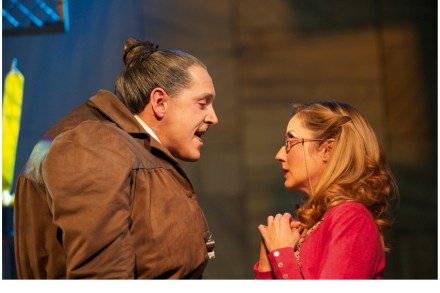
Next month, a formidable band of women will take to the stage at the Southbank Centre for the Women of the World Festival, now in its second year. The line-up includes veteran Annie Lennox, who will perform with rising stars Katy B, Jess Mills, and Brit Award winner Emeli Sandé as part of an eclectic menu of music, comedy, poetry, debates and workshops that cover topics ranging from domestic violence to vajazzling. But if Eighties icons and trends in personal grooming leave you cold, there is plenty more on offer. Top of my list is Irish actress Lisa Dwan’s (above) adaptation as a one-woman play of Beside the Sea, a French novella by Véronique Olmi (published in an award-winning English translation by Peirene Press).

Competition: Mixing it

From our UK edition

In Competition No. 2734 you were invited to provide anagrams of lines from Shakespearean sonnets. These assignments are not the most popular but every so often the urge to send you to anagram hell gets the better of me. ‘I found this competition exasperatingly difficult,’ wrote Josephine Boyle. Equally exasperated, it seems, was Basil Ransome-Davies, whose email subject line read: ‘Everlasting fire for this one’. Shirley Curran expressed her frustration anagrammatically: It is rather gawky to reinvent bards! (It is the star to every wand’ring bark). While W.J. Webster injected a refreshing note of cheeriness: ‘Lovely competition! Two Scrabble sets and a laptray — the insomniac’s dream!’ But I am not alone in inflicting such torture.

Competition: Distilling Dickens

From our UK edition

In Competition No. 2733 you were invited to condense the plot of a Dickens novel into a triple limerick. In case you hadn’t noticed, it would have been Dickens’s 200th birthday this week, and this assignment is a modest contribution to the avalanche of Dickens-related events unleashed across the globe by the bicentenary. (Even estate agents have jumped on the bandwagon: ‘Dickens Mania Brings sales boost to Victorian Homes in the Capital’.) The challenge attracted an enormous and impressive postbag. Well done, one and all. It is a tall order to boil down the great man’s works to 15 lines, and you didn’t shy away from the especially densely plotted doorstops such as Bleak House and Our Mutual Friend.

Competition: Seeking closure

From our UK edition

In Competition No. 2732 you were invited to submit a comically appalling final paragraph to the worst of all possible novels. This challenge is a twist on the magnificent annual Bulwer-Lytton contest, which salutes the memory of the 19th-century writer Edward Bulwer-Lytton, author of the much-parodied opening: ‘It was a dark and stormy night…’ Entrants are invited to come up with deliberately dreadful openings to imaginary novels. It was a most enjoyable competition to judge. I was entertained by some truly vile abuses of the English language, the best-worst of which appear below and earn their authors £25 apiece. Dishonourable mentions to Charles Chadwick, Adam Campbell, R.S. Gwynn, W.J. Webster and Katie Mallett. The bonus fiver goes to Basil Ransome-Davies.

Competition: Pause and effect

From our UK edition

In Competition No. 2731 you were invited to supply a poem in praise of punctuation. An excellent entry, this. Space is tight and I very much regretted not having room for Alan Millard, David Duncan Jones and Frank Osen in addition to the worthy winners below. The bonus fiver belongs to Basil Ransome-Davies. The rest pocket £25. I dallied with a comma whose cute curves had made me pause And catch my breath, if only for a second, But she’d a wild obsession with an adjectival clause Whose charismatic syntax always beckoned. My rebound squeeze, a semi-colon eager to be kissed, Proved versatile, a mark of many talents. She had the power to subdivide a rather lengthy list Or function as the pivot of a balance. And did I stop there? No!

Competition: This be the reverse

From our UK edition

In Competition No. 2730 you were invited to supply a refutation in verse of Philip Larkin’s assertion ‘They fuck you up, your mum and dad’. ‘This Be The Verse’ may not be Larkin’s finest poem but it is certainly his best-known and most oft-quoted (he himself wryly commented that he fully expected to hear it recited by a thousand Girl Guides before he died). The challenge generated a large and generally impressive postbag. Commendations to Frank Osen, Adrian Fry, Robert Schechter and John Whitworth. Star of the show is Alan Millard, who pockets the extra fiver. His fellow winners, printed below, are rewarded with £25 each. You lying toad!

Competition:  Sing a song…

From our UK edition

In Competition No. 2729 you were invited to recast a well-known nursery rhyme, filtering it through the lens of a recent news story. Josh Ekroy was on fine form: ‘Liam had a little friend/ his suit was white as snow/ and everywhere that Liam went/ his friend was sure to go.’ In a strong entry, honourable mentions also go to Mae Scanlan, Katie Mallett and Noel Petty. The winners get £20 each. The extra fiver is Mike Morrison’s. Mary, Mary, ordinary In décolletage, Thought, ‘Such tedium being medium, Why not plump for large?

Competition: After Max

From our UK edition

In Competition No. 2728 you were asked to provide a parody, with a Christmas connection, of a living British writer with an international reputation. The assignment invited you to follow in the mighty footsteps of Max Beerbohm, whose talent for parody few have matched. His A Christmas Garland, whose centenary falls this year, is considered one of the finest collections of parodies ever written in English, and on its publication reviewers agreed that not only had he captured the styles of his subjects but appeared to have gained ‘temporary loan of their minds’ too. A tough act to follow, then. Derek Morgan, G.M. Davis, David Mackie, Shirley Curran and Chris O’Carroll impressed, but first prize goes to Alan Millard. His fellow winners get £25 each.

Girl Power

From our UK edition

Those seeking to banish the January blues should hotfoot it to the Cambridge Theatre for a gloriously uplifting injection of energy and exuberance courtesy of the RSC’s Matilda the Musical. Roald Dahl’s celebration of the redeeming power of the imagination is magically translated to the stage by writer Dennis Kelly and lyricist Tim Minchin. Watching pint-sized prodigy Matilda, champion of justice and mistress of her own destiny, triumph over a truly toxic trio of odious parents and diabolical headmistress is both enormous fun and unexpectedly moving. The role was expertly played by mini powerhouse Kerry Ingram (who alternates with three other girls).

Competition: Short story | 31 December 2011

From our UK edition

In Competition No. 2727 you were asked for a short story entitled ‘An unwelcome bequest’. The Guardian recently invited its readers to share their experiences of unwished-for bequeathals. The request elicited a crop of hugely funny and touching stories featuring, among other things, ‘a hideous pink pig in a hat and a pinny drinking a cup of tea’, which  was initially consigned to a cupboard but metamorphosed over time into a symbol of stoicism that provided its recipient with solace in dark times. Animals popped up frequently in the entry: I especially liked Basil Ransome-Davies malign, windy polecat. Honourable mentions, too, to Mark Ambrose, G.M. Davis and Natalia Colthurst. Bill Greenwell’s vengeful parent gets him £30; the rest nab £25.

Competition | 17 December 2011

From our UK edition

In Competition No. 2726 you were asked for a modern version of ‘The Twelve Days of Christmas’ taking as your first line ‘On the twelfth day of Christmas my true love sent to me...’ and continuing for a further twelve. Perhaps inevitably there was a fair amount of repetition in the entry: plenty of leakers leaking, hacks a-hacking, lawyers laughing and ‘Five Olympic rings’. Still, you were on good form. Here are extracts from three submissions that only just missed out on a place in the winning line-up.

Competition: Earth Moves

From our UK edition

In Competition No. 2725 you were invited to supply the sales particulars for planet Earth. ‘Need a home where you can really spread yourself?’ asks George Simmers. ‘It’s the ideal residence for the adventurous virus with an urge to propagate. There’s a comfily warm and humid climate in most parts of the planet (And it’s getting warmer! Fantastic!) Potential hosts abound.’ What’s not to like? Equally persuasive and slippery of tongue were John Plowman, Tracy Davidson, Frank Upton and Adrian Fry. But those who most successfully accessed their inner  estate agent are printed below and get £30 each. This week’s top dog is Brian Murdoch, who pockets the bonus fiver.

Competition: Paracrostic

From our UK edition

In Competition No. 2724 you were invited to supply a poem in which the initial letters of each line read down the page reproduce the last line. Though some of you clearly relish competitions of this kind (check out Frank McDonald’s double-paracrostic in the winning line-up), there was the inevitable rumble of protest in the ranks. Here’s Jerome Betts: ‘To write a verse within such rules,/ How can this count as fun?/ I think that only drunks or fools/ Suspect it can be done...’ Bill Greenwell agrees: ‘Some competitions/ Expect you to slave/ Nightly. Perdition/ Draws near, as, unshaved,/ Manic and glum,/ Expecting to die,/ Folly fills bumf./ It’s like working out pi.’ Discontent notwithstanding, you rose to the challenge with gusto.