Lloyd Evans

Lloyd Evans

Lloyd Evans is The Spectator's sketch-writer and theatre critic

A lifeless affair

From our UK edition

Was that PMQs? It felt more like the monthly meeting of a particularly soporific knitting circle. The last fixture before Christmas is usually full of mayhem and mischief but Gordon Brown is abroad this week taking his smirk on a tour of the east, so the understudies replaced the regular opponents. In the past Harriet Harman vs William Hague has been an electrifying bout but a sparsely populated house seemed to anticipate disappointment.  Hattie has got the feel for it by now. And Hague? He seems to have lost the feel for it. Or perhaps he deliberately underperformed so as not to overshadow his leader. His tactics were stunningly predictable. His half-hearted call for an inquiry into the Iraq war was easily dealt with. Sure, but not till the troops come home.

Gleeful terror

From our UK edition

Mother Goose Hackney Empire Hamlet Novello God, I hate the panto season. Especially the reviews. You get some cynical, steely-hearted, acid-flinging critic who takes his two-year-old kid to a Christmas show for the first time and the old bruiser’s heart melts, his brain mushes up and his review reads like the last paragraph of a Mills & Boon novel, all gooey and dribbling with marshmallowy tosh. It’s bloody awful. Mind you, if you’d seen little Isaac at Mother Goose perched on my knee with his friend Leo beside him in his yellow parka with the hood up, your heart would have melted too. What a huggable wuggable pair of idgeable squidgeable little shiny pink-cheeked angels they were.

The Doormat PM toils through PMQs

From our UK edition

It was a tale of two howlers at today’s PMQs. The Prime Minister made the fatal mistake of pausing at the wrong moment. David Cameron had probed him about the recapitalised banks’ failure to lend to small businesses and Brown stood up, swelling confidently into one of his self-congratulatory orations. ‘Not only did we save the world banking system,’ he meant to say but a half-second pause after ‘world’ meant that ‘banking system’ never came out. ‘Not only did we save the world …’ The Tories howled and jeered for a full minute while the Speaker, playing the diligent killjoy, flapped his hands to calm them down.

Diffident misfits

From our UK edition

In a Dark Dark House Almeida I Found My Horn Tristan Bates Maria Friedman: Re-Arranged Trafalgar Studios What, already? Another Neil LaBute play? Here we go again then. This time his close-knit group of eloquent and stylishly tormented yuppies (he doesn’t do other types) are haunted by the aftermath of a child abuse episode. As kid brothers, Terry and Drew were interfered with by a friend of the family and now, years later, Drew has been charged with drunkenly crashing his car. He persuades Terry to appear in court as a character witness and to mention the abuse in order to soften up the judges before sentencing. The ruse works, Terry testifies, Drew gets off. This is a bizarre idea. Victims of child rape are partially exempt from the drink-drive laws?

‘They treat me more like a devil than a god’

From our UK edition

Lloyd Evans finds that Bernard-Henri Lévy is not the ageing French dandy of caricature but a serious intellectual with views on everything from Barack Obama to the Muslim veil Oh goody. He’s late. Every journalist wants the interviewee to miss the appointment, if possible by several hours. It gives us the advantage and obliges our subject to apologise or face being lacerated in print for the transgression. French philosopher Bernard-Henri Lévy arrives 35 minutes after the agreed time and greets me with a disarming combination of lightly salted regret and a plausible excuse. In France, Lévy is so famous that he’s known by the simple acronym BHL, like a furniture superstore or a killer virus.

Relative values

From our UK edition

The Family Reunion Donmar Chicken Hackney Empire August: Osage County Lyttelton T.S. Eliot was in his fifties when he turned to the theatre. What’s amazing about his 1939 play, The Family Reunion, is its experimental verve and nonchalant risk-loving energies. Harry, a country squire, returns from eight years abroad to take possession of his estate. His wife has died in a mysterious cruising accident and Harry astounds his family by announcing that he shoved her overboard. Did he? Or is he in the grip of morbid fantasies? Eliot wants to marry several genres here, Gothic horror, country-house whodunnit, Greek tragedy and absurdist sketch-comedy and not all the play’s combinations are successful, but Jeremy Herrin’s production is undoubtedly stylish.

The fall guy

From our UK edition

Break out the bunting. Crack open the champagne. Spit-roast the capon and prepare to party. Or, come to think of it, don’t bother. Break out the bunting. Crack open the champagne. Spit-roast the capon and prepare to party. Or, come to think of it, don’t bother. The fourth centenary of John Milton, which falls on 9 December, is unlikely to be greeted by an outburst of joyful carousing. Of all the great English writers (and he ranks among the half dozen greatest poets in all literature) Milton is the least cherished, the most lacking in glamour, the hardest to adore. His peculiar misfortune is to have been always out of fashion.

Lost treasure

From our UK edition

  Duality, yin and yang, twin-tub theatre. Call it what you like, a Christmas show must straddle the generations and please both kids and adults at once. Casting Keith Allen as Long John Silver in Treasure Island was clearly intended to achieve this double-barrel effect. To kids he’s Lilly Allen’s dad while adults know him as the author of various nuisances in his own right. But no matter how hard he tries, he can’t inject any humour or vitality into this glib and curiously sluggish production. He’s one of those strong-arm acts (Ray Winstone is another) whose air of volatile menace suits the small screen but doesn’t translate well into the theatre’s airy spaces. He looks all wrong.

Change of tack

From our UK edition

Gethsemane Cottesloe State of Emergency Gate There’s a massive hole in the middle of David Hare’s new play. It’s called Iraq. What an issue that was. What a best-seller. Talk about box-office. For two or three years it seemed that Hare had single-handedly won the Iraq war but his victory proved tenuous and short-lived. Once the killing tailed off and the issue slithered down the news agenda, he was left without his worldwide smash-hit subject. A terrible loss. In Stuff Happens and The Vertical Hour, the Iraq issue set Hare’s mind ablaze and he produced thrilling bursts of political analysis and polemic.

IQ2 debate: ‘It’s wrong to pay for sex’

From our UK edition

It was back to basics at Intelligence Squared last Tuesday as we debated the morality of prostitution. Newspaper executive Jeremy O’Grady proposed the motion by taking us on a graphic tour of Amsterdam’s red-light district which he’d visited ‘in an anthropological capacity’. The spectacle of hungry-eyed men sloping from door to door with their moist tongues lolling from their mouths had convinced him that buying sex was demeaning to all concerned. ‘Thinking about sex in the same way as buying a ticket degrades your humanity.’ Mutual desire should be the essence of sexual relationships. Anticipating his opponents’ arguments he examined the notion that courtship and marriage are morally identical to prostitution.

Blast of real life

From our UK edition

Yard Gal Oval House Lucky Seven Hampstead Last week I saw a little-known play, Yard Gal, which I’m pretty sure is a classic. Written ten years ago by Rebecca Prichard and revived with scintillating and furious energy by Stef O’Driscoll, the play follows the lives of two drug–whore teenagers, Boo and Marie, living in the badlands of Hackney. The girls exist in a boozed-up whirl of crappy nightclubs, tainted coke and rough sex with strangers. An early scene gives the flavour. Marie fellates a bent copper in a squad car and when he fails to pay up she exacts revenge with her teeth. ‘Smallest meal I ever ate.’ The plot is slender. Boo falls out with a rival gang member, there’s a bust-up, a stabbing and a prison conviction. All fairly predictable.

Voices of reason

From our UK edition

To Be Straight With You Lyttelton American Briefs Above the Stag, 15 Bressenden Place, SW1 It’s been said that the Catholic Church has always known how to deal with extremists. It also knows — or used to know — how to deal with homosexuals. Monasteries populated by ‘celibate’ bachelors, nunneries teeming with wimpled lesbians, these were the discreetly sanctioned gay playgrounds which gave the Church licence to exploit a talent pool it would have lost had it rigorously pursued the technical prohibition against homosexuality. In fact, the Old Testament God isn’t a particularly virulent homophobe. Cattle-rustlers and liars are mentioned in the Ten Commandments. Gays aren’t.

A world too wide

From our UK edition

Every new biographer of Shakespeare walks splat into the same old problem. What to say? Since he can’t tell us anything we don’t know, he must either tell us things we do know or things we don’t need to know. Jonathan Bate’s ingot-heavy volume announces, in its lackadaisical title, an intention to take all possible routes and to examine not just Shakespeare’s ‘life’ but his ‘world’ and ‘mind’ too. Where Bate offers facts he is sound, but he tends to theorise excessively and he devotes whole chapters to stimulating irrelevances like Elizabeth’s Tilbury speech of 1588 and the Earl of Essex’s botched coup of 1601.

Lead us not into temptation

From our UK edition

Blowing Whistles Leicester Square Theatre Faces in the Crowd Jerwood Theatre Upstairs, Royal Court Oh, what a gay play. The exhibitionist bravado of gay culture, its carnival antics and exuberant self-sufficiency convince us straight folk that we have nothing more to learn about this colourful subterranean neverland. Matthew Todd’s comedy is packed with welcome surprises. It opens with a pair of London swingers, Nigel and Jamie, awaiting a 17-year-old blind date trawled from an internet site. The boy turns out to be a blond-ringleted chav from Croydon, whose angelic looks and towerblock insouciance immediately confound their expectations. He’s bisexual, for one thing. ‘I like c**t,’ he tells the ogling queens.

WEB EXCLUSIVE: debate report – “We were wrong to recognise Kosovo’s declaration of independence”

From our UK edition

Motion: We were wrong to recognise Kosovo’s declaration of independence. Speakers For the motion Sir Ivor Roberts Misha Glenny Dragan Zupanjevac Against the motion Wolfgang Ischinger Paddy Ashdown Veton Surroi The voting tells the story. Before last Tuesday’s Kosovo debate most of the audience were unsure whether we were right to recognize Kosovo’s declaration of independence on February 17th 2008. BBC Balkans expert Alan Little introduced a ‘starry panel of commentators’ beginning with Sir Ivor Roberts, a former ambassador to Yugoslavia. Sir Ivor hoped that one day the people of the Balkans would ‘stop picking at the scabs of history – but the wounds are far too fresh for that.

WEB EXCLUSIVE: Howard Jacobson discusses his novel ‘The Act of Love’ with Peter Florence

From our UK edition

No Jews. No hint of Jewishness anywhere. That was Howard Jacobson’s instruction to himself when he sat down to write his new novel, The Act of Love. ‘I took the restriction very seriously,’ he told Peter Florence in a discussion for Intelligence Squared on 22nd October. ‘I nearly set about writing the book without using any word containing the letter “J”. Then I realised that “Howard Jacobson” would appear on the cover.’ Jewishness defines Jacobson. It provokes, exhilarates and exasperates him but he can’t escape it. ‘I failed anyway,’ he shrugs with ironic pride.

Acting up

From our UK edition

Oedipus Olivier La Clique Hippodrome Here it is. The National’s autumn blockbuster, Oedipus. Of all the plays of classical antiquity this is the best, the most accessible, the least tedious, and Jonathan Kent’s impressive production allows the beautiful and awful symmetry of the storyline to work its magic. Yet Kent and his designer Paul Brown aren’t quite immune to the tempting follies of conceptualism. The set has big ideas. It’s a convex platform,  a sort of upside-down wok, with a steep gradient which makes the actors stand at a tilt, like Charlie Brown and chums on their pitcher’s mound. And it revolves with painful and inexorable slowness, completing a full cycle during the course of the play. One can imagine the peals of ‘genius!

Verbal assault

From our UK edition

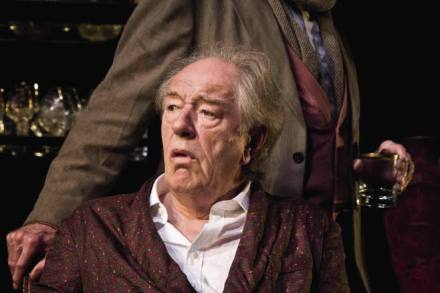
No Man’s Land Duke of York’s Mine Hampstead Slow, fractured, monumental, ineluctable, No Man’s Land lurches at you like a disintegrating ice shelf. The first act opens with two drunks staggering around a Hampstead mansion downing whisky and making oblique statements of self-revelation. Spooner, a broken-down poet, has been invited home by Hirst, a millionaire author on the verge of mental collapse. They appear to be strangers. When Hirst’s two manservants, Briggs and Foster, carry him off to bed they turn on Spooner and try to intimidate him. But Spooner has nothing to lose — ‘I have never been loved; from this I derive my strength’ — and brushes aside their menaces. Cut to the following morning. Spooner is unchanged, Hirst transformed.

Web Exclusive: Lloyd Evans on Thomas Friedman

From our UK edition

Thomas Friedman, the influential American commentator, addressed Intelligence Squared on his new book, ‘Hot, Flat and Crowded. Why the world needs a green revolution and how we can renew our global future.’ A star turn visited Intelligence Squared on 13th October. Thomas Friedman, Pulitzer prize winning journalist and columnist on the New York Times, came to discuss his new book ‘Hot Flat and Crowded’, an analysis of the global challenges of the 21st century. The topic seemed spectacularly tedious but Friedman caught our interest immediately with his unusual stance. He’s both deeply sceptical of America and devoutly patriotic. His language is chatty and challenging.

Fun with Vermeer

From our UK edition

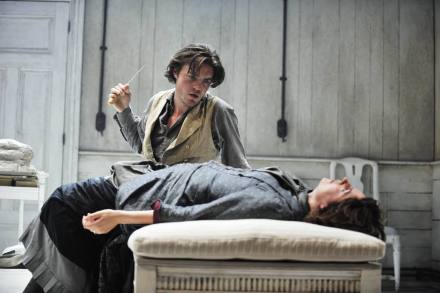
Girl with a Pearl Earring Theatre Royal Haymarket Waste Almeida Creditors Donmar I don’t know much about art but I know what I dislike. Art history. It forces one to view paintings and sculpture through the medium of literature. Every word spoken in appreciation of art is a step away from true art appreciation, which is inevitably unconscious, illiterate, oblivious to itself. The more you know, the less you feel. Those who enjoy art understand these limitations and long for fresh ways to approach their pursuit. Soap opera provides a surprisingly satisfying point of entry and here’s the latest daub-drama, Girl with a Pearl Earring, a fictional narrative about Vermeer’s enigmatic portrait of sexy innocence.