Lloyd Evans

Lloyd Evans

Lloyd Evans is The Spectator's sketch-writer and theatre critic

Blood-stained humour

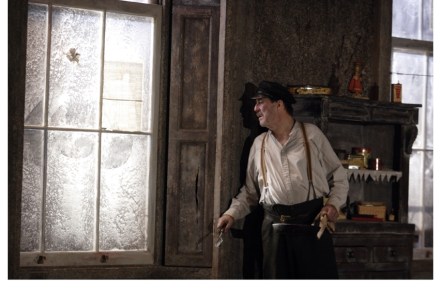
I take no pleasure in saying this but the director of the National Theatre, Nicholas Hytner, appears to have lost his sense of propriety. Or possibly the balance of his mind. He’s asked John Hodge (author of the Trainspotting screenplay) to write a sitcom about the Great Terror. And, rather than bunging it in the nearest skip, Mr Hytner has decided to direct it at the Cottesloe. The blood-stained gag-fest begins in 1938 when a secret policeman orders Russia’s leading satirist, Mikhail Bulgakov, to write a play about Stalin’s early life. Bulgakov meets the Great Leader and Teacher and finds him keen to assume personal control of the scriptwriting. So Bulgakov takes over Stalin’s day job, running Russia. This inspires many hilarities in the horror-slapstick genre.

The return of Ed Nauseam

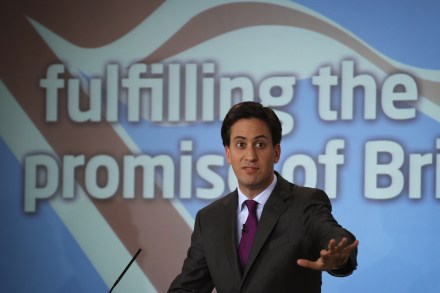
Hot summer, drippy autumn. Ed Miliband’s performances have declined steeply after the heady highs of July. He came to PMQs today badly needing to fight like a champion. Things looked rosy for him at the weekend. And they got better overnight. We learned that a pilot scheme to fast-track incoming tourists last summer had allowed Britain’s border controls to slip so far that visiting bombers and convicted sex-criminals were being greeted at Heathrow with high-fives, goody-bags and a slice of Theresa May’s blueberry tart. Or so it seemed. Worse still, a suspended UKBA official, Brodie Clark, had contradicted the Home Secretary’s statement and was threatening her with unfair dismissal proceedings. Useful stuff for Labour.

Splendid dereliction

Long may it lie in ruins. Wilton’s Music Hall, in the East End of London, is a wondrous slice of Victoriana which exploits its failing grandeur to the max. All visitors are implored to find a couple of quid for the restoration effort. But decay and dilapidation are the best things about it. Every wrinkled façade, every petal of tarnished gilding, is like a tear shed for an age that will never return. It’s wonderful. The administrators have realised this, too. Ruination is their main selling point. The cover of the brochure shows a heart-rending image of the terracotta entrance flaking and declining beautifully. If the renovation campaign were to find enough loot for a proper facelift, the place would go bust overnight. No one wants a squeaky-clean music hall.

Debate report: Britain must cut its overseas aid budget now

Last night, as we mentioned yesterday and the day before, was The Spectator's debate on whether Britain should cut its overseas aid budget. Here, for CoffeeHousers who couldn't attend the event, is Lloyd Evans' review of it:   Chair: Rod Liddle Proposing: Ian Birrell, Richard Dowden, Stephen Glover Opposing: Prof Paul Collier, Alan Duncan MP, Richard Miller   Ian Birrell, former speechwriter for David Cameron, proposed the motion by likening aid programmes to helping child beggars in the third world. The gift, though well-intentioned, keeps children out of school, encourages more kids to start begging and condemns entire families to penury. If aid worked, Birrell would happily treble it. But it distorts economies and humiliates the recipients.

PMQs or St Paul’s protest?

The Hair Shirt walked abroad at PMQs today. Those attending the Square Mile sleepover finally forced their agenda into the political mainstream. The question is, what is their agenda? A protest that doesn’t define its programme allows others to define it for them. And today both party leaders tried to harness the anti-capitalist spirit for their own political ends. Ed Miliband claimed to be scandalised by a recent, and arguable, surge of 49 per cent in directors’ pay. He demanded that the PM take action. Cameron seemed equally appalled at the news that fat cats have been getting fatter during the recession. But he wasn’t taking any sermons from Labour.

Jacobean journey

It sounds like mission impossible. To celebrate this year’s 400th anniversary of the King James Bible, the RSC set itself the task of mounting a play about the controversies surrounding the translation. A drama, therefore, entirely lacking in drama. No action or spectacle, no romance or comedy, no surprise twists or last-minute poisonings. Just people talking. And for David Edgar, who accepted the commission, this was part of the attraction. ‘A meeting between people who are unrelated but share a common purpose,’ he tells me, ‘can be as exciting and vivid and active as that great staple of drama, the family meal. Even sitting around writing a letter to a relative is a recognisable form of human behaviour.’ We meet in a break from rehearsals.

Inadmissable Evidence

Fashionable Londoners go to the Donmar Warehouse to engage in shut-eye chic. It’s a weird way to relax. You buy a ticket to John Osborne’s 1964 classic, Inadmissable Evidence, and you sleep through most of its two and a half hours. All around me were seats full of happy dozers. How I envied them. Mind you, I felt bad for the cast because the snoozers were nodding and drooling in full view of the stage. Entertaining the unconscious isn’t what thesps go into showbiz for. Still, they’d read the script so they knew the scale of their enemy. Osborne’s bright idea was to create a self-loathing misanthropist and to watch his world collapse around him.

Miliband fails to connect

Easy-peasy at PMQs today. All Ed Miliband had to do was slice open the Coalition's wounds on Europe and dibble his claws in the spouts of blood. But his attack had no sense of bite or surprise. And his phraseology was lumpen. He used all six questions gently stroking the issue of Europe rather than driving a nail through it.  He asked about growth. He asked about the '22 committee. He asked about Nick Clegg's "smash-and-grab" phrase to describe the repatriation of powers. He asked about the social chapter. He asked about everything he could think of, and it was clear he couldn’t think of the right thing to ask. At the climax he sounded like a nursery-assistant scolding Cameron for "pleading not leading" on Europe. Desperately flaccid oratory.

The Pitmen Painters; Honeypot

At last, it’s reached the West End. Lee Hall’s hit play, The Pitmen Painters, tells the heartening tale of some talented Geordie colliers who won national acclaim as artists during the 1930s. Hall, who wrote Billy Elliot, has done extremely well from a pretty limited set of dramatic techniques. He draws each of his coal miners from a couple of opposed attributes: youthful but jobless; single-minded but foolish; erudite but insensitive; unhealthy but idealistic. His dialogue consists of gentle interrogations and nothing else. It’s like a cop show for kids. Every scene involves a misunderstanding — caused by ignorance, stubbornness or some cultural confusion — which has to be resolved by characters cross-examining each other.

Cameron outfoxed in PMQs

Alive or dead? At PMQs today we discovered whether Dr Fox is still an active toxin within Cameron’s government. Ed Miliband, using that special quiet voice he likes to try when he’s got a deadly question, described the affair as ‘deeply worrying’, and asked how on earth the prime minister could have let it all happen. Cameron, evidently relieved that Fox is already a stuffed and mounted exhibit in the Museum of Former Big Beasts, pointed out that his minister had resigned. ‘Not something that always happened under Labour.’  It turned very tetchy all of a sudden. Miliband, apparently miffed, struck out with this hoity-toity harangue. ‘Some advice for the Prime Minister,’ he said. ‘In this week of all weeks.

False expectations

Here’s an idea from the heyday of radio comedy. A soap star about to get the chop improvises an unscripted deathbed recovery during a live broadcast in order to save his career. I think it was Tony Hancock who starred in that sketch. To expand it into a full-length play would be quite a challenge. And in the 1960s Frank Marcus, a showbiz journalist, took on the job. And he struck gold. The Killing of Sister George triumphed in London and on Broadway. Now it’s back with a cast of starry comediennes. Sister George, a district nurse, is the leading character in a popular Radio 4 soap opera. One day, on a whim, the BBC execs decide to bump off the character.

Exclusive: Michael Boyd to quit the RSC

The theatre world is abuzz with rumours that Michael Boyd, director of the Royal Shakespeare Company, has quit this afternoon. He was appointed in July 2002 and was expected to complete at least a decade in charge. His colleague Vikki Heywood is also expected to resign. Boyd will probably be best remembered for overseeing the enormous refit of the main theatre in Stratford. The renovated space, with its thrust stage, opened its doors in November 2010 and has been judged a huge success. Boyd has also shown himself adept at the do-gooding jargon of top public officials. He talks of the Bard’s new home in Stratford as if it were a drop-in centre for junkies. He describes it as ‘a chance to build a contingent, optimistic community.

The leprechaun factor

Riots at theatres, commonplace before the Great War, have mysteriously gone out of fashion. J.M. Synge’s classic, The Playboy of the Western World, was disrupted many times during its opening week in 1907 by Dubliners who objected to its portrayal of the rural poor in the west of Ireland. Strange that, feigning outrage on behalf of an alien caste. It’s like insider trading with an ethical twist. You borrow someone else’s moral identity and sell it at a value which has been inflated by your act of adoption. Even today this peculiar mechanism keeps the grievance industry going. The protesters in Dublin, many belonging to Sinn Fein, gave up when they realised that the protests were effectively advertising the show.

Down to earth

Lloyd Evans talks to the warm, vibrant, vegetable-growing actor, teacher and director Caroline Quentin Terminal fear. Rising nausea. And possibly vomiting. That’s what Caroline Quentin expects to go through on the opening night of her new play, Terrible Advice, at the Menier Chocolate Factory. ‘I’m really pretending it’s not happening at the moment,’ she tells me when we meet in the theatre bar. With two weeks to go before the first performance, she confesses, ‘I get dry-mouth at the very bloody thought of it. Mind you, I’m always like this halfway through rehearsals, I think, agh! I can’t bear it, perhaps I can run away. Or feign injury. Or I start booking flights mentally and all that.

Unrequited love

It’s a record breaker. The Trafalgar Studio is staging a rare revival of Christopher Hampton’s breakthrough play, written when he was 18, which made him in 1966 the youngest writer ever to have his work staged in the West End. This record has now stood for so long that it could probably do with a lie-down. The plot, meticulously fashionable and youth-orientated, focuses on an unrequited affair between Ian and his flatmate Jimmy. Hampton’s conception of personality is underdeveloped. And overdeveloped, too. Most of his characters are handsome, vague, middle-class numbskulls, posh little tadpoles wriggling around a cosy pond. But the central character, Ian, is a brilliant study of brooding, adolescent misogyny.

Compelling revelations

Even the cover is a mystery. Julian Assange’s memoir carries a contradictory, if eye-catching, title: the unauthorised autobiography. On his WikiLeaks site the author disclaims authorship altogether. ‘I am not “the writer” of this book. I own the copyright of the manuscript which was written by Andrew O’Hagan.’ He claims that the text was ‘distributed secretly’ in the final week of September. Well I wonder. My copy was delivered by a helmeted courier who handed me the book only after a pre-arranged password had been exchanged between us: my name. This was hardly secret.

Losing the plot | 24 September 2011

A world première at the Almeida. My City written and directed by Stephen Poliakoff. Is it any good? Well, let’s see. Plot, first. It’s not that Poliakoff can’t write a plot; he can’t even think one up. Instead he sets himself a high-minded riddle and examines its possibilities. Take an archetype, ‘the kid-fearful-of-the-dark’, turn it inside-out and you get ‘the adult-fearful-of-the-light’. That’ll do for starters. Bung in a few extra brushstrokes and you’re off. An insomniac teacher (Tracey Ullman with too much grey hair) bumps into two former pupils and tells them about her odd little secret. Every night she trudges London’s streets encountering weirdos and listening to their offbeat chitchat.

Spectator debate: Is it time to leave the EU?

 Christopher Booker, of the Sunday Telegraph, proposed the motion by taking a blast at his own side. Christopher Booker, of the Sunday Telegraph, proposed the motion by taking a blast at his own side. The present Euro crisis had inspired Tory Eurosceptics to talk of "a re-negotiation" and a "repatriation of powers". This, he said, utterly misconstrued the EU project and its "sacred aim" to strip nations of their rights and "never to give back a power once ceded." He called the EU "a 40-year-long slow-motion coup d’etat" and "a crazy make-believe project" whose hubristic ambitions were now facing nemesis. He heaped scorn on Herman van Rompuy for claiming that the best remedy for the Euro was "more Europe".

The triumph of humility

‘John Smith is dead.’ These four blunt syllables, as elemental and atmospheric as the first line of a classic novel, form the opening of Chris Mullin’s new collection of diaries. This is a fascinating read, crammed with gossip, jokes, insights and anecdotes, not all of them political. Mullin’s first disclosure is that the ‘decent interval’ between a leader’s death and the tussle to succeed him lasts about three seconds. The ‘Stop Blair Camp’ formed as soon as Smith was buried. They try to court Mullin and he brushes them off. ‘I’m in the Win the Next Election Camp.’ He considers backing John Prescott, but ‘I can’t bear the thought of another phoney-left leader. Give me an honest right-winger any day.

Essay in off-beat grief

Well done, the Royal Court. It’s got the art of audience abuse down to a tee. The queue for the tiny studio theatre snakes up an airless flight of stairs and bottlenecks into a doorway where each play-goer receives a personalised earbashing from an usherette. ‘Hello, did you hear all that? It’s one hour straight through. No readmission. No recording. No photography. No mobile phones. No sitting on the reserved chairs. No treading on the floor on the way to your seat. Enjoy the show. Hello, did you hear all that...?’ and so on. The floor we mustn’t tread on is strewn with a layer of sacred grit which the director insists will remain untouched by human sole before the show begins.