Lloyd Evans

Lloyd Evans

Lloyd Evans is The Spectator's sketch-writer and theatre critic

Famine zones are more fun than this play: Dancing at Lughnasa, at the Olivier Theatre, reviewed

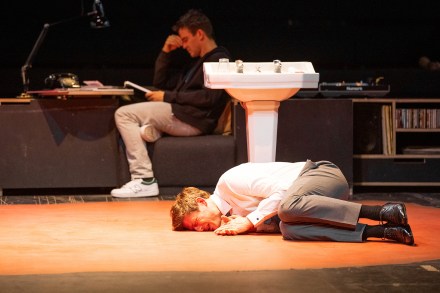
Snowflakes, an excellent title, rehashes The Dumb Waiter by Harold Pinter. A guest in a hotel room is visited by two intruders posing as staff. The intruders are hired assassins who accuse the guest of committing a half-explained hate crime on social media. His punishment, execution, will be livestreamed as a warning to other hate criminals. Brian Friel’s shrieking bumpkins are exactly what the Arts Council wants us to see It’s a thrilling start but the show lacks tension and the accused’s back story isn’t explained fully. And once the sentence has been carried out, the story becomes predictable. The core idea – freelance killers dispensing justice on behalf of tech giants – would make a great TV series. It needs a lot of development.
There was yet more proof of the SNP’s megalomania at PMQs

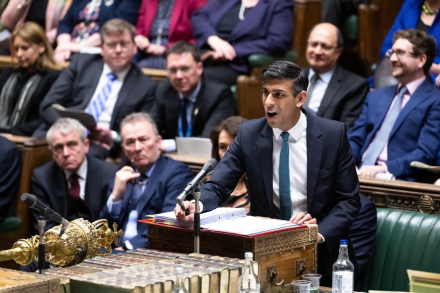
‘Sir Softie.’ That’s Rishi’s new nickname for Sir Keir Starmer. ‘Sir Softie,’ he called out twice at PMQs. ‘He’s soft on crime!’ The insult works because it’s easy to remember and pleasantly alliterative. And it builds on an existing perception of Sir Keir as a criminal-hugging lawyer. Sir Keir set out to overturn that impression by posing as the scourge of the law-breaking classes. He started with a trick question. Citing the case of a man found guilty of scalding a prison officer with boiling water, he asked if the offender deserved a jail sentence. Rishi could tell that this was a booby-trap so he answered in generalities. Sir Keir had to unpick his subterfuge.

Why do theatres hate their audiences?

War has broken out in theatreland. Managements are increasingly at odds with the audiences who fund their livelihoods. A recent stand-off involved James Norton’s new show, A Little Life, which contains a couple of scenes in which the actor removes his clothes. A punter at a preview in Richmond secretly photographed the moments of nudity and posted the images online. This sparked a furore in the newspapers and the majority of commentators took the producers’ side against the theatre-goers. Dr Kirsty Sedgman, a media studies lecturer, spoke piously to the Independent about ‘an absolute violation of the unwritten contract between audiences and performers’. The Mirror reported that ‘drastic measures’ might be needed to ensure that similar ‘privacy breaches’ don’t occur.

A puzzling spectacle: The Secret Life of Bees, at the Almeida Theatre, reviewed

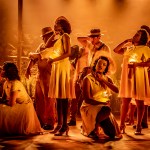
The Secret Life of Bees is a fairy-tale set in the Deep South in 1964. Lily, a bullied white girl, befriends a plucky black maid, Rosaleen, and they escape together from Lily’s tyrannical dad. After various adventures they take sanctuary at a honey farm run by a commune of astonishingly successful African-American businesswomen. This story clearly wants to expose the cruelty of whites and the oppression of blacks but the details suggest the opposite. This is a tale of black self-confidence and white failure. Spineless Lily could never have fled her abusive dad without the intelligent and combative Rosaleen to spur her on. And the all-female honey corporation is a fantasy of African-American empowerment.

An epic bore: A Little Life, at the Harold Pinter Theatre, reviewed

A Little Life, based on Hanya Yanagihara’s novel, is set in a New York apartment shared by four mega-successful yuppies: an architect, a fine artist, a film star and a Wall Street attorney, Jude, played by James Norton. A friendly doctor tags along occasionally and an older lawyer, in his sixties, joins the gang after legally adopting Jude. None of the men has a partner or a family, and they never discuss things like sport, cars, investments, movies or girls. Instead they hug a lot and cook pastries for each other in a kitchenette on stage. The play feels like a joke-free episode of Friends with an all-male cast. And the script might have been written by a teenage girl.

Deeply unsatisfying: Berlusconi – A New Musical, at Southwark Playhouse Elephant, reviewed

Berlusconi: A New Musical, an excellent title, has opened at a new venue in south London, Southwark Playhouse Elephant. The show begins with the former Italian prime minister preening triumphantly on a white marble set that resembles the Capitol in Rome where Caesar was murdered by rivals who’d grown sick of his power lust. Berlusconi introduces us to his nemesis, a state prosecutor called Ilda Boccassini, who pursues him for years through the courts. With typical coarseness he dismisses her as a ‘haggard old sow’. And yet the pair perform a strange romantic dance that culminates in a bizarre Berlusconi chat-up line: ‘If you weren’t so frigid we’d end up in bed.’ Misogyny is his defining characteristic. Gallantry and charm are alien to him.

A totally unmemorable PMQs for Raab and Rayner

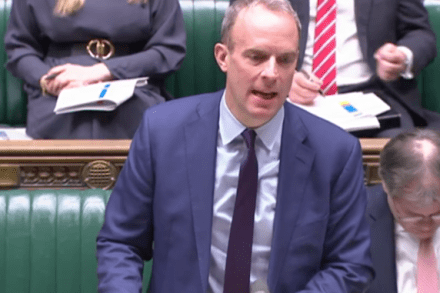
Rishi Sunak missed PMQs to attend Betty Boothroyd’s funeral and a half-empty chamber watched the deputies, Dominic Raab and Angela Rayner, slug it out. Rayner, always a crowd-pleaser, began by hailing the late Paul O’Grady as ‘a true northern star.’ And she had fun with the new crackdown on street thuggery or ‘anti-social behaviour’ as our genteel government puts it. Rayner linked this to the Dominic ‘Raabspierre’ allegations made by a handful of snowflake civil servants who felt that the Justice Secretary had mistreated them. It was good knockabout stuff. Rayner suggested that Raab had personal knowledge of louts ‘exploding in fits of rage and creating a culture of fear, and maybe even, I don’t know, throwing things?’ Raab guessed this was coming.

Flawless: Accidental Death of an Anarchist, at the Lyric Hammersmith, reviewed

Accidental Death of an Anarchist has been performed all over the world with varying degrees of success. Written by Dario Fo and his wife Franca Rame, the script was inspired by an actual case of police brutality in 1969 when a train driver with anarchist leanings was found dead beneath the open window of a fourth-floor interrogation room. Official reports described the fatality as ‘accidental’. The plot structure is borrowed from Gogol’s The Government Inspector. A senior civil servant arrives in an isolated town and exposes the corrupt and self-serving ways of the townsfolk. After he departs, the civil servant is exposed as an imposter. Here, the authority figure is a mercurial exhibitionist, the Maniac, whom we first meet during a police interview.

PMQs proved that we have too many politicians

PMQs drove up a cul-de-sac today. Sir Keir’s team of researchers have discovered a crime blackspot where ten houses have been burgled in the last 18 months, but only one of these offences has ended up in court. This delighted Sir Keir as it gave him a chance to remind the world that he once worked as a prosecutor. Even better, the benighted cul-de-sac happens to be in Yorkshire where Rishi Sunak’s constituency is located. Crime dominated the session because Sir Keir brought up Baroness Casey’s end-of-term report on the London police force. The cops have fluffed it, according to the baroness, and their ranks are now overflowing with sexists, racists and homophobes.

Drab by comparison to the film: Bonnie & Clyde, at the Garrick Theatre, reviewed

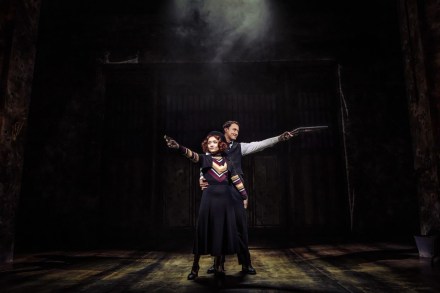
The murderous odyssey of Bonnie and Clyde is a tricky subject for a musical because the characters are such loathsome wasters and their grisly ambition is to fleece poor people at gunpoint during the Great Depression. They’re famous for stealing from banks but they changed tack once they realised that grocery stores and funeral parlours were easier to rob. The little guy was their real target. In this revived musical, written in 2009, the principal figures have no redeeming qualities at all. Bonnie is a beautiful brain-dead popsicle who dreams of becoming a poet or a movie star. Nowadays she’d be ranting on TikTok from the front seat of an SUV. Clyde is an amoral thug who shoots dead anyone who comes between him and his greed.

Jeremy Hunt’s crafty Budget spells trouble for Labour

Jeremy Hunt was designed to exclude unnecessary body movements. Tall and gaunt, his demeanour faintly bird-like, he worked through his Budget statement at a steady pace, sipping regularly from a tumbler of water. Or was it vodka? No, it was water, of course. Hunt has the air of someone who always waits for the green man to flash before crossing the road. And every library book he has ever borrowed came back on time. At the despatch box he wore a Davos costume: white shirt, bland tie, midnight blue suit with no badges or political emblems attached. Is there a man alive who can project ‘anonymity’ better than Jeremy Hunt? Probably, but we’ll never know what he’s called.

A ripping production with plenty of laughs: Guys and Dolls, at the Bridge Theatre, reviewed

Further than the Furthest Thing is an allegorical play set on a remote island populated by English-speakers from all over the world. Dialect experts will have a ball unscrambling the set-up. First we meet Auntie Mill, a white Scotswoman whose husband, Uncle Bill, is a black fisherman with a West Country accent. Their nephew, Francis, is a mixed-race teenager whose verbal mannerisms seem to originate from North Yorkshire. And he has a pregnant girlfriend, Rebecca, who looks east Asian but talks like a Dubliner. This crazy muddle may be a deliberate assault on the entire cult of colour-blind casting. Or it could be a thoughtless embrace of chaos. Either way, it’s baffling to watch. Theatre is all about resemblances and the closer the resemblance, the more successful the play.

PMQs gets ugly over small boats fight

Small boats could be the issue that swings the next election. Photographs of new arrivals being shuttled from beaches to free hotels is a potent symbol of a government in chaos. A country and its borders are the same thing. If the borders cease to exist, so does the country. Voters grasp this instinctively but the collective mind of parliament has failed to realise it for years. Rishi’s crackdown represents a great opportunity for him and a moral crisis for Labour. Sir Keir Starmer couldn’t find a consistent line at PMQs but he succeeded in exposing the scale of the problem.  Last year, he said, 18,000 newcomers were deemed ineligible for asylum. ‘How many have actually been returned?’ The Labour benches reverberated with finger-wagging murmurs. ‘Ah, mm, yes, good point.

Cumbersome muddle: Women, Beware the Devil, at the Almeida Theatre, reviewed

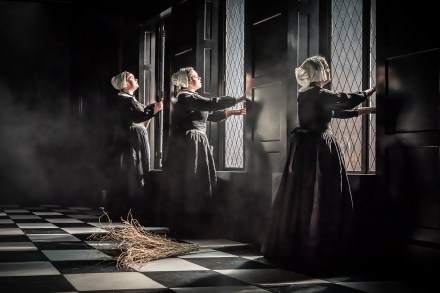
Rupert Goold’s new show, Women, Beware the Devil, has great costumes, sumptuous sets and an intriguing chessboard stage like a Vermeer painting. Impressive to look at but that’s where the good news ends. Dramatist Lulu Raczka should have thought twice before writing a script about witchcraft, which was bound to invite comparisons with The Crucible, one of the greatest plays in the theatrical canon. Raczka is no Arthur Miller. She seems to take a dim view of human beings and her writing feels like a vehicle for her vengeful sense of revulsion. Her female characters are mostly skittish, cackling ninnies and her males are lusty, arrogant, predatory monsters. No figure in this play is remotely likeable and no one has a dramatic goal that makes any sense.

Rishi Sunak is starting to enjoy PMQs

A bad day for daffodils. Hundreds of these little golden trombones were cut down this morning so that our MPs could display their bogus affection for Wales. Honestly, sporting a daff on St David’s Day is like clapping for the NHS – a badge of insincerity. The issue of the moment, the Windsor Framework, barely got a mention at PMQs. Hats off to the marketing genius who coined the phrase ‘Windsor Framework’. Such a cosy, domestic and stylish term. One imagines a pine gazebo by John Lewis or a luxurious summerhouse from Habitat. A place where friends and families can relax forever. To Ulster-watchers, it’s odd that the agreement has been reached with so little acrimony. Usually when a deal is about to be done, the factions boil over with fury. Not this time.

Approaches perfection: Medea, @sohoplace, reviewed

Winner’s Curse is a hybrid drama by Dan Patterson and Daniel Taub which opens as a lecture by a fictional diplomat, Hugo Leitski (a dinner-jacketed Clive Anderson). Leitski offers to teach us the subtle art of negotiation. An expert diplomat, he explains, must convince each side that they’re the winners in the negotiation and that their opponents have lost. In his youth he helped to broker peace between two Slavic nations, Karvistan and Moldonia, and the action switches from Leitksi’s lecture room to a seedy hotel, the Black Lagoon Lodge, where the peace deal was agreed.

The secret truth about Dom: The Play

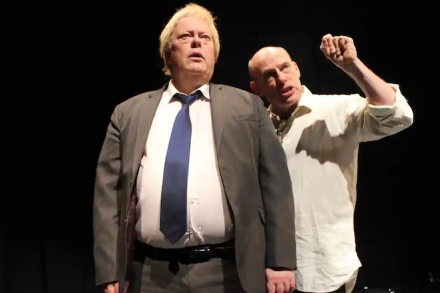
‘Who wrote it?’ asks the Times, of Dom: The Play. I’ll let you in on a secret: it was me. If you’re selling a product, you need to advertise what you’re flogging, rather than its creator. That’s why, when my satire about Dominic Cummings launched at The Other Palace in Victoria this week, I withheld my name from the poster and the programme. Simple reason: my name doesn’t shift tickets. And a poster without the waffle is likely to cut through better. As a result, our poster has the show’s emphatic title in crimson letters beneath three shots of Dom's face taken from different angles. This has a decent chance of attracting the gaze of the fickle and easily distracted public. It’s a split-second opportunity. Shout at them. Grab their attention. ‘Dom the Play.

Small boats are Rishi’s big problem

Small boats are becoming a big problem for Rishi. Four Tory backbenchers raised the issue at PMQs. Andrew Selous asked about a ‘much-loved’ hotel in his constituency which the Home Office has annexed on behalf of their beloved migrants. Weddings and family parties have been cancelled. Selous, rather ludicrously, asked the PM to ‘redouble his efforts’ to solve the crisis. Let’s look at the maths. Redoubling zero gives you zero. And zero is what Rishi is doing to deter the boats and send new arrivals packing. He confessed as much. The PM is campaigning to please people who loathe him Some time in the future he plans to pass a miraculous new bill aimed at bogus asylum claimants but he has little faith in its effectiveness.

How has it escaped being cancelled? The Lehman Trilogy, at the Gillian Lynne Theatre, reviewed

Standing at the Sky’s Edge is an ode to a monstrous carbuncle. The atrocity in question is a concrete gulag, Park Hill, built by Sheffield council in the 1960s as a punishment for hard-up locals who couldn’t afford to buy a house. The show is a propaganda effort on behalf of bossy, big-state, high-tax Labour authorities so the smiling residents of the brutalist eyesore keep telling us how much they love their multistorey dungeon. ‘You can see the whole city from up here,’ say the characters, as if no Sheffield resident had ever mounted any of the bluffs or heights that surround the area. The script is honest enough to admit that Park Hill’s secondary purpose is to reduce the city’s population by encouraging depressives to jump from its upper levels.

A sex farce reminiscent of Alan Clark’s diaries: Phaedra, at the Lyttelton Theatre, reviewed

Simon Stone claims that his new comedy, Phaedra, draws on the work of Euripides, Seneca and Racine. In fact, the porn-mag narrative resembles a passage in Alan Clark’s diaries where the priapic scribbler seduces a mother and daughter in rapid succession. That’s what happens to Sofiane, a homeless Moroccan lecher, aged 41, who has the looks of George Best and the sexy drawl of a Riviera gigolo. He befriends Helen, a senior Labour MP, who shares her picture-perfect London home with her two brattish children and her high-flying husband Hugo, who speaks 15 languages. Helen appears to be starved of sex and male attention, which seems rather improbable for a Westminster insider.