Lionel Shriver

Lionel Shriver

Lionel Shriver is a columnist at The Spectator and author of We Need to Talk About Kevin, among other books.

How to lose sales and alienate people

In some quarters, American enterprise is alive and well. Established in 1929 to promote consumer protection, the conservative non-profit Consumers’ Research is launching the free service ‘Woke Alerts’, which texts subscribers news of companies ‘putting progressive activists and their dangerous agendas ahead of customers’. Using iconography reminiscent of adverts for those high-frequency plug-ins that ward off mice, the parent website urges shoppers tired of corporations latching onto fashionable left-wing causes to dramatise their displeasure through product boycotts. The idea is a bit goofy. Yet the app could appeal to a far more than niche market. Only 8 per cent of the US public self-identifies as far left.

Why Democrats want Trump

Manhattan district attorney Alvin Bragg’s indictment of an even more prominent fat man seems a big win for Donald Trump, regardless of how the case is decided. If convicted, Trump is a martyr, managing to portray himself once more as a persecuted Washington outsider, a status that’s quite a feat for a politician to retain after setting up shop in the White House for four years. If found not guilty, Trump is exonerated, a contrived case likely to rely on tentative legal reasoning exposed as an overtly partisan manhunt. After all, in a Quinnipiac poll last week, a plurality of Americans (42 per cent) considered the charges in New York either ‘not too serious’ (16 per cent) or ‘not serious at all’ (26 per cent).

The high price of low interest rates

You’ll recall that I’ve railed for years against zero interest rates, which transplanted a cancerous marrow into the very bones of the financial system. Originally a novel emergency expedience to shore up a fiscal skeleton riddled with osteoporosis in 2008, effectively free money was allowed to persist for an improbable 14 years. Not to forget, bank rates also plummeted in 2002, barely recuperating to a modest 5 per cent at last when the spectre of the end of the world shoved rates smack down to nothing. Brief expedience slid to long-term crutch. So we’ve really had two decades of central banks setting up lemonade stands on the corner: cups brimming with millions for five cents. Europe got downright dystopian with negative interest rates.

Despotic social controls cost lives

Look, I realise you don’t want to read this column. I’m unenthusiastic about writing it. For most of us, any mention of Covid triggers a deep aversion and desperation to flee. Even recalling the uncanny tranquillity of the first you-know-what – the blue skies, the blazing sunshine, the serene silence in once-bustling London – makes me wince. Between the slow drip-feed of the Telegraph’s Lockdown Files and Rishi Sunak’s dubious Protocol breakthrough, most UK news consumers would have greeted last week’s headlines with a double-whammy of ‘Oh, no, not that again!’ – since the only subject that rivals Covid’s revulsion quotient for Brits is Northern Ireland. Waves of variants came and went, oblivious of state diktats.

My list of banned words

North America’s Ecology and Evolutionary Biology Language Project has released yet another list of Bad Say. Scientists are to swap ‘male’ and ‘female’ for ‘sperm-producing’ and ‘egg-producing’ – as presumably most biologists are stuck in remedial learning and haven’t yet got to the chapter explaining that humans come in only two sexes. But rather than opt for another chortle at these petty rhetorical tyrants’ expense, I’m regarding turnabout as fair play. Behold, a by no means complete list of the expressions I’m banning right back. ‘Black and brown bodies’ – a bizarrely dehumanising reduction of people to biomass, often disconcertingly employed by the very folks in possession of said black and brown bodies.

Why publishers are such cowards

After publishing 17 books, I’m no stranger to the publicity campaign. In my no-name days, my publicist would purr that my novel’s release would be ‘review-driven’ – which decodes: ‘We don’t plan to spend a sou on your doomed, inconsequential book.’ By contrast, as we’ve seen writ large with Prince Harry’s Spare, your volume can be cast upon the public waters as not a mere object but an event. The intention is to convince book-buyers that unless they snap up a copy sharpish they’ll be caught up short at cocktail parties.

Matthew Parris, Lionel Shriver and Gus Carter

24 min listen

On this week’s episode, Matthew Parris wonders what ‘winning’ in Ukraine really means (00:52), Lionel Shriver says she’s fighting her own war against words (08:43), and Gus Carter wonders whether it’s a good idea to reintroduce Bison into Britain (18:28).

The war against words

The University of Washington technology department has banned the word ‘housekeeping’. Not because the ‘problematic’ noun is overtly ist (ableist, sexist, racist, ageist…; by now, you must know the ist list). No, because it ‘feels gendered’. Would that they’d simply banned housekeeping. I hate scrubbing the shower. This month, the University of Southern California’s School of Social Work proscribed the word ‘field’. ‘Field work’ might have unpleasant connotations for the descendants of slaves. (Sorry! Descendants of ‘enslaved people’. Nouns that reference persons – like, you know, ‘doctor’ – are reductive and dehumanising.) A ‘field of study’ is henceforth a ‘practicum’.

Lionel Shriver, Theo Hobson and John Maier

25 min listen

This week: Lionel Shriver asks whether we are kidding ourselves over Ukraine (00:56), Theo Hobson discusses Martin Luther King and the demise of liberal Protestantism (09:28), and John Maier reads his review of Quentin Tarantino's new book Cinema Speculation (18:11). Produced and presented by Oscar Edmondson.

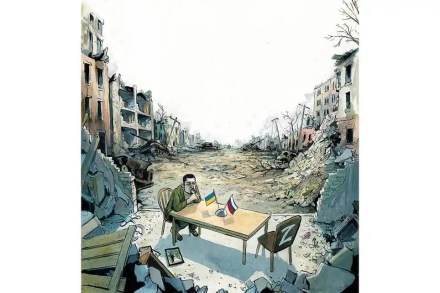
Are we kidding ourselves over Ukraine?

Optimism can be surprisingly hilarious. In my last novel, two spouses agree to quit the planet once they’ve both turned 80, and the book explores a dozen possible outcomes of their pact. No chapter made me chuckle at the keyboard more than ‘Once Upon a Time in Lambeth’ – in which the couple don’t kill themselves but live to 110 in perfect health because they eat their vegetables. Young people flock to their table for advice, as my protagonists grow only wiser and more physically riveting in old age. Meanwhile, modern monetary theory makes everything free. Limitless energy is derived from carbon dioxide. A new portmanteau religion, ‘Jeslam’, eliminates Islamist terrorism. The reader gradually twigs that this happy-clappy scenario is a piss-take.

Most-read 2022: Why are so few Americans willing to defend their country?

We’re finishing the year by republishing our ten most popular articles from 2022. Here’s number seven: Lionel Shriver’s piece from March on fighting for your country. For many of us war voyeurs watching the news with a glass of sherry, admiration of the little-engine-that-could Ukrainian fighters is underwritten by unease. As families escape to safety, plenty of feisty Ukrainians are remaining behind to battle a far more powerful aggressor, and they’re not all men, either. The question nags, then: in the same circumstances, would we stick around to defend our homelands, or would we cut our losses and get out? Earlier this month, that’s precisely what a Quinnipiac poll asked Americans. Some 7 per cent answered ‘Don’t know’.

Xi, Covid and seasonal schadenfreude

’Tis indeed the season to be jolly.  Over the holidays, we can all put our feet up to view a cracking remake of David and Goliath, ‘The Microscopic Nullity vs Winnie-the-Pooh’, in which a giant bear-like bully has been pushing around 1.4 billion people but cannot prevail against an opponent too tiny to be seen by the naked eye. Inverting the customary balance of power, the narrative arc is classically satisfying: a would-be omnipotent despot is driven to crazed distraction by the sneaky afflictions of the infinitesimal. I’m reminded of a favourite newspaper clipping: ‘Drunk tries to kill spider, sets house ablaze.’ Because you cannot lock up a coronavirus. You can’t censor a coronavirus or send a coronavirus to a re-education camp in Xinjiang.

What Trump really wants

Over the years, I’ve received my share of green-ink author’s mail. You know, from folks who’ve discovered an exciting variety of textual special effects: lurid colours, freaky fonts, creative insertions of upper case, frenzies of inverted commas around standard vocabulary and lashings of exclamation marks. Calling these letters ‘fan mail’ would be a stretch. They are universally hostile, and their authors are crazy. Rule of thumb: DO NOT ‘respond’! Trump wants to run, but he wants to lose – and throwing the contest should prove a cinch But how do you ignore green-ink communiqués sent to the world at large from a former president of the United States?

James Heale, Lionel Shriver and Tanjil Rashid

23 min listen

This week: James Heale reads his interview with former Secretary of State for Environment, Food and Rural Affairs George Eustice (00:50), Lionel Shriver asks what's the price of fairness (05:38), and Tanjil Rashid reflects on the BBC at 100 (14:01). Produced and presented by Oscar Edmondson.

Should the better-off pay more for everything?

Once the energy price cap expires in April, the Chancellor is apparently considering the levy of ‘social tariffs’ on the energy bills of the better off – a pleasantly elastic category, since most of us are better off than somebody. Charging wealthier customers extra for their energy could facilitate reducing the bills of benefit claimants. The same kilowatt hour would cost the ‘rich’ (i.e. the marginally solvent) more than the socially dependent. To bolster our beloved fairness, might this novel pricing scheme be extended to all British goods and services? After all, for higher-rate taxpayers (assuming that after obeisance to HMRC they have anything left), springing for a £7.95 fillet steak at the supermarket is a relatively mild experience.

Kamala’s blagging it

We throw around pejoratives such as ‘Idiot!’ a bit too carelessly, because then when we need to flag up genuinely subpar intelligence, the slag doesn’t land. I sometimes resort to the distinction ‘medically stupid’. As in, ‘Kamala Harris is medically stupid’. As I write this, next year’s Congressional balance of power is uncertain. What is certain: after the midterms, the same terrifyingly unfit politician will remain one cardiac arrest away from the American presidency. The press characterises the Vice President’s missteps as ‘gaffes’, but a proclivity for making embarrassing mistakes in public doesn’t capture the scale of the problem.

Money is rotting

Punters and pundits alike reacted to rising mortgage rates in the wake of Truss’s mini-Budget with indignant horror. Leaving aside a market overreaction to fairly modest policy proposals, I wanted to tell aghast homeowners: ‘Well, what did you think was going to happen, people?’ In 2008, the plunging of central bank rates to nearly zero was super-weird. (EU rates eventually going negative, meaning you paid banks to keep your money, was even weirder.) Flatlined interest rates were a response to an emergency. Yet when emergency measures continue long enough, they start to seem totally normal, in this case inducing the bizarre expectation that borrowing money will be basically free, for ever. Sorry, virtually free borrowing is intrinsically dysfunctional. It (surprise!

Harriet Sergeant, Lionel Shriver, Martin Vander Weyer and Philip Patrick

30 min listen

This week: Harriet Sergeant writes about why ethnicity matters in sexual abuse cases (0:30), Lionel Shriver takes aim at the American university students failing their exams, (8:06), Martin Vander Weyer looks at the latest forecasts for housing prices (17:01), and Philip Patrick thinks Japanese food is overrated (25:19).Produced and presented by Natasha Feroze.

Should failing students really graduate as doctors?

If I seem to be bashing universities lately, they’ve asked for it. The prestigious New York University in lower Manhattan didn’t cover itself in glory when, just before this semester began, it responded to a petition from 82 students (out of a class of 350) by sacking the professor. The petitioners’ main objection? The course was too hard. After retiring from Princeton’s chemistry department where he’d taught organic chemistry for more than 40 years, Maitland Jones Jr taught the same course at NYU on one-year contracts as an adjunct. I used to be an adjunct, and this much hasn’t changed since my day: adjuncts are atrociously paid. I’m just guessing, but Dr Jones would surely have been handsomely remunerated at Princeton.

Shame should not be heritable

Vice-chancellor Stephen Toope claims it was ‘inevitable’ that a university ‘as long-established as Cambridge’ would have links to slavery. Now that faculties gorge on racial guilt as Cambridge dons once famously feasted on roasted swans, what was really inevitable is that a body christened ‘The Advisory Group on the Legacies of Enslavement’ would find links to slavery. Why, it must have frustrated the authors of the report released last week that their three-year inquiry didn’t manage to dredge up any evidence that the university ever directly owned slaves or plantations. Rather, it’s the money that was tainted; lucre having always passed through dirty hands somewhere along the line, there’s no such thing as clean money.