Kate Andrews

Kate Andrews

Kate Andrews is deputy editor of The Spectator’s World edition.

Could Jeremy Hunt actually abolish National Insurance?

From our UK edition

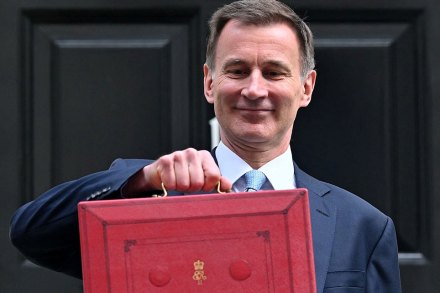
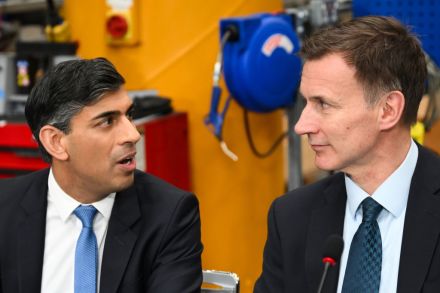
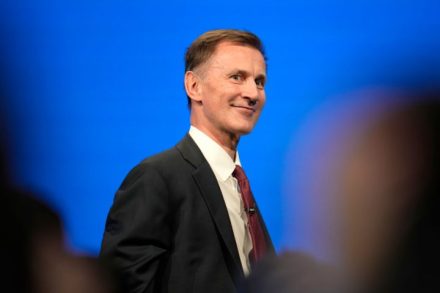
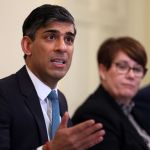
Could Jeremy Hunt really abolish employee National Insurance (NI)? His additional 2p cut announced in yesterday’s Budget seems to be the start of what the Tories might offer up in their election manifesto. Hunt has now suggested the end goal would be to merge income tax with employee NI, helping to simplify the tax code. The point was further made by Rishi Sunak at the Centre for Policy Studies’ 50th anniversary dinner last night: that it should be the Conservative party’s ‘plan, long term, to end that unfairness’ of taxing income twice. But is this in any way possible?
Never Trumpers were never going to win

From our UK edition

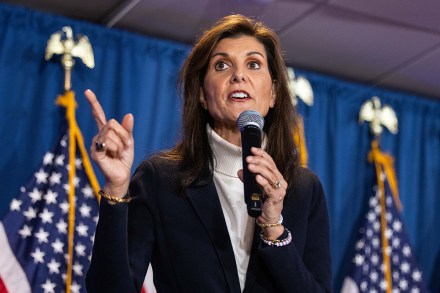
‘We fight for every inch,’ declared Nikki Haley after she won her first primary in the District of Columbia last week. Her fight didn’t last long. The former governor of South Carolina managed to win one state primary on Super Tuesday, handing the presidential nomination to Donald Trump. Haley’s campaign is over – and with it went the hopes of the Never Trump movement. Why did the attempt to reclaim the Republican party from Trump fail so badly? There are 340 million people in the US: all the Never Trump campaign needed to do was find one who’d make a more convincing Republican candidate. Not only did no candidate emerge, no one came close. Almost from the get-go in the Republican primaries, there has been no contest.

Jeremy Hunt’s low-key Budget

From our UK edition

22 min listen

Jeremy Hunt said the government would cut National Insurance by 2 per cent, would abolish the non-dom tax status and would raise the threshold for child benefits in his Budget today. To discuss the new measures, Katy Balls speaks to Kate Andrews and David Miles, from the Office for Budget Responsibility.

What Hunt’s ‘tax-cutting’ Budget didn’t mention

From our UK edition

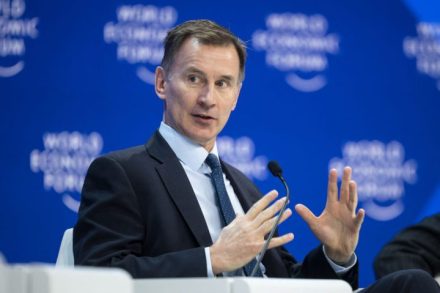
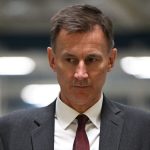
Can the Tory party now credibly claim it is cutting taxes? That was the big mystery going into Jeremy Hunt’s pre-election Budget this afternoon, as so many of the policy measures had already been trailed.  As expected, the Chancellor announced another 2p off employee National Insurance, following on from the 2p cut he announced in the Autumn Statement. Between both fiscal events, NI falls from 12 per cent to 8 per cent (and from 10 per cent to 6 per cent for the self-employed) – a saving of £900 a year for the average worker. Hunt also announced changes to child benefit rules, which will shift the calculations from individual to household earnings, and raise the threshold for paying the charge.

Would another cut to National Insurance be enough to move the polls?

From our UK edition

We’ll know tomorrow afternoon what exactly Jeremy Hunt has included in his Budget, but reports this evening suggest we’re looking at another 2p cut to employee National Insurance: a move that is estimated to put £450 back in the pocket of the average worker, which Hunt will try to sell as a £900 tax cut, if you combine it with the additional 2p taken off NI in his Autumn Statement last year.  The decision to opt for NI will be driven by fiscal restraints rather than political desire. Tory MPs, and workers, have been expecting something bigger than what was already delivered last autumn, and an income tax would have fit the bill.

What tax cut will Hunt deliver tomorrow?

From our UK edition

13 min listen

Kate Andrews speaks to James Heale and Isabel Hardman as the speculation grows over what taxes Jeremy Hunt will cut in tomorrow's budget. National Insurance is looking most likely – it's a giveaway but does it go far enough?

Sunak and Hunt face a Budget dilemma

From our UK edition

14 min listen

Budget day is approaching and the government has hinted that their plans for tax cutting 'giveaways' are now less likely. James Heale speaks to Katy Balls and Kate Andrews about what to and what not to expect for Wednesday's Spring Budget.

Is this really the Tory party’s election budget?

From our UK edition

February was a tough month for Jeremy Hunt, as he tried to roll back the tax cut promises that were made by himself and Rishi Sunak in January. The money simply did not materalise, despite the government borrowing less than expected in recent months. The rough £15 billion that independent forecasts now think the Chancellor has for additional announcements is not enough to deliver the major income tax cuts Hunt wanted to announce.  The disappointment is palpable. Appearing on BBC One this morning, Hunt squashed all remaining hopes that this Wednesday might be the tax-slashing Budget Tory MPs were desperate to deliver ahead of an election.

Migration is too high, says party in charge of migration for 14 years

From our UK edition

When Rishi Sunak made ‘stopping the boats’ one of his five priorities after entering No. 10, he ensured that immigration (legal and illegal) would become one of the big issues heading into an election. It seemed, for a while, that the government thought the emphasis on migration would work in its favour. It hasn’t exactly turned out that way. The migration crackdown announced by James Cleverly at the end of last year is designed to reduce the headline number of net migrants to the UK, after it was reported that in 2022 that net migration reached a record high of 745,000.

We need to talk about Truss

From our UK edition

15 min listen

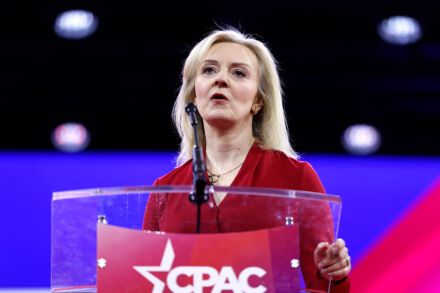
Liz Truss continues to haunt Rishi Sunak. Labour leader Keir Starmer took aim at her recent exploits at CPAC in the US during prime minister's questions today. Starmer called on the prime minister to remove the whip after Truss claimed that her premiership was sabotaged by the 'deep state'. What's Truss up to this time?  Also on the podcast, chancellor Jeremy Hunt will deliver his budget next week. We expect that he will have made his final decision on the March 6th budget by the end of the week. What do we know so far?  Oscar Edmondson speaks to Katy Balls and Kate Andrews.  Produced by Oscar Edmondson.

A Donald Trump debate

From our UK edition

28 min listen

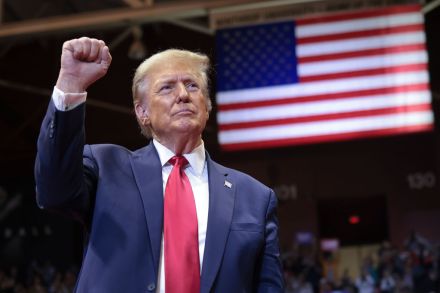
In this special episode of Americano, The Spectator's editor Fraser Nelson explores Trump's candidacy with political commentator Deroy Murdock, and The Spectator's economics editor Kate Andrews.  They debate the influence of his rhetoric on American politics. How important is language? Will his achievements as President be enough to secure his re-election? Does personality Trump policy?

Can Jeremy Hunt actually afford to cut taxes?

From our UK edition

Does Jeremy Hunt have the cash to spend on tax cuts in his spring Budget next week? That’s the billion pound question that the Institute for Fiscal Studies (IFS) focused on during its pre-Budget briefing this morning, hosted by Director Paul Johnson and Deputy Director Carl Emmerson.  As Ross Clark notes on Coffee House, the latest rumours suggest that the Chancellor is pivoting away from an income tax, inheritance tax or stamp duty cut (the last of which is considered most desirable by economists, including those over at the IFS, due to how badly it distorts the housing market and weighs down growth). Instead he may be opting for another penny off employee National Insurance.

Falling energy prices raise hopes of a Spring rate cut

From our UK edition

The good news started with the revelation that last month had produced a surplus of £16.7 billion for the Treasury – double the surplus of the same month last year and a record-breaking amount (in nominal terms) since records began. This has boosted hopes that the Chancellor will be able to offer up more tax cuts in his Spring Budget (though admittedly his headroom to do so still seems to be notably less than the amount he had to play with last autumn to deliver the business tax cuts).  Now, as money comes off workers’ tax bills, their energy bills will fall too. This morning Ofgem announced changes to the energy price cap from April, which will fall by 12.3 per cent. The new cap for gas prices will be 6p per kWh, and 24p per kWh for electricity.

Why Britain stopped working

From our UK edition

50 min listen

Welcome to a slightly new format for the Edition podcast! Each week we will be talking about the magazine – as per usual – but trying to give a little more insight into the process behind putting The Spectator bed each week. On the podcast this week: the cost of Britain’s mass worklessness. According to The Spectator’s calculations, had workforce participation stayed at the same rate as in 2019, the economy would be 1.7 per cent larger now and an end-of-year recession could have been avoided. As things stand, joblessness is coexisting with job vacancies in a way that should be economically impossible, writes Kate Andrews in the cover story.

Why Britain stopped working

From our UK edition

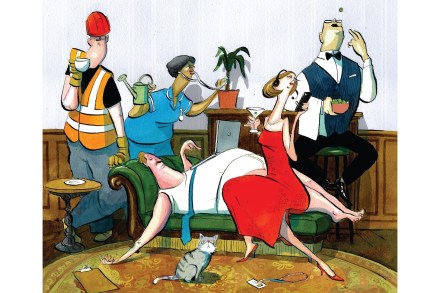
What sent the economy into recession at the end of last year? The government blames higher interest rates, ushered in by the Bank of England. The Bank in turn points the finger at shocks such as Russia’s war against Ukraine. Both are plausible answers – and certainly part of the equation. But the Office for National Statistics has offered up another explanation, one that the Chancellor Jeremy Hunt will be grappling with as he prepares for the Budget in two weeks’ time: mass worklessness. ‘If more people were in work, consuming, producing,’ said ONS chief economist Grant Fitzner when the recession was announced, ‘we would have higher GDP numbers.’ Those numbers would be quite a bit higher, according to The Spectator’s calculations.

Jeremy Hunt’s cash boost isn’t quite what it seems

From our UK edition

Jeremy Hunt needed some good news this morning, when the monthly public sector finance update was released by the Office for National Statistics (ONS). Having promised meaningful tax cuts last month – and then rowed back expectations this month – the Chancellor was hoping for a notable surplus and reduction in borrowing to give himself a bit more room within his fiscal rules to cut tax. January delivered. The ONS reports a surplus of £16.7 billion in January 2024 – not only double the surplus of the same month last year, but a record-breaking surplus (in nominal terms) since records began. Receipts jumped up to £111.4 billion – almost £4 billion more than January 2023 – while borrowing for the financial year rose to £96.6 billion, £3.

Britain’s economic pain started long before the recession

From our UK edition

The Tories have had a tax problem for quite some time. But news of a recession at the end of last year has made matters much worse.  It has been an uncomfortable position, for Rishi Sunak and Jeremy Hunt, to defend the Conservative party taking the tax burden to a post-war high. The political defence has been that it was necessary to prove to markets that the UK took the state of its finances seriously, and that cutting tax was only an option when inflation meaningfully slowed down. Reasonable points – but there’s a catch.

UK tips into recession – what’s left of Sunak’s priorities?

From our UK edition

11 min listen

This morning's figures show that the UK went into a technical recession last year. Forecasts suggest it will be a short and shallow recession, but how badly does this reflect on the government's priorities to increase growth and lower inflation? Also, will this make Rishi Sunak think again about his plan to meet as many rattled voters as possible on the campaign trail? Natasha Feroze speaks to Kate Andrews and James Heale.

The UK is in recession – but for how long?

From our UK edition

At the start of last year Rishi Sunak made the promise to ‘get the economy growing’ one of his five major pledges. Today he is confronted with headlines that the UK fell into recession at the end of last year, as the Office for National Statistics reported this morning that the economy contracted by 0.3 per cent between October and December 2023. This fall in the fourth quarter followed a fall of (an unrevised) 0.1 per cent in the third quarter. That’s two consecutive quarters of negative growth – the technical definition of recession. Today’s revelation is going to spark debate about what constitutes a recession. The technical definition has been met, but do these economic contractions fit the typical model of recession?

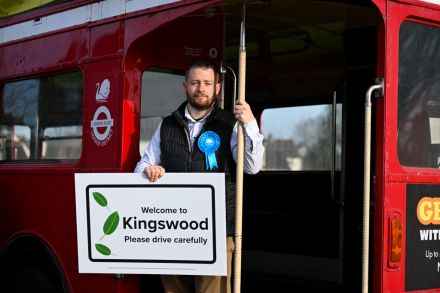
Have the Tories given up on Wellingborough & Kingswood?

From our UK edition

10 min listen

Inflation figures released this morning have remained at 4 per cent – a worry for Rishi Sunak's five pledges. There are several hurdles are still to come for the Prime Minister this week, including growth figures tomorrow and two by-elections on Friday. Why are the Tories keeping things low-key on the campaign trail? James Heale is joined by Kate Andrews and Lucy Fisher Whitehall editor of the Financial Times.