Julius Strauss

Julius writes Back to the Front, a substack on Ukraine, Russia, the Middle East & the Balkans

Bucha and the dark echoes of Srebrenica

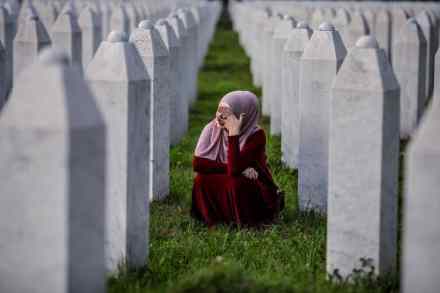
High on a hillside not far from the eastern Bosnian town of Srebrenica the remains of dozens of young Muslim men had been left to rot. By the time I found them most of the flesh had been eaten away by forest scavengers – bears, wolves, foxes and even stray dogs – but the skeletons and skulls remained, some with rags of clothing and scraps of hair still attached. Personal possessions lay among the remains: tobacco tins – one inscribed with the name Suljo, a pair of broken glasses, family photographs. Most of these photos were taken with Polaroid cameras – a status symbol in the old Yugoslavia. The black backings had peeled away but the faces were still visible, if faded.
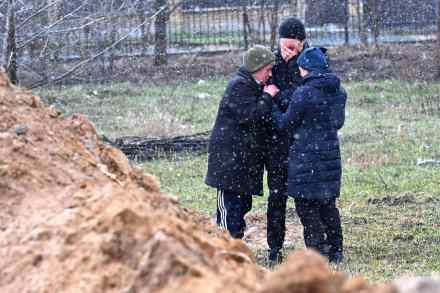
Russian cruelty has been laid bare

It was 2 a.m. when Russian gunmen broke in and took away 21-year-old Milana Ozdoyeva. When Sara, her three-year-old daughter, tried to grab her mother's hand they shoved her aside. Milana's son, who was 11 months old, just stared uncomprehendingly. ‘They were wearing masks and camouflage,’ Milana's mother told me. ‘They forced us all to the floor at gunpoint. Milana was too terrified to speak. She just looked at me and mouthed the words “mama”. It was the last time any of us saw her.’ The kidnapping and subsequent killing of Milana took place in Chechnya on 19 January 2004. Her sin was to have been married to a man who was suspected of taking up arms against the Russian military.

Has Putin finally handed over control to his generals?

Russia has signalled that, a month into a war that it expected to take a few days, it would begin scaling back its military activities around the Ukrainian capital Kyiv. Moscow's deputy defence minister, Alexander Fomin, said that the move was designed to increase mutual trust between Russia and Ukraine. The real reason, if indeed the claim proves to have any veracity, is more likely that Vladimir Putin's military has taken a pounding around Kyiv, leaving village high streets strewn with burned-out Russian tanks and dead soldiers. Fomin said that Russia 'would dramatically reduce military activities in the directions of Kyiv and Chernihiv.' Chernihiv is one of several major cities under siege by their forces.

The terrifying prospect of Putin escalating the war

Battered Kharkiv, Ukraine’s second most populous city, is showing no signs of falling. The column of Russian tanks outside Kiev has gone to ground. The capital itself seems to be off Moscow’s menu entirely, at least for now. In Russia FSB chiefs are reported to be under house arrest. The economy is in freefall. There are rumours swirling of a potential coup d’etat. Nearly four weeks into Russia's full-throated attempt to seize Ukraine, things are not going the Kremlin’s way. Volodymyr Zelensky, a former comedic actor leading a country that has long been considered an also-ran, has bloodied Putin’s nose. But far from this being a time to relax, or, even worse, fall into self-congratulation, we are now entering a period of high peril.

Putin and the Muslim world

Several thousand Muslim Chechen fighters are reportedly massing on the edge of Kiev. Syrian volunteers, filmed this week holding assault rifles and chanting pro-Moscow slogans, are en route to the Ukrainian frontlines. Is Vladimir Putin running out of Christians for his war machine? The number of Russian battlefield casualties has certainly been high. Up to 7,000 Russian infantry have been killed since the invasion began, according to US estimates. That would put Russian casualties at more than the entire American losses in 20 years of fighting in Afghanistan and Iraq. As many as 14,000 Russians may have been injured.

Ukrainians fear Chechen fighters. Russian soldiers hate them

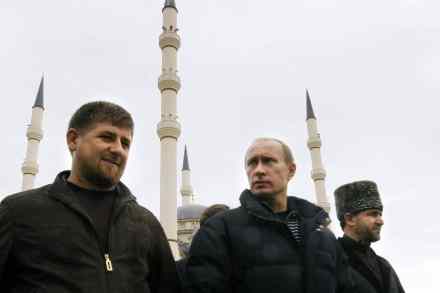
Residents fleeing the Kiev suburb of Bucha reported Chechens machine-gunning cars, even those with the word ‘children’ written in their windscreens. The arrival of Chechen strongman Ramzan Kadyrov, who claims to lead a force of 10,000 of his countrymen, will have unnerved Ukrainian volunteers defending their city. When the Chechens intervened in eastern Ukraine in 2014, they gained a reputation for undue cruelty. ‘There were stories of Kadyrov's guys castrating prisoners of war,’ one woman with family still living in the Donbas told me.  Ukrainian fighters won’t be the only ones feeling nervous. Russia’s military has had an acrimonious relationship with the Chechen leader stretching back nearly two decades.

Putin is bored

At the beginning of this year, Vladimir Putin was sitting comfortably in the Kremlin: his legacy so far a steady leader who had saved his people from the helter-skelter of robber capitalism in the 1990s and given them a modicum of stability and pride. He must have known that if he waged war on a country of 45 million brother Slavs, he risked losing it all. Liberty and life are now less certain. So why did he do it? Having spent four years in Moscow and more than two decades of Russia-watching, I have never believed that Putin was a chess grandmaster. While his apologists in the West lauded his cunning, I have always seen him as an improviser. Like the best at his favourite sport – judo – he prepares for combat, studies his opponent, and considers various eventualities.

Putin’s next move

Budapest Russian troops, many apparently without insignia, began advancing into the disputed Donbas region yesterday. The question now is how much further they will go. The Donbas rebels claim an area three times the size of the territory they currently hold, which is roughly equivalent to the area of Devon. If Moscow were to try to take control of the larger territory, it would mean overrunning the Ukrainian frontlines. It is unlikely that Kiev’s military can mount a serious defence if the Kremlin orders a full-scale attack. The call to advance came in the form of a belligerent speech by Putin to the Russian people. In it, he strongly suggested that his aim was to reintegrate the country of 45 million into the motherland.

The phoney war

39 min listen

In this week’s episode: Will Putin invade Ukraine? For this week’s cover story, Owen Matthews argues that if Putin is going to invade Ukraine, he will do so later rather than sooner. He joins the podcast, along with Julius Strauss who reports on the mood in Odessa for this week’s magazine. (00:42)Also this week: Is Brexit working?This week marks the second anniversary of Brexit. But how successful has it been? Joining the podcast to answer that question is Lord Frost who was Chief Negotiator of Task Force Europe from January 2020 until his resignation in December last year - and the journalist Ed West, who runs the Substack, Wrong Side of History (13:12)And finally: What is the allure of a classified ad?

Letter from Odessa: life on the front line of a new Cold War

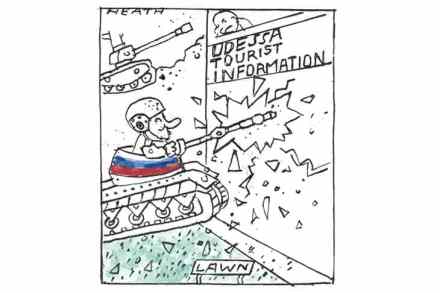
‘God Save the Queen’ trended on Ukrainian social media over the weekend. ‘As a Brit in Kiev I have never felt so popular,’ one expat tweeted. Four hundred miles to the south, however, on the once grand, now shabby streets of Odessa, the enthusiasms of the Twittersphere seem remote. There is little optimism that Britain, or indeed any other western country, can do much to halt the tidal wave that locals fear Russia is about to release on them. At first blush, life might look normal. On the main pedestrian street, Deribasovskaya, horsemen offer children rides on ponies with pink saddles. But in the city’s cafés, markets and large open squares, there is gnawing fear and growing unease. ‘How can we plan for tomorrow?