Jules Evans

Jules Evans is an author and the founder of the Challenging Psychedelic Experiences Project, which helps people experiencing post-psychedelic difficulties.

Big Pharma wants to sell you psychedelic drugs

This year is set to be the year of psychedelics – Trump’s trip, you could call it. Since the President signed an executive order supporting the use of psychedelic medicines in April, no fewer than six federal agencies have announced initiatives to help usher the industry along. The agencies, mainly connected to the Department of Health and Human Services, have approved multiple million-dollar initiatives to research, approve and roll out psychedelics. A whole fleet of startups are now circling the Food and Drug Administration. Three of these have Commissioner’s National Priority Vouchers from the FDA, which means that when they submit their new drug applications, the agency will make a decision within two months of filing.

psychedelics

How AI led a psychiatrist to a breakdown

This is the story of Paul, a 52-year-old psychiatrist who had a psycho-spiritual crisis triggered by overwork and overuse of AI. But this is not a usual AI cautionary tale, because Paul also says AI helped him navigate said crisis and make sense of it. Is he still in the grip of AI-induced mania? You decide. Paul has ADHD, and took a common form of stimulant to treat it until recently. He is interested in big ideas and spirituality. Early last year, he was working freelance and using AI to help him produce two or three 5,000-word reports a day. Because it was so useful at work, Paul started talking to AI more and more, sometimes for 20 hours a day. One night, he uploaded books by Epictetus and Marcus Aurelius into an AI and spent the night chatting to “them.

Fighting spirit | 16 April 2011

From our UK edition

How does the army of a liberal, multicultural and often secular society develop in its soldiers the spiritual resilience to cope with war, to face trauma, death and bereavement, and to fight opponents who have the advantage of a strong and common religious faith? That’s the question the Pentagon has been grappling with, as it confronts the apparent epidemic of post-traumatic stress disorder affecting a fifth of its troops coming home from Iraq and Afghanistan. Its response is a new psychological training programme called Comprehensive Soldier Fitness, which aims to strengthen the emotional, psychological and, yes, spiritual resilience of each of the 1.1 million soldiers serving in the US Army.

‘I made this revolution’

From our UK edition

In a white room in Bishkek, Kyrgyzstan, a tattooed man from Georgia is trembling violently. His eyes are rolled back to the whites, his spine is arched, his arms flail in front of him as if he is being electrocuted. Behind him stands another man, Asiatic, completely bald, with dark piercing eyes. He shouts, almost raps, into the convulsing Georgian’s ears, ‘Drive out the filth! You are a strong man, charged with energy! Help yourself out of this!’ He repeats this over and over until the Georgian has a spasm and collapses in a trance. He is put on to a stretcher, carried out of the room and laid in a bed with high metal sides.

The Russian whose fortune fell from the sky

From our UK edition

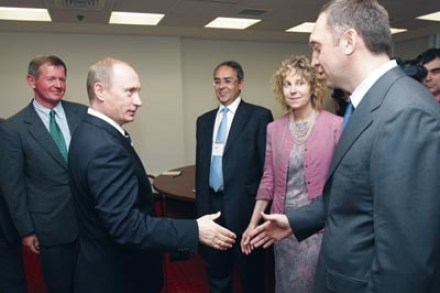
Jules Evans says billionaire industrialist Oleg Deripaska has global business ambitions — but a dispute with another Russian tycoon, Michael Cherney, may get in his way Oleg Deripaska wants it all. He already has quite a lot: assets in Russian insurance, pulp, construction, airports, media, cars, and oil, and a controlling stake in the world’s largest aluminium company, Rusal. These make him Russia’s second-richest man, worth $18 billion according to Forbes; only Roman Abramovich is richer. But Deripaska’s ambition is not yet sated. He wants a place in the top league of global businessmen alongside Bill Gates and Lakshmi Mittal. And so far his ambition appears to enjoy strong Kremlin backing.

The KGB man who spied on the bond markets

From our UK edition

It’s not every day a former KGB spy invites you to interview him. But Alexander Lebedev is not your typical KGB spy. He’s made billions in stock-market trading, he throws lavish parties in London attended by the likes of Tom Wolfe and J.K. Rowling, and he might just be the most serious critic of Kremlin policy still standing. Naturally I accept, and go to meet him in the Hyatt hotel in central Moscow. He’s sitting at the back of the bar, dressed more like a rock-band manager than a billionaire spook. Lebedev joined the KGB in the early 1980s and was sent to London in 1988, operating out of a flat in Kensington High Street.

The only Western oligarch in Moscow

From our UK edition

Stephen Jennings is very tall — about six feet seven. He wraps his body into contortions to fit his limbs into his chair in his central Moscow office. He would certainly suffer in Aeroflot’s economy class —  but luckily he has his own jet. He’s also a towering figure in Russian business. His investment bank, Renaissance Capital, is worth up to £3 billion, and he owns roughly 80 per cent of it. He is, says another Moscow banker, ‘the only foreign oligarch in Russia’. This 47-year-old Kiwi hasn’t just had a front-row seat in the turbulent changes of the last 15 years of Russian business and politics. He’s played a key role in those changes.

A rollercoaster ride with the Caucasian billionaire

From our UK edition

In his annual meeting with foreign journalists in January, President Putin enthused over his country’s record on initial public offerings: ‘Without any doubt, 2006 can be called the year of IPOs, because it was the first time that Russian companies carried out ... IPOs worth dozens of billions of dollars on international and Russian exchanges.... And this is just the beginning.’ Indeed, this year’s schedule for Russian IPOs is even more packed, as companies rush to issue before the presidential elections next year. Analysts estimate Russian companies will attempt to raise as much as $25 billion this year, well ahead of last year’s total of $15 billion.

Is Belarus next in line?

From our UK edition

If you listen carefully, you can hear the drums of revolution beating once more in Washington. The neoconservatives have found another regime that needs changing, another enemy of ‘freedom’, and they are setting about putting matters right in their usual way. This time the target is Belarus, a small country in between Poland, Ukraine and Russia with a population of 10 million. Since 1996 Belarus has been run as a communist dictatorship by President Aleksander Lukashenko. All the usual precursors to a US-sponsored ‘revolution’ are in place: an influential Washington NGO — the US Committee on Nato — has said that fostering democracy in Belarus is an ‘essential, moral and strategic imperative for US foreign policy’.