Jonathan Portes

Right to reply – Jonathan Portes on Niall Ferguson

From our UK edition

Two weeks ago I was too 'obscure to bother with' for Professor Niall Ferguson. He's changed his mind, dedicating an entire article in The Spectator to me. In particular, he is very upset that, after I complained, the FT was obliged to correct his recent article about the UK economy. Professor Ferguson's article contained one undisputed factual error (about UK business confidence) and one statement which the FT's independent complaints commissioner found to be misleading, but which Professor Ferguson argues is composed of two 'true statements'. This was: 'Weekly earnings are up by more than 8 per cent; in the private sector, the figure is above 10 per cent. Inflation is below 2 per cent and falling.


Why Fraser Nelson is wrong about a jobs ‘miracle’

From our UK edition

In his blog earlier today, Fraser Nelson argues: 'The UK jobs miracle is happening mainly due to radical welfare reform – the type Labour ducked in office..Under Labour, record numbers of people in work were celebrate as an end in itself – but most of the increase was accounted for by immigration. So more jobs did not mean less poverty – not if a quarter of Glasgow and Liverpool were still languishing on the dole at the peak of a boom. This time, it’s different. The welfare reforms are restoring the see saw link between jobs and dole queues.' I suppose I should by now get over the fact that intelligent, articulate journalists feel able to write with such certainty about data they simply don't understand.

Analysis: what is meant by 13,000 ‘excess’ NHS deaths?

From our UK edition

When the dust settles on the Keogh report published last week  one figure is likely to linger: the "13,000 excess deaths" in the 14 NHS hospitals. It deserves careful scrutiny – and some has been applied by Isabel Hardman here with more details about this curious notion of "Hospital Standardised Mortality Rates" in the Health Service Journal here.  But these still leave the question unanswered as to why these "extra" people are dying, and what, if anything, we can and should do about it.  Here’s my attempt. It’s fairly detailed, and it's still a lovely day so those who don’t have an appetite for such things may not want to click on the link. But those who do want to get their heads around this may find it interesting.

Why George Osborne’s ‘Plan A’ has failed – and what to do next

From our UK edition

Does George Osborne need to adopt a Plan B? This will be the topic for a Spectator debate a week on Monday. But the argument is pretty clear to everyone with even a passing interest in the trials of George Osborne. Let’s look at the story so far. His Plan A - accelerated fiscal consolidation - was based on two key premises:  there was no alternative to cutting the deficit much more sharply than previously planned, because otherwise the markets would panic and long-term interest rates would rise sharply.  As one Treasury Minister put it: 'Britain’s AAA credit rating was under threat...George Osborne had no choice but to come up with a comprehensive deficit reduction plan—not to merely halve the deficit over four years, but eliminate it.

Another voice: Against austerity

From our UK edition

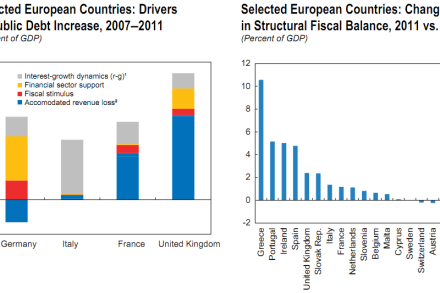
Here's the latest in our Another Voice series of posts, which give prominence to viewpoints outside the normal Coffee House fold: You can't help but notice that the UK economy isn't doing too well. Part of this is down to international developments, sure. But part – as Mervyn King said in "http://www.bankofengland.co.uk/monetarypolicy/pdf/govletter111006.pdf">his letterto George Osborne last week – is the result of "fiscal consolidation", aka spending cuts. The IMF's assessment, published a few days ago, shows both why debt has risen (lower tax revenues) and what is happening now (sharp contraction): And there's much more contraction to come: So why keep on contracting if it is affecting economic growth?

Right to reply: The impact of immigration on the labour market

From our UK edition

Yesterday, we introduced our new “Right to reply” series, where outside writers take on some of the ideas and arguments raised on Coffee House. In that case, it was the IPPR’s Matt Cavanagh replying to Fraser’s recent post on immigration and the labour market. Here’s another reply to the same post, this time by Jonathan Portes of the National Institute of Economic and Social Research: Myths abound when it comes to the effect of immigration on the labour market — and the most damaging of these is that most or all “new jobs” go to migrants. Although I agree with Fraser Nelson's general views on immigration, he is misleading on this one point.