Jonathan Jones

The public doesn’t want the government to drop Lords reform or gay marriage

From our UK edition

It’s been a fashionable line on the Tory right of late that if the government pushes ahead with Lords reform and same-sex marriage, it will be out-of-step with public opinion. But we have new evidence — courtesy of YouGov — suggesting that isn’t the case. In their latest poll, YouGov asks whether respondents think ‘the government should or should not go ahead with’ a number of contentious policies, including ‘Reforming the House of Lords to make it mostly elected’ and ‘Allowing same-sex couples to get married’. Note that they’re not just asking whether folk support the policies, but whether they think the government should be going ahead with them now. And what do they find?
Clegg goes mobile

From our UK edition

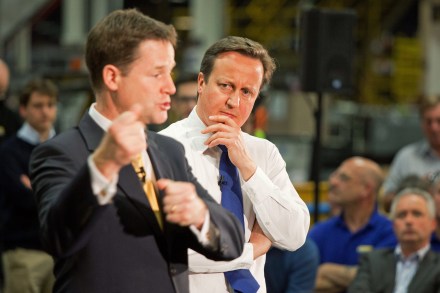
Just as David Cameron is trying to move on from a tough few weeks by returning to themes that worked for him earlier in his leadership, Nick Clegg is also focusing on familiar territory. He’s given a speech this morning on the pupil premium — which he made a key component of his Lib Dem leadership bid back in 2007. And today’s speech marks the start of a two-week push on a key Clegg concern: social mobility. It’s not as if Clegg’s been silent on the topic recently, but this is the first time it’s been at the top of his agenda since he launched the government’s social mobility strategy last year. In a way, Clegg’s speech was set up nicely by Michael Gove’s forceful words on Thursday.

Get set for more Greek elections

From our UK edition

A second Greek election is looking more and more likely, with party leaders unable to form a coalition. I reported on Tuesday that Antonis Samaras — leader of the largest party, New Democracy — had admitted that he couldn’t put together a government and had passed on the mandate to Alexis Tsipras, leader of Syriza. Well, Tsipras also failed to build a coalition, as he couldn’t convince ND and centre-left Pasok to turn against their austerity plan, and so the baton has been passed to Pasok leader Evangelos Venizelos.

The coalition: two years in

From our UK edition

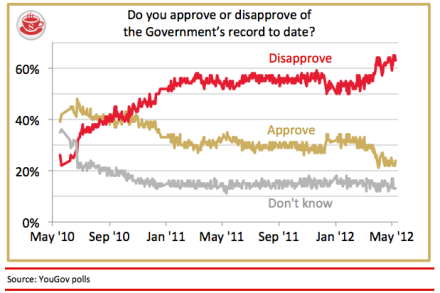
As the coalition celebrates its second birthday, it seems as good a time as any to take a look at how it’s doing in the eyes of the public. First, here’s how the government’s approval rating — as measured by YouGov — has changed since its formation: As you can see, the coalition took office with reasonably good ratings, but the first ten months or so — which included the Comprehensive Spending Review and the tuition fees vote — saw public opinion turn against it. For the rest of 2011, the ratings stayed fairly flat, with the government neither regaining ground with the public nor losing any more — and there was even a slight bump in popularity in early December, following David Cameron’s EU ‘veto’.

Gove takes on private school dominance and trade union opposition

From our UK edition

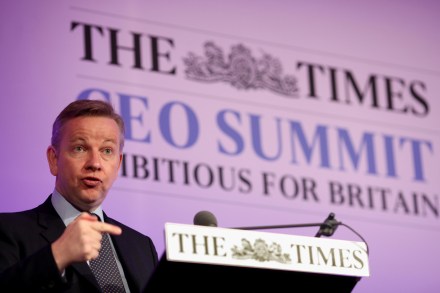
The Education Secretary gave a very pugnacious speech this morning on the need to improve the country’s state schools. ‘It is remarkable,’ Michael Gove said at independent school Brighton College, ‘how many of the positions of wealth, influence, celebrity and power in our society are held by individuals who were privately educated’. He cited the various professions — politics, law, medicine — where private schools are ‘handsomely represented’. That’s certainly not a new observation. Gove could have, if he’d wanted to, cited the Sutton Trust’s statistics (below) showing the proportion of judges, Lords and CEOs who come from independent schools.

Obama comes out for gay marriage

From our UK edition

video platformvideo managementvideo solutionsvideo player It isn’t just this side of the Atlantic where same-sex marriage is very much on the political agenda. Here, the Prime Minister gave it his support in his October conference speech, and the government is pressing ahead with plans to legislate for it before the next election, under the leadership of Lib Dem equalities minister Lynne Featherstone. Meanwhile, across the pond, Barack Obama gave his support for equal marriage last night. In an interview with ABC News (above), he said: ‘At a certain point I’ve just concluded that for me personally it is important for me to go ahead and affirm that I think same sex couples should be able to get married.

The Greek tragedy goes on

From our UK edition

‘The eurozone's weakest link just got weaker.’ So says Tristan Cooper, sovereign debt analyst at Fidelity Worldwide Investment, on the results of Sunday’s Greek elections. The four parties who said they would continue the country’s austerity programme won just 36.4 per cent of the vote between them. The two of those that won parliamentary seats — centre-right New Democracy and centre-left Pasok — fell just short of a combined majority (they now hold 149 of the 300 seats). And now ND leader Antonis Samaras has admitted defeat in his efforts to form a coalition.

15 (other) cities to watch

From our UK edition

Forget London. Odds are that Boris will win re-election while Labour becomes the largest party on the GLA. There are far more exciting battles going on around the country. Here’s the state of play in 15 cities outside the M25: 1. Birmingham. After strong gains in 2011, Labour are looking to depose the Conservative-Lib Dem coalition and regain the overall majority they held here until 2003. They need just five gains to do so — and, with 18 Tory seats and 13 Lib Dem ones up, that shouldn’t prove too difficult. Both of the coalition parties are simply in damage limitation mode. 2. Glasgow. Labour held a majority here for three decades, but lost it just a few weeks ago through resignations.

Boris wins the popularity contest

From our UK edition

So, after all that, it looks like today’s London Mayoral will be just a little bit of history repeating. YouGov’s final poll predicts that Boris will defeat Ken in the second round by 53 to 47 — exactly the same result we saw four years ago. The third place finisher will probably be the same too: the poll has Brian Paddick getting 7 per cent in the first round, ahead of Siobhan Benita and UKIP’s Lawrence Webb on 4 and Green Jenny Jones on 3. If Boris does overcome Labour’s partisan advantage in London, it won’t be mainly down to his achievements in office. In fact, voters are split 39-38 between Ken and Boris on who’s achieved more as Mayor (although Ken did, of course, have four more years than Boris has so far).

What would count as a success for Labour?

From our UK edition

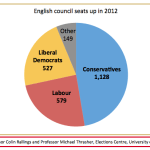
In today’s English council elections, there’s no doubt that Labour will do better than in 2008 — the last time most of these seats were contested. Experts Colin Rallings and Michael Thrasher predict that they’ll improve their ‘national equivalent vote share’ by 13 points compared to four years ago. But how many seats can they pick up of the back of that improvement? Rallings and Thrasher say a figure of 700 would justify a five-point lead in the polls. LSE’s Tony Travers expects Labour’s gains to be around 700-800, and says that: ‘If Labour only manage to put on a further 500 seats, that would be seen as seriously underperforming expectations. Ed Miliband will need 900 gains for a good night.

Boris has won already, says bookie

From our UK edition

We may still be 19 hours away from the polls opening — and more than 48 away from hearing the result — but bookmaker Paddy Power has already paid out £20,000 to punters who bet on Boris. It’s a publicity stunt by the company, but one that's unlikely to backfire, with the pollsters agreeing that Boris is set for re-election — the only question seems to be how much he’ll win by. YouGov show him 4 points ahead of Ken in the second round, ComRes have him up by 8, Survation 10 and Populus 12. Paddy Power says that 94 per cent of the bets they took on the race in the 24 hours before they paid out were for Boris. Similarly, Ladbrokes announced yesterday that 88 per cent of the cash bet had been for the current Mayor.

Le Pen says ‘non’ to Sarkozy

From our UK edition

Marine Le Pen didn’t achieve quite the shock result in this year’s French presidential election that some thought she might when a few polls showed her ahead of Nicolas Sarkozy. But, even though she didn’t make it through to this weekend’s run-off, the National Front candidate did win 17.9 per cent of the first round vote. That means there are 6.4 million Le Pen voters for Sarkozy and Francois Hollande to fight over, putting her in a potentially very influential position. Sarkozy — currently trailing Hollande by six to ten points in the polls — has been particularly keen to court those voters, saying in a radio interview today, for example, that France has taken in too many immigrants.

Boris extends his lead

From our UK edition

As we enter the final stretch of the campaign for London Mayor, YouGov have a new poll putting Boris four points ahead of Ken. It’s a touch better for the blue team than the 2 point lead YouGov found last week, but not as comfortable as the 8- and 10-point leads shown by ComRes and Survation respectively. Despite dropping a bit further behind Boris, Ken does not seem to be suffering from Labour supporters turning their backs on him. Indeed, he now gets 92 per cent of those Labour general election voters who express a preference between him and Boris — the highest level of party loyalty YouGov have found for him yet.

Boris drops the f-bomb (again)

From our UK edition

More ‘colourful language’ from Boris Johnson today. Interviewed by the BBC about his reported attempts to secure sponsorship from News International while they were being investigated for phone hacking, he dismissed the claims as ‘f***ing b****cks’.

Comedian-in-Chief

From our UK edition

Every year, the White House Correspondents’ Dinner boasts an eclectic guest list, and last night’s was no exception. Stars of the political world — including Colin Powell and Chris Christie — were joined by Hollywood stars including George Clooney, Steven Spielberg, Kevin Spacey and Lindsay Lohan. Late night TV host Jimmy Kimmel provided after dinner entertainment, but — as last year — the best jokes came from Barack Obama. He poked fun at himself: ‘Some have said I blame too many problems on my predecessor. But let’s not forget, that’s a practice that was initiated by George W Bush.’ The Republican primaries: ‘[Mitt Romney] took a few hours off the other day to see The Hunger Games.

Britain’s longest downturn

From our UK edition

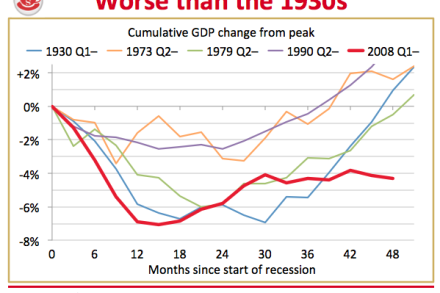
As of today, we now have four years’ worth of GDP figures since the UK first went into recession — and they don’t look pretty. By this point in the 1930s, we’d already fully recovered from the Great Depression.

Miliband more popular than Cameron

From our UK edition

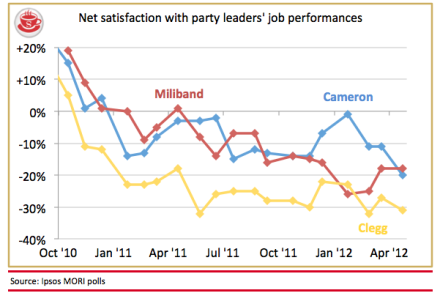
For the first time since August last year, Ed Miliband’s net approval rating with Ipsos MORI is higher than David Cameron’s. That marks quite a turnaround in the last few weeks: in January, Miliband’s rating was 25 points lower than the PM’s. Cameron’s ratings are now at their worst point ever.

The state of the public finances

From our UK edition

£126 billion. As we discover today, that’s how much the government borrowed in 2011-12 — the fiscal year that's just ended — pushing the national debt up to £1.02 trillion. The figures show the deficit falling by 10 per cent in real terms on 2010-11, but it has come in slightly over the £122 billion the OBR predicted in March last year, and well above the £116 billion it forecast when Osborne delivered his first Budget. So the fiscal consolidation is proceeding, albeit a bit slower than planned. So far, it’s mainly being achieved through raising revenues — particularly VAT receipts, which are up 10 per cent on last year. Central government current spending, meanwhile, has fallen by just 0.2 per cent.

The race for London Mayor gets tighter

From our UK edition

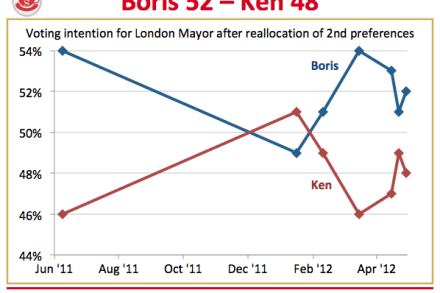
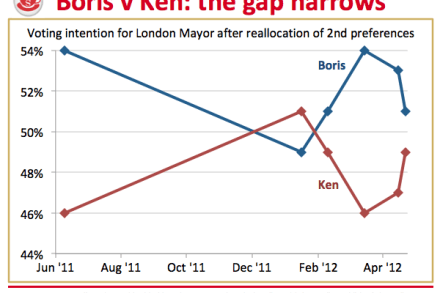
It looks as though the London Mayoral election isn’t the foregone conclusion some thought it was. A new YouGov poll for the Evening Standard has the gap between Boris and Ken down to just two points — well within the margin of error. That contrasts with the eight-point lead that Boris had opened up last month: One interesting finding is that, despite all the controversy over his tax affairs, Labour supporters are not turning their backs on Ken. In fact, they seem to be rallying around him. Of those Labour general election voters who express a preference between Ken and Boris, Ken now has the support of 89 per cent.

Car crash in the desert?

From our UK edition

In 2004, when the Formula One circus first travelled to the Middle East for the inaugural Bahrain Grand Prix, there was little sign of the storm to come. The first event was hailed as a success — and not just for Michael Schumacher, who notched up his 73rd victory in the Sakhir desert. The FIA — the sport's governing body — even declared it that year's ‘Best Organised Grand Prix’. Few would have guessed then that, eight years later, so many would want to see the race cancelled. But when the calls came — first from Nabeel Rajab, the Vice President of the Bahrain Centre for Human Rights, two days after Bahraini police were accused of beating him — it wasn’t such a surprise.