Jonathan Jones

Fisking the coalition’s deficit-reduction boast

From our UK edition

'We have reduced the deficit by a quarter in just two years' — the coalition's mid-term review. True. But when Gordon Brown proposed to do precisely the same in Labour's last budget, George Osborne criticised him for not moving fast enough and endangering the economy. The ONS shows that public sector net borrowing was down 24 per cent from 2009-10 to 2011-12. But George Osborne cannot claim to have stuck to his deficit reduction plan. That has been torn up. The below graph shows Brown's plan (in the middle), Osborne's original plan (at the bottom) and his current plan (at the top): As you can see, Osborne is now cutting the deficit more slowly than Alistair Darling proposed in 2010. Darling planned to cut the deficit by 33.9 per cent by this year, compared to the 24.
Briefing: Means-testing Child Benefit

From our UK edition

George Osborne's removal of child benefit from high-earners kicks in on Monday, but what exactly does it entail? Who loses what? Initially, Osborne's plan was 'to remove child benefit from families with a higher rate taxpayer', as he announced in the Spending Review of October 2010. (This year, that'd be anyone earning over £42,475.) But after criticism that this would hit too many people, and that it would create a 'cliff-edge effect' (whereby someone earning £42,475 would keep all their Child Benefit but someone earning £42,476 would lose it all, so the lower-earner would end up better-off), Osborne changed his mind.

Ed Miliband vs the working class

From our UK edition

Who's on the side of the strivers? Is it George Osborne, who's cutting benefits in real terms for the next three years, which he defends as 'being fair to the person who leaves home every morning to go out to work and sees their neighbour still asleep, living a life on benefits'? Or is it Ed Balls, who's opposing the move as Osborne 'making striving working families pay the price for his economic failure'? Both men are convinced that their stance will help win the votes of low- and middle-income workers. At least one of them is wrong. Isabel has explained the sources of Labour's confidence. One is a YouGov poll released on Sunday, showing 42 per cent of 'C2DEs' (working class and lower) think benefits should rise at least in line with inflation.

Private sector growth pushes employment to new record high

From our UK edition

The number of people in work in the UK hit 29.6 million in August-October – the most ever — according to today's figures from the Office for National Statistics. So despite GDP still languishing 3 per cent below pre-recession levels, employment has fully recovered, with half a million jobs created in the last year: The rise in employment has been thanks to the private sector more than making up for the job cuts in the public sector.

We’ve shown forecasts are unreliable, jokes OBR chief

From our UK edition

'We've done quite a good job at demonstrating the limitations of economic forecasting,' half-joked Office for Budget Responsibility Chairman Robert Chote at the start of his Treasury Select Committee appearance this morning. And he spent a lot of his answers emphasising those limitations, while robustly defending himself against charges that the OBR is just making it up. His challenge was to explain to sceptical MPs why we should pay attention to the OBR's new forecasts, given that their previous ones have missed by so much. For the OBR's economic forecasts — rather than its forecasts for the public finances — Chote admitted that 'we don't have access to any information that other forecasters don't.

The public’s verdict on the Autumn Statement

From our UK edition

We've only had two days to digest it, but the early signs from YouGov are that George Osborne's Autumn Statement has gone down a lot better than his March Budget. The Chancellor's personal ratings are still dire – just 24 per cent think he's doing a good job — but that's a lot better than 15 per cent five months ago. His approval rating had tanked after the Budget, but Osborne does seem to have turned that around: And the government's approval rating on the economy similarly seems to have been helped by the Autumn Statement, and is back up to pre-Budget levels: Though a 35 per cent approval rating on the economy is not exactly great, it's notably better than the government's overall approval rating, which is currently just 26 per cent.

The Autumn Statement in 7 graphs

From our UK edition

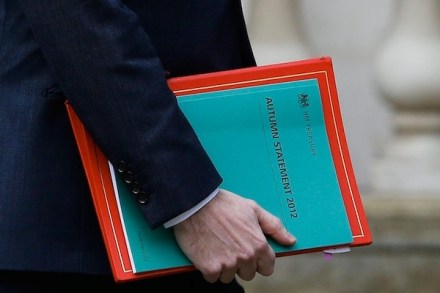
1. Growth evaporating. The Office for Budget Responsibility once again downgraded its growth forecasts for 2012-13 and, for the first time, also did so for 2014-16. Despite that, the OBR is still slightly more optimistic than the average independent forecaster: 2. A seven year slump. On the OBR forecasts, it will now take until the end of 2014 to get back to where we were before the crash. In the 1930s, it took 'just' four years to recover: 3. Slower deficit reduction. The weaker economic outlook means the government will be borrowing more than expected. When George Osborne delivered his first Budget in 2010, the OBR predicted he'd get the deficit down to £20 billion in 2015-16. It now says it'll be £82 billion.

A budget for the squeezed middle

From our UK edition

Ed Miliband may have coined the term, but it seems George Osborne has the squeezed middle on his mind too. The overall effect of yesterday's budget* was to take from the rich, take from the poor and give to the middle. The IFS has crunched the numbers and produced the latest in its series of decile charts: The bottom half of households lose out mainly due to the Chancellor's decision to increase most working-age benefits by only 1 per cent a year for the next three years, and hence cutting them in real terms. The rich, meanwhile, have been hit mainly by the cut in the tax-free allowance for pension contributions and the below-inflation 1 per cent increase in the point where the 40p income tax rate kicks in.

Autumn Statement: What Osborne will say

From our UK edition

Lower growth, bigger deficits, targets missed — that'll be the backdrop to George Osborne's Autumn Statement tomorrow. So what medicine will he prescribe to make it all better? As usual, many of the policies have been leaked already: More capital spending, paid for by extra cuts elsewhere This was announced by Number 10 this morning: £5 billion extra spending on schools, science and transport over the next three years. That'll include an extra £1 billion for Michael Gove's academies and free schools programmes, to provide 50,000 new school places. It'll all be paid for by extra cuts in departments' resource budgets: 1 per cent more than planned next year and 2 per cent the year after (though Health, Education and International Development will be protected).

Autumn Statement: Downgrades R Us

From our UK edition

How much trouble is George Osborne in? We don’t need to wait until his mini-Budget tomorrow, we already know most of it. And we’ll enter that peculiar Budget game, where the already-known is restated and treated like news. CoffeeHousers might like to get ahead of the curve. Growth evaporating The Office for Budget Responsibility will have to follow the other economic forecasters and downgrade its growth forecasts for 2012 and 2013 (again). The Treasury collects independent forecasts monthly, and here's how the picture has deteriorated since March: Although the OBR significantly downgraded its forecasts for 2012 and 2013 last year, it hasn't ever done so for its longer-term forecasts for 2014-16. But it will have to now, probably from around 3 per cent to 2 per cent.

Labour’s safe seats stay safe

From our UK edition

In the end, the threat from smaller parties came to nothing, and Labour easily retained all of the three safe seats it was defending yesterday. In fact, they extended their vote share in all three as well. Respect could only manage a distant fourth in Rotherham and sixth in Croydon North, where former Ken Livingstone adviser Lee Jasper lost his deposit. Instead it was Ukip who came second in Rotherham and Middlesbrough, and third in Croydon North. Both coalition parties saw their vote collapse in all three seats. The Conservatives ended up fourth in Middlesbrough and fifth in Rotherham (their worst results of this parliament), though they did manage to hold onto second in Croydon North. The Liberal Democrats fell to third in Middlesbrough, fourth in Corydon North and eighth in Rotherham.

More left the UK for work in the last year than came here for it

From our UK edition

Net migration to the UK from April 2011 to March 2012 was 183,000, down by a quarter on 242,000 the year before. That's the headline figure from today's Office for National Statistics release, and the government is using it to claim success. Immigration minister Mark Harper said: ‘This shows we are bringing immigration back under control. Our tough policies are taking effect and this marks a significant step towards bringing net migration down from the hundreds of thousands to the tens of thousands by the end of this Parliament.’ But it's worth looking a bit deeper into the figures.

Leveson report: Prising politicians away from the press

From our UK edition

It shouldn't come as a shock that Lord Justice Leveson thinks the relationship between politicians and the press is ‘too close’. And he doesn't think it's a good thing, stating simply: ‘I do not believe this has been in the public interest.’ (Though he does say: ‘I am, of course, conscious of the limited extent to which the Liberal Democrat party (and its predecessors) have, in practice, fitted within that description.’) Leveson puts three specific allegations at the door of politicians: They ‘have spent a surprisingly large amount of time, attention and resource on this relationship in comparison to, and at the expense of, other legitimate claims in relation to their conduct of public affairs.

Labour is sitting a little less comfortably for tomorrow’s by-elections

From our UK edition

Tomorrow's three by-elections — the 11th, 12th and 13th since the general election — should have been three easy Labour victories. They are defending majorities of 16,481 in Croydon North, 10,462 in Rotherham and 8,689 in Middlesbrough. And certainly neither the Conservatives nor the Liberal Democrats — second and third in all three seats in 2010 — look capable of overturning them. But Labour are not looking as comfortable as they'd hoped. In both Croydon North and Rotherham, they've come under threat from Respect, raising the possibility that we'll see a repeat of the 'Bradford Spring' that saw George Galloway return to the Commons with 56 per cent of the vote in Bradford West in March.

Miliband’s false ‘millionaires’ tax cut’ attack

From our UK edition

Messrs Miliband and Balls performed their pre-autumn statement double act today. If for some inexplicable reason you missed it, the Labour chiefs launched their Q&A with an attack on the government for its decision to cut 50p income tax rate to 45p: 'The Government is about to give an average of £107,500 each to 8,000 people earning over a million a year. Not £40,000, but £107,500. To 8,000 millionaires. David Cameron and George Osborne are giving them this money. But it’s coming from you. 'You are paying the price of their failure and them standing up for the wrong people. David Cameron and George Osborne believe the only way to persuade millionaires to make work harder is to give them more money.

Thatcher’s favourite think tank backs Danny Alexander

From our UK edition

In the run-up to the Budget in March, Danny Alexander was pushing for the abolition of higher-rate relief on pension contributions, which would save the government £7 billion plus a year. George Osborne didn't include it in his Budget, but today the Liberal Democrat gets support from a perhaps unlikely quarter: the Centre for Policy Studies. Echoing the Chief Secretary to the Treasury's analysis, Michael Johnson's CPS report says: 'Today's tax-based incentives to save for retirement are hugely expensive and, worse, ineffectively deployed. Skewed towards the wealthy, they do far less than they should to minimise pensioner poverty. Furthermore, they do little to catalyse a savings culture amongst younger workers, thereby exacerbating the looming generational inequality.

IFS warns Osborne: don’t cook the books, like Brown

From our UK edition

The Institute for Fiscal Studies has today published its attempt to predict what the OBR forecasts will show when they're released as George Osborne sits down after delivering his Autumn Statement next week. They put forward two possible scenarios: a ‘pessimistic’ one where the economy's recent weakness is largely permanent, and an ‘optimistic’ one where it is largely temporary. In both scenarios, they show Osborne missing his ‘supplementary target’: to have the debt-to-GDP ratio falling by 2015-16. But these forecasts exclude the effect of transferring of the interest on the Bank of England's Quantitative Easing purchases to the Treasury.

George Osborne might meet his debt target after all

From our UK edition

When George Osborne gives his Autumn Statement on 5 December, the OBR will publish its new forecasts for growth, deficit and debt. For the last few weeks, the consensus has been that the OBR would declare that Osborne will miss the debt target he set himself in 2010: to have the debt-to-GDP ratio falling in 2015-16. The logic behind this, as I set out in September, is pretty straightforward: the OBR will have to lower its growth forecasts, which will in turn mean lower tax revenues, higher deficits and more debt. But it now looks like Osborne might narrowly avoid failure, though not because the outlook for the economy or the government finances is any brighter.

Labour underestimated Osborne’s deficit

From our UK edition

As Fraser reported at the time, Labour put up a deficit clock on its website last month, claiming that the government was borrowing £277 million more during Tory conference than in the same four days last year. It based this on the borrowing figures available at the time, which were for the period April to August. In that period, the government had borrowed £802 a second more than in the same five months of 2011, so Labour assumed it would continue to do so in October. But new figures out yesterday show that this was not the case. In fact, looking just at borrowing in October, Labour was lowballing it by about £67 million. The ONS says the government borrowed £8.6 billion in October 2012, £2.7 billion more than the £5.

US Elections: The favourites for 2016

From our UK edition

Even so soon after President Obama's reelection, speculation over who might replace him in January 2017 is already in full swing. Here are the early favourites, as judged by Ladbrokes: Republicans: Paul Ryan: Nominee 5/1, President 12/1 The Congressman from Wisconsin has gained national prominence as chair of the House Budget Committee and more recently as Mitt Romney's running mate, setting him up as the early favourite to be the GOP's next nominee. But if he were to be successful in the primaries, it'd be only the second time ever a losing Vice Presidential candidate had won the nomination four years later. Of the 16 losing VP nominees since the Second World War, eight ran for their party's nomination in the next election, and only one — Walter Mondale — secured it.