John Waters

Why Paul Lynch’s Prophet Song is one of the strangest books ever

From our UK edition

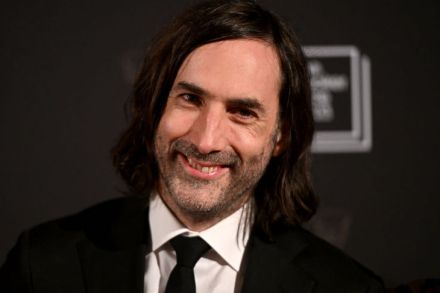
The 2023 Booker winner, Paul Lynch’s Prophet Song, is a vastly admirable book, but there is something deeply odd about it: it is a novel about a dystopian coup that takes down Ireland’s ‘liberal democracy’, not about the dystopian coup that was actually happening at the time it was written. By definition, most novels are stories rendered from imagined events, set in the past, present or future. But there are occasional examples that are fictionalised accounts of real events – almost always, by definition, from the past, and rather contradictorily termed ‘non-fiction novels’ – as well as imagined vistas from the future – almost always dystopias, most famously, George Orwell’s 1984.

The king is dead

An inescapable insight emerges from the lockdown: today’s young are not what the young once were. Scanning western streetscapes, it is hard to miss that the ones wearing face masks are not overwhelmingly — as one might expect — the old and vulnerable, but include a disquieting number of youngsters, all but immune to SARS-CoV-2, who wear their acquiescence in the current plunge into tyranny like a pendant of courage along with their Nike Airs and Buck Mason Mavericks. It’s like rock ’n’ roll never happened. Or, rather, as if the rock ’n’ roll spirit had never proclaimed the rejection of slavery and subjugation.

rock ’n’ roll

Human after all

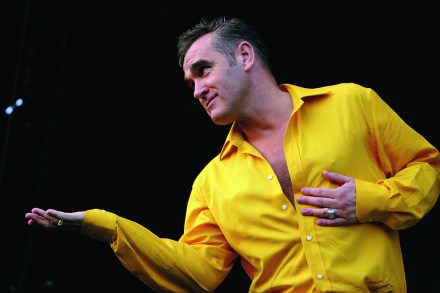
As the weird world of lockdown winds down, we might pause to consider what we’ve learned. I am hardly alone in my heightened hankering to unravel, synthesize, undo and discard. In this mission a voice from the past is helping me piece things together anew as the strange tyranny begins to dissolve. It began when Google started throwing videos of the Smiths in my daily cyberpath, prompting a non-essential trip down Memory Lane. Back in the day, I was, as David Cameron used to boast, a ‘huge fan’ of the Smiths. Precisely, I was a fan of Johnny Marr’s guitar literacy and the persona of Morrissey, the enchanting singer who had jettisoned his given names.

morrissey

Is he talking to us?

This article is in The Spectator’s January 2020 US edition. Subscribe here. There’s an old joke about Democrats and Republicans that might help us understand the anti-Trump rantings of pop-culture icons such as Robert De Niro and Bruce Springsteen. Two old guys are talking politics. One asks the other which party he supports. ‘The Democratic party,’ he responds. ‘Why so?’ ‘Because my daddy voted for the Democratic party, and my granddaddy voted for the Democratic party. So I vote for the Democratic party.’ ‘That’s ridiculous,’ rejoined the Republican voter. ‘So, if your daddy had been a hoss thief, and your granddaddy had been a hoss thief, does that mean you’d be a hoss thief, too?

de niro

American Catholicism is going back to the future

A couple of years ago, in high summer, my wife and I attended Mass in St Patrick’s Cathedral, as we do every time we visit New York. It is, in general, a bracing experience for Catholics who have been paddling in the tepid pools of Irish Catholicism. The celebrant, a middle-aged man with the physique and personality of a matinee idol, gave a startling sermon about the gospel of the day, Matthew 10:34, in which Jesus declares, ‘I have come to bring not peace but a sword.’ In his homily, the priest tore into sentimental notions of Christianity and the corruptions of concepts such as compassion and mercy.

catholicism

Paddy powerless

From our UK edition

In February, I spoke at the first ‘Irexit’ public meeting in Dublin, a discussion about options for Ireland in the event of various eventualities arising from Brexit or some more fundamental disintegration of the EU. Nigel Farage was among the speakers, so what might otherwise have been ignored became the focus of finger-wagging by the media ayatollahs. Punctuating the speeches were videos about Ireland’s economy, resources, history--in-the-EU and so forth. One featured a classic Irish rock song by the venerable fivesome Horslips, a rock band of the 1970s. The song was ‘Dearg Doom’ (Red Destroyer), which turns on a riff based on an Irish march, ‘O’Neill’s Cavalry’.

Frame by frame, Gosnell tears apart everything America has told itself about abortion

The legal limit for abortion in Pennsylvania is 23 weeks and six days. Theoretically, a termination one minute beyond that could become the basis of a homicide rap. Yet, there is no visible or measurable difference between a foetus of 23 weeks and one of 24 weeks. The self-evident arbitrariness of such a law announces itself as quite devoid of reason and morality, and thus offers a provocation to the consciences of those whose reasoning mechanisms derive their logic from a perhaps unfocussed belief that man might become his own God. Such a man was Kermit Gosnell, the Philadelphian abortionist who in 2013 was put away for the rest of his natural for the unnatural crimes that to him seemed to represent naturalistically good deeds.

earl billings kermit gosnell

Baby, the rock n’ roll spirit should be on your side

From our UK edition

I am a rock ‘n’ roller by origin and inclination. I started off in rock journalism writing about bands and song and gigs. I wrote a book vaguely about U2, though not really. I loved the blues, where the whole thing started: the cry of the slave waking up to the theft of his life. I revered Lennon and Dylan because they tuned into that cry and sought to mobilise its power into the modern world. For a few years in my youth I nestled into the cool embrace of modern rock ‘n’ roll culture of protest and hope. But then I began to sense something amiss.