John R. MacArthur

John R. MacArthur is the publisher of Harper’s Magazine.

The descent of New York

New York When Will Smith strode to the stage and slapped Chris Rock, I was surprised by how many of my friends thought the violence had been staged to rescue the Academy Awards from its years-long ratings decline. I instantly recognised it as authentic rage, not because I know anything about Hollywood or Will Smith, but because I witness similar ugliness so frequently on the New York City subway. For me, Smith’s outburst was shockingly familiar – emblematic of a simmering, pre-volcanic atmosphere in the country that no one seems to be examining or attempting to explain.

Joe Biden is winning

From our US edition

By the middle of January, I’d read some version of the headline “Biden Can Still Rescue His Presidency” so many times that it seemed an algorithm had taken over from the editors. The New York Times placed it above a column by Bret Stephens, a prominent anti-Trump conservative and a member of the pundit pack that earnestly wished the president Godspeed when he entered the White House more than a year ago. Stephens, like most of his colleagues, argued that Biden was “flailing — and failing” — because of what the paper’s news pages have described as a “legislative agenda in shambles.

biden

Biden isn’t FDR

With Biden sliding to 38 per cent approval in the polls, it’s finally time for everyone to stop calling him 'the new FDR'. That preposterous moniker was always misplaced. Biden’s ambition for 'transforming' the country has never extended beyond removing Donald Trump from the White House, inserting his patronage picks into important jobs and, most importantly, crushing the intra-party insurgency led by Senator Bernie Sanders. He has been spectacularly successful in all three of these goals given his meagre talents. But comparing him to Franklin D Roosevelt — America’s most transformative president since Abraham Lincoln, and a man of immense energy — has always been downright absurdity.

You can’t keep an American exceptionalist down

Like millions of other Americans I was riveted by the images of chaos and despair at the Kabul airport as US forces finally left Afghanistan, yet another sad result of a forever foreign policy driven by ignorance, overreach and hubris. But as distressed as I was by the sight of desperate Afghans clinging to the exterior of a moving US Air Force cargo jet, what truly horrified me was the flood of belligerent anti-withdrawal nonsense uttered in print and on TV by an American political and media establishment that has apparently learned nothing since the Korean War, when General Douglas MacArthur provoked China’s invasion of North Korea by pushing too close to the Chinese border.

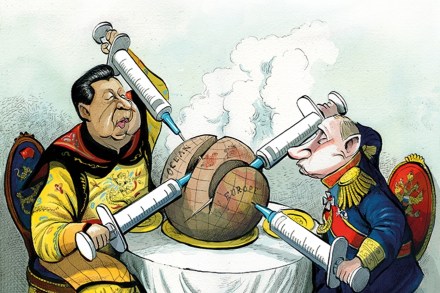
Power jab: the rise of vaccine diplomacy

44 min listen

How are China and Russia getting ahead in the great game of vaccine diplomacy? (00:50) Has the US press lost its way? (11:30) Why is Anglo-Saxon history making a comeback? (27:20)With The Spectator's broadcast editor Cindy Yu; journalist Owen Matthews; Harper's publisher Rick MacArthur; The Washington Post's media critic Erik Wemple; journalist Dan Hitchens; and Sutton Hoo archaeologist Professor Martin Craver.Presented by Lara Prendergast.Produced by Max Jeffery and Matt Taylor.

The decline of American journalism

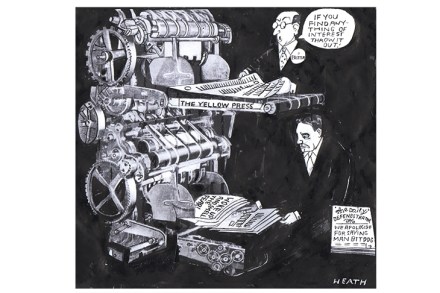
The latest absurdity in American journalism is the forced resignation of the veteran New York Times reporter Donald McNeil Jr for uttering the word ‘nigger’ in front of a group of teenage tourists on a Times-sponsored trip to Peru. It has been justly ridiculed by many sane conservatives and even some courageous liberals. Although the infraction happened more than a year ago, calls for reason have had no practical effect against the demands online and inside the Times that McNeil be fired after the Daily Beast revealed the teenagers’ complaints. McNeil’s own defence is that he used the racial epithet as information with the high school students, not as an insult. This cut no ice with the hanging judges of Times-world.

New York has turned ugly

From our US edition

New York City In grim times such as these, New Yorkers tend to flatter themselves for possessing special reserves of moxie, an outdated word that connotes courage, brio and a kind of raffish know-how. Think of Humphrey Bogart as Rick, a nightclub owner in the film Casablanca, when he jousts with Major Strasser, the German bully who thinks he can outsmart and intimidate him. Pressed to reveal his background and political beliefs, the poker-faced Rick replies: ‘I was born in New York City, if that’ll help you any.’ Asked if he could imagine the Germans occupying New York, Rick retorts, with a little extra moxie, ‘There are certain sections of New York, Major, that I would not advise you to try to invade.

new york

Is Trump more left-wing than Biden?

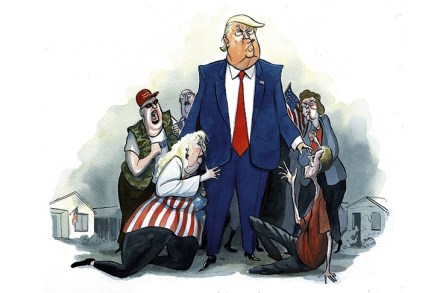
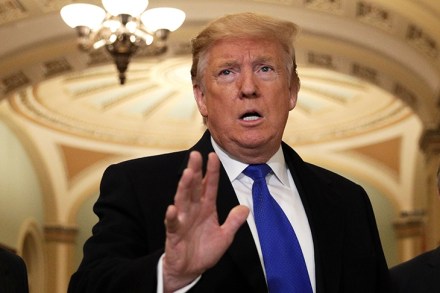
Just when it seemed that Donald Trump had finally committed political suicide — his notion of injecting disinfectant to cure coronavirus marking only one of his recent reckless absurdities — he says something off the cuff that makes one lament the sight of so much raw political talent going to waste in the cause of solipsistic mania. A leftist anti-Trumper I may be, but I’ve been strangely impressed by the President’s capacity for perfectly credible, progressive--sounding political analysis, especially on the trade issues that sometimes bring together on common ground right-wing nationalists and left-wing defenders of labour rights.

How Graham Greene earned The Spectator a place in cinematic history

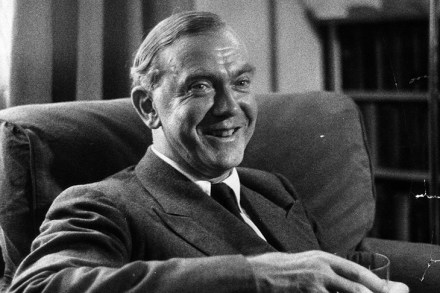
When Graham Greene impulsively took up film reviewing for The Spectator in 1935, he was not yet the renowned literary figure he was to become, and thus, like so many other writers in those parlous economic times, prosaically in need of cash. As it happened, the confluence of interests between a 30-year-old novelist of modest commercial success and Derek Verschoyle, The Spectator’s literary editor from 1932 to 1939, resulted in something extraordinary — for there is nothing prosaic about these reviews. Greene’s opinions about the films he critiqued for the magazine over nearly five years constitute an impromptu cultural history of the 1930s, in addition to being a joy to read.

In this golden age of corruption, it takes much courage to be a whistleblower

Midway through Crisis of Conscience, the massive new compendium about US whistleblowers by the journalist Tom Mueller, I wanted to cry out for help: first in saving the country from the profound and corrosive corruption that is so well chronicled in this volume, and then finding a seasoned editor to cut the book down to readable size and scope. Mueller’s reporting and insight about the unusual breed of civic-minded citizen willing to risk his or her career by exposing government fraud and corporate malfeasance are extraordinarily detailed and vivid. But he does himself and his readers a disservice by overloading this work with lengthy disquisitions about behavioural theory and inflated quotations from the interested parties.

Alfred Dreyfus is being erased all over again

In London to promote a book, I received an invitation to a secret screening of An Officer and a Spy, Roman Polanski’s new film about the Dreyfus affair. I boarded public transportation to a clandestine destination, somewhere in England, to view what recalled for me the samizdat literature once produced in Communist eastern Europe. I looked over my shoulder several times to see if anyone was watching me; if the possibility of exposure wasn’t real, my anxiety certainly was. My emotional reflexes still echo the trip I took to Prague in 1983 to meet dissident writers during which I was followed. But why all the cloak-and-dagger dramatics now? Why can’t I reveal where I went? An Officer and a Spy is untouchable in the Anglo-Saxon world.

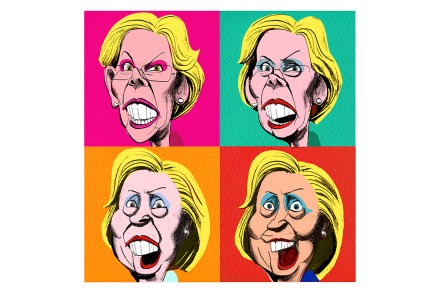
Elizabeth Warren is the Hillary Clinton of 2020

From our US edition

This article is in The Spectator’s November 2019 US edition. Subscribe here. How did Elizabeth Warren, a left-wing populist, become the candidate of Democrats who dislike left-wing populism? Why is it fine for Warren to menace the rich — but not for Bernie Sanders? With some polls placing her ahead of the former vice president Joe Biden, the Massachusetts senator is suddenly basking in praise from mainstream newspapers as well as ‘progressives’ like Emily Tisch Sussman, a ‘Democratic strategist’ who appears regularly on MSNBC. Led by its star hosts, Chris Matthews and Rachel Maddow, MSNBC functions as the mouthpiece of an official Democratic party still dominated by the Clintons and Barack Obama.

warreh

A rotten party

 New York For leftist anti-Trumpers like me, the Mueller report was initially a godsend, though not for the more obvious reasons. I belong to a rarified group that hates liberal moaning about Russian ‘interference’ in the 2016 election: we ridicule the claim that Vladimir Putin and his henchmen stole the presidency from Hillary Clinton because we know that Clinton herself and neo-liberal Clintonism were the real causes of her demise. I often tell outraged Democrats to calm down and stop watching Russiagate obsessives such as Rachel Maddow on TV.

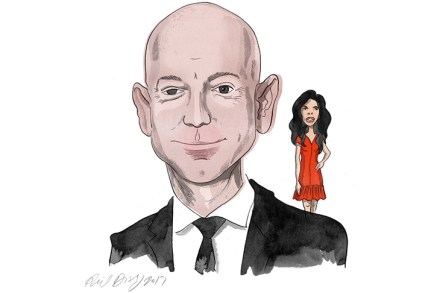
The hypocrisy of Jeff Bezos

It is tempting to view the blow-up between Amazon’s billionaire owner Jeff Bezos and David Pecker, publisher of the tabloid National Enquirer, with the peculiar glee some journalists experience when they cover a natural disaster: it can be exciting, fun even, to sit back and observe the flames. As political earthquakes go, the Bezos-Pecker face-off is spectacular, since Pecker is a long-time ally of Donald Trump and Trump is the sworn enemy of Bezos and the newspaper he owns, the Washington Post. Trump calls him ‘Jeff Bozo’, presumably because the Post has been so aggressive in its coverage of Trump’s alleged collusion with Russia and seems determined to bring down his presidency.

All the rage | 25 October 2018

My father, an avowed liberal, taught me old-school manners: hold the door and give up your seat for ladies; stand up when anyone, male or female, enters the room or approaches you at a social gathering; extend your hand in greeting; listen politely when others speak. My mother issued similar instructions in French, and as a consequence I almost never fail to say bonjour before I address a French merchant or telephone operator. Now 93, she recently admonished me that ‘one shouldn’t make fun of people for being incapable of doing this thing or that thing’. So it’s come as a rude surprise that good manners and polite behaviour seem to have disappeared wholesale from American society.

There is a greater menace than chasing ‘diversity’ at any cost

While I largely agree with Coleman Hughes that racial quotas are counterproductive (‘The diversity trap’), he misuses Martin Luther King Jr to buttress his argument. King said that he hoped his descendants would ‘be judged…by the content of their character’, not by their standardised test scores. The grim pursuit of purely quantifiable ratings for intelligence and achievement in American schools — by Asians and white Protestants alike — is an even greater scourge these days than the illiberal goal of ‘diversity’ at any cost. Harvard admissions may well be covertly, and unfairly, anti-Asian, but by taking into consideration ‘courage’ and ‘kindness’, they might also be doing the right thing.

Analysing the dream

The figure of Donald Trump looms over Sarah Churchwell’s new history of American national identity, which highlights the ugliest features of the country’s ingrained traditions of intolerance and bigotry. But it is the current president’s father, Fred, who first leaps off the page in a startling cameo appearance. On Memorial Day 1927, as Churchwell recounts, the white supremacist, anti-Catholic and anti-Semitic Ku Klux Klan organised a march in New York City’s borough of Queens, home to the German-American Trump family, whose patriarch, Friedrich Trump, had emigrated to the United States in 1885.