John McEwen

Flower power

From our UK edition

Mrs Delaney (1700-88) is an inspiring example for old age; also a reproach to those who think ‘upper class’ a term of abuse and that women have only recently had a life. Mrs Delaney (1700-88) is an inspiring example for old age; also a reproach to those who think ‘upper class’ a term of abuse and that women have only recently had a life. Her extraordinary cut-paper flowers, collected in the 10-volume Flora Delanica, are now enshrined in the British Museum as masterpieces of collage art. Looking at their remarkable intricacy and accuracy, it is incredible to think she made them between the age of 72 and 82. Nonetheless, these ‘floral mosaiks’, as she called them, are only the summation of her achievements.

Romantic approaches

From our UK edition

Spectator readers will know that Andrew Lambirth is a romantic, a force for the literary and poetic approach to art criticism, so he is an admirably empathetic guide to Hoyland: In England the subversive underground Romantic spirit has never run dry, it consistently nourishes art in this country and erupts forth in strange and unexpected ways. The late work of John Hoyland is one such unpredictable manifestation. Mel Gooding’s standard monograph covers Hoyland’s career to 2006, but such is the artist’s productivity that, despite serious heart surgery last year, many of the excellent colour plates — the majority in the case of the 46 full-page illustrations — are of new paintings.

The Oaks of Cheyithorne Barton

From our UK edition

Michael Heathcoat Amory inherited Chevithorne Barton in Devon from his grandmother. She had experienced the unimaginable loss of her husband in the First War and their three sons in the Second, including the author’s father. Creating a garden at Chevithorne was a consoling distraction. Michael Heathcoat Amory has done her and his family proud, transforming Chevithorne over a mere 25 years into one of the world’s great arboretums. His passion is the oak. He now has 282 of the 500 extant species, of which 190 are catalogued in this handsome book. His model introduction is supplemented by three specialist essays. The photographic illustrations reveal that many oaks are unrecognisable as relatives of our emblematic tree, Quercus robur.

The sweetness pictures can add to life

From our UK edition

This is the tribute of a child to a parent, especially commendable when the very concept of fatherhood is threatened; rarer still, the co-authors are themselves artists in their separate fields. Peter Mann is responsible for the pleasing design and photographs, and Sargy Mann has answered his son’s questions to provide an autobiographical text which largely concerns visual perception, ‘not at all straightforward even when you can see’, as Peter Mann says. Jean Renoir’s Renoir, My Father is the prototype. Sargy Mann selected and discussed 27 paintings or series of paintings covering his career and Peter Mann has photographed them as they hang today in private houses. This novel idea is also indebted to Renoir, who told his son: You don’t look at a painting.

Poles apart

From our UK edition

With more Poles in Britain than at any time since the second world war, when the 17,000 remnant of the Polish army arrived after the fall of France, this book could not be more pertinent. Nor could it have been written by anyone better. Douglas Hall (b. 1926) was the first Keeper (indeed the Alfred Barr) of the Scottish National Gallery of Modern Art. He made a virtue of a small budget by backing artistic outsiders rather than hot favourites, and these uprooted Polish painters were by definition eccentric. Under his keepership no British public gallery did more for them in the long years of their exile.

Haunting melancholy

From our UK edition

As a former winner of Britain’s most prestigious award for painters, the John Moores prize (other winners include Hamilton, Hilton, Hockney, Hoyland), a new show by Andrzej Jackowski should not be missed, especially not these notably small but powerful paintings in his latest exhibition at Purdy Hicks. The phrase ‘depth charge’ is used in the catalogue to describe their effect, in the sense that their force is densely contained and profound. It is certainly what Jackowski aspires to achieve.

Flights of fancy

From our UK edition

Did you know that the first person to cage a budgerigar was John Gould, the 19th-century English artist/naturalist? Or that the word ‘penguin’ is derived from the Welsh words ‘pen’ (white) and ‘gwyn’ (head)? Or that there is no scientific (in other words fossil) evidence that the dodo ever existed? These are just three informative nuggets from Katrina Cook’s entertaining text for her sumptuously illustrated elephant-folio-size history of bird art.

Blast from the past

From our UK edition

Percy Wyndham Lewis 1882–1957, Design Centre, Rugby School, until 8 December In the 1915 Vorticist Manifesto, published in the movement’s magazine Blast, Wyndham Lewis (he dropped Percy) wrote: Lewis is one of them, as this first-rate exhibition at his alma mater — he was a pupil for two years from 1897 — amply demonstrates. It is the sole commemoration of the 50th anniversary of the death of this artist writer, who is comparable only with that other double-yolked exception to the rules, William Blake, one of his heroes, born 250 years ago this 28 November.

Life and conflict

From our UK edition

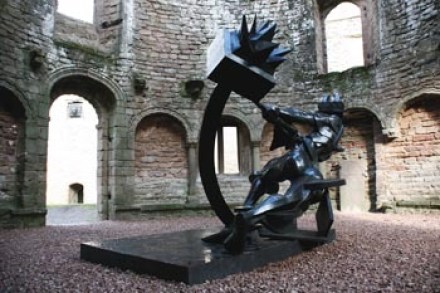
Ever since he burst on the scene in the 1960s Michael Sandle RA has been the rogue elephant of British art. At Ludlow Castle, a perfect venue for work whose subject is war, both metaphorical and actual, his artistic power is irrefutable. This is a superb show. John Powis, who owns the castle, should be praised for his enlightened patronage and Judy Cox for curating with such panache. The event marks the inauguration of an annual sculpture exhibition of international standard. The selection covers the past 30 years of Sandle’s output, 18 bronzes and one fibreglass, most of it done when he was professor of sculpture at two of Germany’s leading art schools.

Treasures of the South Seas

From our UK edition

The enlarged, updated and now undivided Sainsbury Centre has reopened with the most comprehensive selection of Polynesian art ever assembled; and yet, shamefully, it has received not a single review. It would be a waste of space to wonder why, better to state that the stunning Pacific Encounters, curated by Dr Steven Hooper of the University of East Anglia, utterly confounds the supposition that Oceanic art is largely a matter of shell and feather knick-knacks. These superlative objects from British collections (testimony to those pioneers of the scientific Enlightenment who went exploring with Captain Cook), three-quarters of them resurrected from the limbo of museum stores, prove that Polynesian (Greek for ‘many islands’) sculpture and workmanship can stand any comparison.

The Knight’s noble rescue

From our UK edition

This handsome and scholarly book is a catalogue of a selection of pictures of Ireland, all, remarkably, collected over the past 30 years by Desmond Fitzgerald, 29th Knight of Glin, for his famous country seat in west Limerick, where his family have held sway since 1350. It whets the appetite for the next major publication by the Knight (with James Peill), a history of Irish furniture. Forty years ago, when the Knight first made his scholarly mark as a collaborator with Desmond Guinness and others on the pioneering exhibition ‘Irish Houses and Landscapes’, Ireland was an economic and cultural backwater. Today, as 250,000 people annually up sticks to escape the horrors of London, civilised and prosperous Ireland is of course acclaimed one of the most desirable places on earth.

Cheeps, tweets and warbles

From our UK edition

In his old age John Ruskin lamented, ‘I have made a great mistake. I have wasted my life with mineralogy, which has led to nothing. Had I devoted myself to birds, their life and plumage, I might have produced something worth doing.’ Here are two bird books which have been eminently worth doing. Both are by North Americans but their sweep is global. David Rothenberg is a musician, composer, author and professor; the Canadian, Graeme Gibson, is a renown- ed novelist and chairman of the Pelee Island Bird Observatory. Gibson only succumbed to the charm of birds at 37, which is why he begins his book with the Ruskin quotation. Rothenberg’s interest in birds has also intensified with age — it is only since 2000 that he has taken to playing music live with them.

Visual agility

From our UK edition

It is difficult to place oneself in the position of the pioneers of graphic art shown at the Estorick Collection: their extraordinary leaps of the imagination have become the standard vocabulary; the shift from old to new they represent now distant history. Born in the 19th century when 90 per cent of human understanding came through the naked eye, as adults they were confronted with a reality which was becoming the invisible reverse. Means of communication and commerce had been transformed beyond the scope of normal looking and common intelligence. Nothing was more spectacular in its effect than electricity, as some of these designs proclaim. This new engine of industry and mass communication turned night into day and transformed and consolidated urbanisation.

A hunter’s eye for nature

From our UK edition

For pure delight you must away to Northampton and see this admirable celebration of the centenary of Denys Watkins-Pitchford (1905–90) — amazingly, the first ever solo show of his pictures. Watkins-Pitchford was born and lived in Northamptonshire; he went abroad only a couple of times but he travelled extensively in Britain. Watkins-Pitchford and BB were one and the same. As an artist he used his own name; as a writer the pseudonym — derived from a heavy shot designed for shooting wild geese. Through illustration, BB combined his artistic and literary talents.

Finding salvation

From our UK edition

A tragic love story lies behind the jovial title to this delightful exhibition, which unveils the David and Liza Brown Bequest, the largest ever received by Southampton City Art Gallery. In 1967, David Brown was one of Britain’s most distinguished veterinary surgeons, the world authority on the cattle disease rinderpest, and newly appointed federal director of Veterinary Research for Nigeria. It was a daunting job, undertaken during a civil war and overseeing 400 staff, but he and his prospective wife, Liza Wilcox, eagerly accepted the challenge. Brown was divorced when he met Wilcox, a tie-dying fabric specialist. She was married, but for both it was the love of their lives. By the time they decided to up sticks in Kenya for Nigeria, she had already changed her name to Brown.

Poetic eye

From our UK edition

It is not Robert Frank’s fault, but one might think from the hype — ‘arguably the world’s greatest living photographer’, etc. — that he had invented documentary photography. When Humphrey Spender, who did for Mass Observation and Picture Post in the 1930s and 1940s what Frank did for social documentation in the 1950s, was similarly praised, he pointed out that photography had been an instrument of social change since the 1870s. And the photo-journalist’s favourite camera, the 35mm Leica, was invented in 1914.

Force for good

From our UK edition

This is the first in a series of short sharp shows devoted to leading British artists which Tate Britain proposes to stage over the coming years. According to Stephen Deuchar, Tate Britain’s director, Rego was easily the most popular choice, and little wonder. It is a sign of true quality that in a 50-year career she has gone from strength to strength.

The hum of special contentment

From our UK edition

How welcome it is to find a book published by a small private concern in this age of conglomerates; the more pleasing when one knows that the Perpetua Press is the creation of the poet Anne Ridler’s husband Vivian, former Printer of the Oxford University Press, and that it is still run from their Oxford home, where they raised three children and lived from 1948 until Anne Ridler’s death, aged 89, in 2001. These gentle reminiscences, the final few pages put together by the Ridlers’ son Ben, are of happy industry based on the Affirmative Way, ‘which pursues perfection through delight in/adoration of the created world’.

Scotland’s Italian connection

From our UK edition

John McEwen applauds the ‘Age of Titian’ in Edinburgh, and other Festival treats Sir Timothy Clifford celebrates the completion of the Playfair Project, uniting the 19th-century architect William Playfair’s two art temples on Edinburgh’s Mound, with an exhibition that is both a witty deceit and appropriately self-congratulatory. The Project gives Edinburgh an ‘exhibition complex’ that vies for charm and technological sophistication with any in the world. Obviously, the show celebrating such a milestone had to be something special: a ‘blockbuster’ that would not only attract sponsorship and pull in the punters, but would also draw specific attention to the significance of the Project.

No tendency to corrupt here

From our UK edition

Two things about this book — the first on the artist for over a century — are immediately off-putting: intermittent mustard-coloured pages, which make it look like a magazine, and the insistence of Robyn Asleson, a fledgling American historian, that Albert Moore’s paintings transcend words. Nonetheless she manages to hold the reader’s attention, despite the additional disadvantage that her subject had an uneventful life. Albert Moore (1841-93) was an important figure in the Victorian neo-classical revival, which in painting meant endless pictures of nude or draped beauties in a style derived from ancient Greece and Rome — none of it looking in the least classical, usually because the subject matter was clearly an excuse to paint a pin-up.