John Martin-Robinson

Rescuing an Irish gem

From our UK edition

This large and splendid book is more in the nature of a grand illustrated guidebook than a historical monograph. Hundreds of photographs cover every aspect of Abbeyleix today, the magnificent Georgian house 60 miles south-west of Dublin — its contents, the garden and demesne, not to mention the owner’s family and friends. It makes a fascinating insight into the revival of the Irish country house in recent decades, as bankers, lawyers and entrepreneurs have taken on Irish estates and shaken them out of their 20th- century slumberous (or violent) decline. William Laffan has produced a well written overview of one of the more spectacular contemporary resurrections.


From Edwardian idyll to meetings with Nehru: the life of Lady Ursula D’Asbo

From our UK edition

This is the Real Thing, an evocative account of English upper-class life throughout the 20th century. It begins amidst the Edwardian feudal splendours of Belvoir Castle, where Ursula d’Abo spent much of her childhood with her beloved grandfather ‘Appi’. At the coronation of George VI she was a maid of honour to the Queen. During the second world war she worked with 2,000 women making bullets. Postwar life was hardly less varied and amazing, with an other-worldly stay in princely India, and meetings with Nehru. Married life at West Wratting Park and Kensington Square, two beautiful Georgian houses she restored, was followed in her widowhood by five years with Paul Getty at Sutton Place.

An enduring romance

From our UK edition

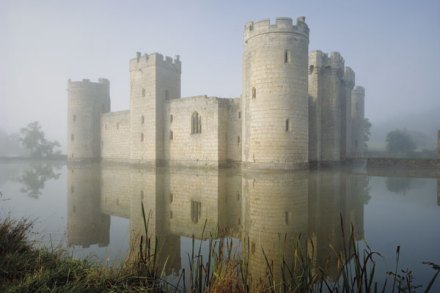
In the Pevsner volume on Sussex, the otherwise sane topographer Ian Nairn, harrumphed of Arundel ‘that anybody, duke or banker, could as late as 1890 have embarked on the pretty complete building of an imitation castle, remains a puzzle …’  In this amusing and richly illustrated book, Amicia de Moubray gives the answer, and demonstrates how castle-building continued as a serious architectural thread not just in the 19th but throughout the 20th and into the 21st century. The British love of castles is deeply rooted in their psyche as an island race. Children learn to love them from fairy stories and Harry Potter. Castles are an emblem of Britain itself, an island surrounded by a moat. A castle is a place of refuge and safety where we can do what we wish.

A Charlotte Brontë of wood and stone

From our UK edition

Sarah Losh is not forgotten (as the subtitle of this book suggests) in her own village of Wreay (pronounced ‘Rear’), south east of Carlisle in Cumberland. The locals refer to ‘Miss Sarah’ as if she were still alive, rather as they speak about Lady Anne Clifford at Appleby. Anybody who has visited the village and seen the extraordinary church built in 1841-2 by Miss Losh at her own expense will know why. Travellers are met with the apparition of a small Roman basilica stranded on a village green, embellished with mind-blowing carvings. They are partly inspired by fossils, obscure natural history specimens and esoteric symbols. The Losh graves in the churchyard are strikingly odd and personal too.

The new arbiters of taste

From our UK edition

Both these books are dominated by the American connection, over half of each being devoted to transatlantic collecting in the 20th century. James Stourton’s theme is post-war art collecting, and his US section is headed ‘America Triumphant’. He describes the 60 years when the USA dominated the international art market through sheer buying power but also because of the vitality and originality of the contemporary American art scene in New York. John Harris, by contrast, paints a hilarious picture of the earlier 20th-century trade in historic interiors and architectural bric-a-brac when ‘period rooms’ were a must-have in American houses and art museums, though most of the latter have now been de-accessioned as fake.

No provincial laggard

From our UK edition

Inigo Jones is well-known as the first true English Classical architect, and his stature has been established by a series of books and exhibitions over the last 40 years. English historians, however, have tended to treat Jones as an isolated, even old-fashioned, disciple of Palladio, ‘catching up’ with the Italian Renaissance, at a time when mainstream Europe had moved on to the Baroque. The purpose of this book is to prove this accepted view wrong. Giles Worsley’s aim is to demonstrate that Jones was a distinguished figure in a European-wide classical architectural movement of the early 17th century.

A brace of noble piles

From our UK edition

The great houses of England have been singularly blessed in their owners (with one or two exceptions) during the latter decades of the 20th century. None more so than Chatsworth and Holkham where the baton is currently being passed on to the younger generation. Both these volumes therefore have a slight valedictory quality, though they are different in scale and intention. Round About Chatsworth is not concerned with the house itself but with structures and objects in the surrounding estate landscape — pigsties, privies, pubs, pounds, and pavilions. ‘Whether old or new, grand or humble, beautiful or ugly, these kind of man-made architectural oddities give character to a place.

From Edgar all the way to Elizabeth

From our UK edition

Once upon a time, the young Roy Strong spent many hours, with the encouragement of Sir Anthony Wagner, researching the records of the College of Arms in connection with his interest in Elizabethan and Stuart portraits and pageantry. This resulted in what many regard as his best work, Art and Power: Renaissance Festivals. Now, 50 years and 24 books later, he has trawled the heralds’ records again, this time for a history of the English coronation service from its Saxon origins to Queen Elizabeth II in 1953. The result is a well organised, sympathetic and fascinating account of the central ritual of the English people. This is a serious book with a full scholarly apparatus of notes, bibliography, charts, chronologies and index.

The inside story

From our UK edition

This posthumous book is the summation of a lifetime’s research into aspects of the 18th-century interior in the British Isles by the leading historian of the subject. I say British Isles, for John Cornforth had strong interests in Irish and Scottish Georgian architecture, as well as English. As the former architectural editor of Country Life and co-author, with the decorator John Fowler, of English Decoration in the Eighteenth Century (1974), he had already aired some of the themes developed here, and many of the subjects have appeared in articles in Country Life. It is useful, however, to have them all melded together into a seamless celebration of the golden age of Georgian architectural decoration.

Not poor or lowly

From our UK edition

Which is the finest 18th-century building in England? Not a royal palace, not a library, not a cathedral, but a stable block: that designed by James Paine at Chatsworth. It is a faultless piece of architecture with none of the messiness and compromise of buildings intended for mere human habitation. Perfect in siting, perfect in proportion, perfect in its golden stone execution, it is a masterpiece. Horace Walpole thought the masonry of Chatsworth had the ‘neatness of wrought plate’, but that of Paine’s stables has a poetic, Centaurish magnificence, rippling with five different types of rustication (channelled, striated in two directions, pocked and vermiculated).

The last of a noble line

From our UK edition

The new, 107th edition of Burke’s Peerage comes in three massive volumes. It is likely to be the last in printed book format. The previous, 106th edition (1999) was in two volumes, and all the Burke’s Peerages before that were single volumes back to No. 1 in 1826. There seems to be a touch of Parkinson’s Law in this; the increasing scale and grandeur of the book counter- balancing the decline in the power and prestige of the peerage. The publishers’ preface has an elegiac tone. ‘This 107th is likely to be the Final Edition in the form as we have known it.’ Burke’s genealogical future will lie in digitalised data as an ‘on-line accessible subscription service’.

The stateliest and the starriest

From our UK edition

This elegant synthesis (you can tell immediately that Simon Jenkins is an Oxford man and not a product of the other place) is intended to complement the author’s successful Thousand Best Churches. It could be argued that England’s houses are much better known than its churches and that this sister volume is hardly essential. ‘Not another book on country houses!’ Such an attitude would be graceless. For those who do not know their houses, this is an excellent general guide: it is impressively comprehensive in its coverage, and the entries are clearly written. For those who are already house buffs, Jenkins’s Best Houses should be regarded as an intelligent conversation with a friend.