John Keiger

John Keiger

John Keiger is a former Research Director at the University of Cambridge and author of the biography of French president Raymond Poincaré

Macron’s scheming could have disastrous consequences for France

From our UK edition

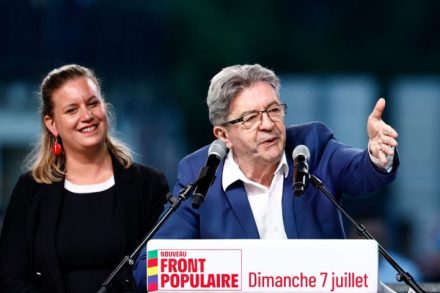
French voters are looking on aghast at the state of their country's democracy. Faced with stalemate in the French National Assembly since the 7 July elections, acute frustration is building among left and right wing députés. They fear that the election is being stolen from them by the scheming of president Emmanuel Macron’s much depleted centrist bloc. Despite taking a beating in the European and legislative elections from left and nationalist right, Macron has been manoeuvring to deny any chance of government to members of what he refers to as the ‘extremes’: Jean-Luc Mélenchon’s France Unbowed party and Marine Le Pen’s National Rally. He has been brutally successful in the latter case.  How will this dismal saga end?

Is France heading towards its Sixth Republic?

From our UK edition

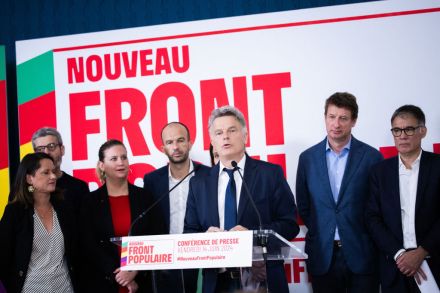
Against a backdrop of considerable tension – barricaded city centre shop-fronts and 30,000 police on standby – a radically divided France has voted in the second round of the legislative elections. To general amazement, the largest party in the National Assembly is the left-wing Nouveau Front Populaire (NFP) – but none of the major political groupings is able to form a majority government.  So what happens in France now? Who will actually govern? France will probably be ungovernable for some time to come First in line to form a government must be the New Popular Front. But unlike Le Pen’s National Rally (RN) or Macron’s Ensemble, no putative prime minister has been put forward by the block.

Labour should be wary of Macron’s cooing

From our UK edition

French president Emmanuel Macron has phoned Sir Keir Starmer to congratulate him on his appointment as prime minister. Macron’s Twitter account records that he was ‘pleased with our first discussion’, adding: ‘We will continue the work begun with the UK for our bilateral cooperation, for peace and security in Europe, for the climate and for AI.’ But the British Prime Minister should beware Macron bearing gifts. As is the custom, the British prime minister will have received similar calls from a host of foreign heads of state and government. But Emmanuel Macron is different. The European and French general elections have taken a serious toll of his reputation domestically and internationally.

The plot to stop Marine Le Pen’s National Rally

From our UK edition

This week France has drifted from surprise to confusion and panic as Sunday’s second round vote approaches. The bien-pensant centre-left weekly Nouvel Obs’ cover says it all. Black lettering on a red background menacingly warns: ‘Avoiding the Worst’; ‘The National Rally at the gates of power’. Yet the National Rally is an officially recognised legitimate mainstream party. France is not staring into the abyss. But if we were to indulge in such gloom-ridden musings what would be France’s post-electoral worst case scenarios. Let us begin gently.

The reckoning: it’s payback time for voters

From our UK edition

39 min listen

This week: the reckoning. Our cover piece brings together the political turmoil facing the West this week: Rishi Sunak, Emmanuel Macron, and Joe Biden all face tough tests with their voters. But what’s driving this instability? The Spectator’s economics editor Kate Andrews argues it is less to do with left and right, and more a problem of incumbency, but how did this situation arise? Kate joined the podcast to discuss her argument, alongside former Cambridge Professor, John Keiger, who writes in the magazine about the consequences that France’s election could have on geopolitics (2:32).  Next: what role does faith play in politics?

What the National Rally means for France’s foreign policy

From our UK edition

The electoral turmoil in France threatens its status as a world power. Friendly nations are despairing; rivals and enemies are gloating, even circling. France is the world’s seventh-largest economic power, a prominent Nato member, a member of the UN Security Council and the EU’s leader on foreign and defence issues. It has the fifth largest strategic nuclear force and the fifth largest navy, a ‘tier one’ military and one of the highly effective ‘Nine Eyes’ intelligence services. Last year France was the world’s second largest arms exporter. It controls the third largest global undersea cables network and has the second largest coastal economic area, whose confetti territories give it a global strategic toe-hold.

National Rally brings a political earthquake to France

From our UK edition

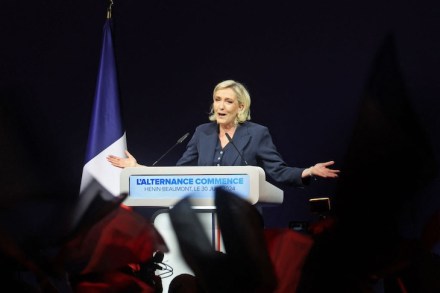
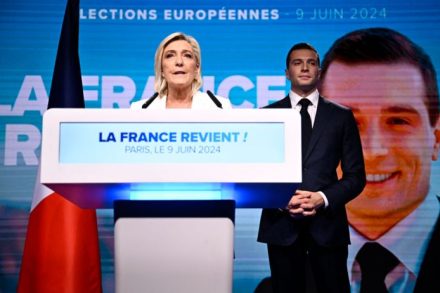
There is one big winner from the first round of the French legislative elections – and several big losers. The winner is the Rassemblement National (National Rally) with 33 per cent of voters backing its candidates or their allies – on a turnout of 67 per cent, the highest in decades. The RN now has a fighting chance of forming a working government from 7 July.  Marine Le Pen has called on voters to give her party an ‘absolute majority’ in the National Assembly in the next round of elections on Sunday. ‘We need an absolute majority for Jordan Bardella to be named prime minister by Emmanuel Macron in eight days,’ she said, to ‘avoid the country falling into the hands of…. a far-left leaning toward violence.

Macron’s power in Europe is draining

From our UK edition

In Brussels over the last two days EU heads of state and government have been carving up the ‘top jobs’. France is represented by President Emmanuel Macron, whose party took a lashing in the European elections, diminishing further his international standing. By contrast, Marine Le Pen’s victorious Rassemblement National, now on track to win the 7 July general elections, was not present. When RN forms a government it will have to live with the consequences of the President’s decisions for at least five years. It is no coincidence, therefore, that on Wednesday night Marine Le Pen gave an interview opening the way to a constitutional struggle with the head of state on one of his most important roles: the so-called presidential ‘reserved domain’ of defence and foreign affairs.

Macron’s ‘civil war’ warning might be closer to reality than he realises

From our UK edition

Of the 20 or so opinion polls since France's president Emmanuel Macron announced a snap election this month, the vast majority put Marine Le Pen's right-wing party ahead. The Rassemblement National and its allies are predicted to get around 35 per cent of the vote, with the left-wing coalition Nouveau Front Populaire (NFP) on 29 per cent and Macron’s centrist coalition Ensemble pour la République trailing on 20 per cent. Barring a black swan moment, Jordan Bardella’s RN will win the most seats in the chamber. But no one party is likely to have an absolute majority. Bardella announced on 18 June that, without a working majority, he will turn down the premiership, which he has every constitutional right to do. What will happen next?

Is France’s left-wing coalition more dangerous than Le Pen?

From our UK edition

French and international media cannot break their fixation with the ‘extreme right’. They continue to target the Rassemblement National (RN) as the ultimate menace for the 7 July legislative elections. But as of Friday, a more potent threat to French political and financial stability has raised its head: the radical left-wing ‘New Popular Front’ (NPF). This coalition of greens, communists, socialists and Trotskyists dominated by the radical-left La France Insoumise party (LFI), surprised many by their agreement to field common constituency candidates and a common manifesto.   Following the bitter breakup two years ago of the radical left-wing NUPES coalition, prospects for a new agreement were slim.

France’s future looks far from certain

From our UK edition

The much loved and quintessentially French singer, Françoise Hardy, born in 1944, died last night. French certainties are disappearing. The Fifth Republican regime could be next. President Macron’s stunning decision on Sunday night to dissolve the National Assembly in the wake of the remarkable victory of the Rassemblement National (RN) in the European elections is likely to turn a political crisis into a crisis of regime.  Following Macron’s 2022 re-election, devoid of a working majority, France entered a slow-building crisis. The fall-out continues to contaminate the political life of the country.

The EU may struggle to find its way out of this election crisis

From our UK edition

It is said that the EU thrives on crises. These are what spurs it on to the ultimate goal of wider and deeper integration. But yesterday’s European election results may be a crisis too far. Unlike its predecessors, this election has returned nine or so large Eurosceptic national parties intent on arresting the march towards ever-closer union. The nationalist and identitarian right, while by no means a majority in the new European parliament, is in a commanding position to seriously influence the EU’s future direction. According to the Bertelsmann Foundation’s European expert, quoted in Le Monde, the EU is entering ‘its most decisive phase in its 70 year history'.

Macron is trying to scare French voters into rejecting Le Pen’s party

From our UK edition

The French presidential list score in the European elections ‘is not a good result for the parties which defend Europe’. So declared president Macron euphemistically on television last night to the French nation, as he called a snap election to be held on 30 June and 7 July. Official results published this morning show the Rassemblement National (RN) has romped home on 31.47 per cent. Macron’s party is in a lamentable second place on 14.56 per cent (way behind its 22.4 per cent in 2019) and very closely tailed by the moderate socialist Raphaël Glucksmann on 13.8 per cent. These European election results are a severe personal defeat for Macron These European election results are a severe personal defeat for Macron.

Macron is to blame for France’s dismal economy

From our UK edition

Standard & Poor’s downgrading of France’s credit rating on Friday is a hammer blow to President Macron’s reputation. The ratings agency has reduced France from AA to AA-, putting it on a par with the Czech Republic and Estonia and one notch below the UK. It is the first time S&P has downgraded France’s debt since 2013, although the firm Fitch did so in April 2023. This is comeuppance for years of ‘as much as it takes’ spending by a president haunted by the gilets jaunes movement. The credit rating downgrade comes just a week before the European elections, where Macron’s Renaissance party is trailing the Rassemblement National (RN) by over 16 points. It is even more poignant given ex-banker Macron’s reputation as ‘the Mozart of finance’.

Aukus is becoming a potent alliance

From our UK edition

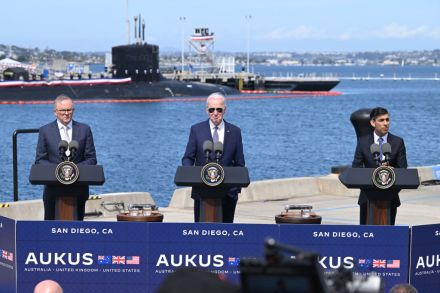
Compare and contrast the frenetic, largely unwanted and unnecessary manoeuvres to create a common EU defence union, with the methodical, steadfast construction of Aukus as a formidable Indo-Pacific entente to counter the Chinese threat. Only this week, South Korea signalled its intent to join the alliance and share advanced military technology with the United States, the United Kingdom and Australia. Aukus began in September 2021 between Australia, the UK and USA to supply Canberra with a fleet of nuclear-propelled submarines better able to confront Chinese regional expansionism.

Why Emmanuel Macron wants to give nukes to the EU

From our UK edition

Emmanuel Macron is thinking and saying the unthinkable for a French President of the Republic. This weekend he suggested that French nuclear weapons – the holy grail of French security, intended to ensure that France never relives 1940 – could be put at the disposal of the European Union’s defence. For Macron this is a make or break moment for the EU to remain a world power or face oblivion His comments drew strident criticism from across the political spectrum. ‘Macron is becoming a national danger’, claimed the Rassemblement National’s Thierry Mariani. ‘And after France’s nuclear weapon’, he added, ‘it will be France’s permanent seat on the UN Security Council which will be sold off cheaply to the EU.

The plot to stop Marine Le Pen could backfire badly

From our UK edition

At first, French elites haughtily dismissed the Rassemblement National (RN) and its voters. Then they were in denial about its rise. Now they are scrambling to block its path to victory in 2027 by all manner of subterfuge. Marine Le Pen, the leader of the RN and front-runner in the 2027 presidential election, will go on trial this October, with other RN party members, for the misuse of European parliamentary funds. Whereas members of Macron’s coalition were recently found guilty of similar misdemeanours, in the case of Le Pen the stakes are particularly high: a likely guilty verdict will see her declared ineligible for political office and thus eliminated from the presidential race.

Keir Starmer should think twice before shunning Marine Le Pen

From our UK edition

Riding high in the polls with a 20-point lead, the Labour party is preparing for government. Across the Channel with a 10-15 point poll lead in the June European elections and predicted victory in the 2027 presidentials, the Rassemblement National is making tentative preparations for government too. Two years after forming his cabinet, Sir Keir Starmer’s cross-Channel interlocutor will be either Marine Le Pen or – should her ineligibility be declared in the forthcoming October trial for alleged misuse of European parliamentary assistants – the RN’s star president Jordan Bardella.

Why is Macron suddenly pro-Ukraine? Fear of Le Pen

From our UK edition

Its an old ruse to deploy foreign policy for domestic purposes. France has a long history in that vein. General de Gaulle was adept at using popular domestic anti-Americanism on the world stage to embarrass pro-Nato political forces at home; François Mitterrand exploited the early 1980s Euromissile crisis with the Soviet Union to humiliate and isolate the French Communist party. Emmanuel Macron’s startling declaration that the West should not rule out putting troops on the ground in Ukraine is less a Damascene conversion than a strategy to stymy the Rassemblement National’s runaway 10 point poll lead for June’s EU elections.

Why France is a target for Russian spies

From our UK edition

Last week was a good time to bury bad news in France. While French and international media were focused on president Macron’s Trump-like maverick statement of not ruling out western troops being deployed in Ukraine, a new book slipped out detailing the extent of KGB spying in France during the Cold War. Ironically this was also a week in which Macron and French authorities publicly warned of France being a privileged target of Russian intelligence agencies, through large-scale hacking, manipulation of social media in everything from the French ‘bed-bug scandal’ to the June European elections.