John Ferry

John Ferry

John Ferry is a contributing editor for the think tank These Islands and a former financial journalist

Prepare for Sturgeon’s ‘Indyref 2’ stunt

This is the time of year when economists and political scientists make their predictions for the upcoming 12 months. Will we finally see the back of Covid and economic recovery? Will Boris Johnson survive as Prime Minister? In Scotland, the politerati are speculating on what Nicola Sturgeon's next move on the constitution will be. It seems likely the Scottish government will introduce a bill, without the agreement of Westminster, on a second independence referendum. This is expected to be challenged at the UK Supreme Court. The most likely outcome of that is the referendum bill failing on the grounds that it goes beyond the constitutional powers of the devolved parliament — a UK Supreme Court case earlier this year reinforced the view this will be the most probable conclusion.

Sturgeonomics would have crashed an independent Scotland

The Omicron variant is upon us, which means the return of the Scottish First Minister's news conferences. These can be testy affairs, as Michael Blackley, the Scottish Daily Mail's political editor, found out at a recent one. Blackley had the temerity to politely question the Scottish government's support for the hospitality sector, asking if Sturgeon had considered relaxing isolation rules for staff. 'Yeah, that would really help,' came the sarcastic response. Blackley was then asked if he had 'listened to a single word I said?' With the First Minister finishing off by complaining that she doesn't have the borrowing powers the Treasury has to fund support schemes. Who could have guessed Donald Trump would be the model for Sturgeon's presidential-style news conferences?

Sturgeon’s war on business is strangling Scotland’s economy

There was one minor and one big surprise in the Scottish government's latest budget, which was set out by Kate Forbes, the finance secretary, last week. The minor surprise was the Sturgeon administration's decision to provide less business rates relief, in comparison with England, to the retail, hospitality and leisure sectors during the next financial year. Businesses in Scotland will be eligible for 50 per cent relief, capped at £27,500 per rate payer, but only for the first three months of the 2022-23 financial year. In England, the same businesses will be eligible for 50 per cent relief for the whole financial year. A winding down of rates relief was anticipated, but the full withdrawal of support just three months into the next financial year was unexpected.

The SNP’s desperate bid to save sterlingisation

‘I hope the sterlingisation zombie now has a stake through the heart,’ tweeted SNP delegate Tim Rideout after getting his resolution on ‘The Scottish Reserve Bank Establishment Bill’ passed at his party’s conference last weekend. Rideout sits on the SNP’s policy committee and is part of a faction challenging the SNP leadership’s plan for Scotland to informally use the pound for a prolonged period after secession – a policy known as sterlingisation. This faction wants to see Scotland establish a new currency, controlled by a new Scottish central bank, as soon as possible after exit day. In his conference speech, Rideout was blunt.

Nicola Sturgeon’s desperate new misinformation drive

Less than a quarter of Scots believe Scotland is likely to leave the UK within the next five years, according to a new poll. The poll also shows that secession does not command majority support. As we approach the second anniversary of the start of the pandemic, it seems getting back to normal is more important to most people than the break up of the UK. Managing to holiday abroad over the next two years is likely to be a more popular aim than another referendum. Seemingly disconnected from that reality though are Scotland’s nationalist parties, which last week produced – in conjunction with the National newspaper and a separatist campaigning organisation called Believe in Scotland – an eight-page tabloid-style pull-out designed to make the case for secession.

The strange greenwashing of Nicola Sturgeon

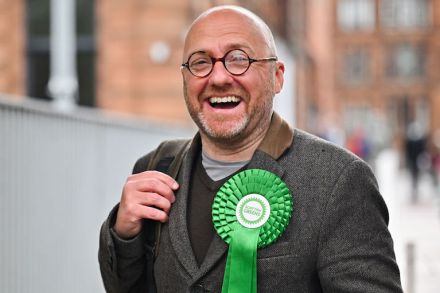
It was only a matter of time. When the Scottish Green party entered government alongside the SNP in August, it was clear Nicola Sturgeon would use the party as a shield against her questionable record and stance on the environment. The surprise is that it happened so quickly and so blatantly. This week we had the extraordinary situation of the Scottish Greens attacking Greenpeace for daring to push the First Minister to explicitly come out against exploitation of the Cambo oil field off Shetland. Scottish Green co-leader Patrick Harvie said Greenpeace was unfairly criticising Sturgeon and is ‘not particularly politically active in Scotland’.

Nicola Sturgeon is flailing in response to the Budget

The big tax and spend budget. More Gordon Brown than George Osborne. Sunak's spending spree. However you wish to describe it, one thing is clear: Rishi Sunak's budget marks a radical departure from previous Conservative chancellors. And while it might have ruffled the feathers of some Tories, it’s also causing problems for the SNP. In some ways the break from Tory convention is no surprise. Calls by the International Monetary Fund (IMF) in 2020 for rich countries to spend their way out of the pandemic – and then further calls this year to shell out to boost recovery – signalled a new economic orthodoxy that Sunak has tapped into. Austerity is passé. Fiscal activism is the new normal.

Is Brexit making Scexit seem impossible?

This month we’ve seen the UK government introduce temporary visas for butchers after farmers were forced to slaughter healthy pigs, the extension of cabotage rights (whereby foreign lorry drivers can do additional pick-up-and-drop off jobs within a country) and a move to replace Brexit’s controversial Northern Ireland protocol. Supply chain problems can’t all be pinned on Brexit – and you could argue endlessly about which factor, Covid or Brexit, is dominant in the disruption we’re seeing – but most people would agree that leaving the EU single market and customs union has not helped matters. Which brings us to the issue of a Scottish exit from the UK (Scexit).

The SNP’s NHS meltdown

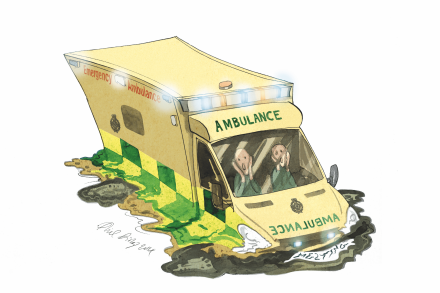
When he’s not falling off his scooter like he’s auditioning for the role of Inspector Clouseau in the Pink Panther franchise, the gaffe-prone Scottish health minister, Humza Yousaf, is mired in a multitude of Scottish NHS crises. This month saw Britain’s armed forces parachuted in to prop up the Scottish Ambulance Service. Nicola Sturgeon was forced to call on the military after distressed patients had to wait hours, and sometimes even days, for an ambulance – one of the most harrowing cases involved a frail Glasgow pensioner who died after waiting 40 hours for an ambulance to arrive. Dig into the government statistics and the scale of the crisis facing the Scottish NHS is clear.

Will Scottish independence really be ‘Brexit times ten’?

Scottish civil servants are to start work on a 'detailed prospectus' for independence so the Scottish government can hold another referendum 'when the Covid crisis has passed', Nicola Sturgeon announced earlier this month. The irony of this – coming just days before the Office for National Statistics reported that the percentage of Scots testing positive in a single week for Covid-19 equated to around one in 45 people – was lost on the First Minister. These things happen when you're busy fighting to free your people from the tyranny of liberal democracy and free society in one of the richest places on earth.

Does Nicola Sturgeon care more about oil revenue or climate change?

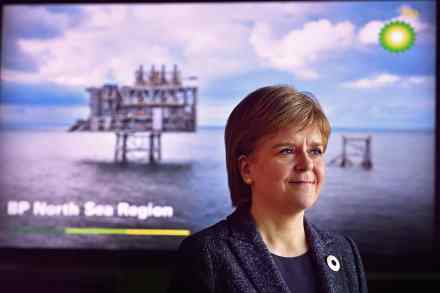
'Now, as I've hopefully made clear throughout all of my remarks, the North Sea will continue to produce oil for decades to come. It still contains up to 20 billion barrels of recoverable reserves. Our primary aim – and I want to underline and emphasis this – our primary aim is to maximise economic recovery of those reserves.' The words are from a speech made in June 2017, a few months after the Paris Agreement that aimed to limit climate change came into effect. A speech by a pro-oil Conservative, or perhaps the head of an industry group working on behalf of the oil sector? No. They are, in fact, the words of First Minister Nicola Sturgeon speaking at the Oil and Gas UK Conference that year.

The north-east’s green success puts Scotland to shame

It’s confirmed. The co-leaders of the Scottish Greens, Patrick Harvie and Lorna Slater, have become junior ministers in Nicola Sturgeon’s government. Harvie is Minister for Zero Carbon Buildings, Active Travel and Tenants’ Rights, while Slater is Minister for Green skills, Circular Economy and Biodiversity. Of the two, Slater’s is the more interesting role as it includes green industrial strategy, an area where Scotland has continued to fail under the SNP. If Slater is serious about turning this around then she should make her first ministerial outing a trip to the north-east of England to see how green industrial strategy should be done.

When will Nicola Sturgeon see sense on Scotland’s mounting deficit?

UK borrowing in 2020-21 hit a record level of almost £300 billion, representing 14.2 per cent of British GDP, reported the Office for National Statistics in June. In the face of the biggest spending challenge since the Second World War, the Treasury, backed by one of the world's most established central banks, stepped up to supply all the funding needed to pay for furlough, business support and a highly successful vaccination programme.

The SNP-Green alliance is a victory for the cranks

The SNP’s nationalist outriders, the Scottish Green party, are reported to be within touching distance of agreeing the terms of a formal cooperation agreement that will see them enter government for the first time. What will this mean for Scotland and its governing party? On the face of it, not a great deal. Some Green MSPs (the party has seven, including co-leaders Lorna Slater and Patrick Harvie) will get ministerial posts but will have minimal impact on SNP policy, which will likely remain tightly controlled by Sturgeon and her inner sanctum. The SNP will hope that the optics of hooking up with the Greens will boost their environmental credentials in the build-up to the Cop26 conference in Glasgow.

Can Scotland reach net zero without the Union?

What’s more important to supporters of Scottish secession, achieving the break-up of Britain or seeing Scotland successfully transition to net zero greenhouse gas emissions? It is a difficult question for environmentally conscious independence supporters to face, but face it they must, for it is becoming increasingly clear that Scotland cutting itself out of the UK will see England, Wales and Northern Ireland power ahead to net zero while Scotland gets left behind. This month saw the publication of the Office for Budget Responsibility’s (OBR) latest fiscal risks report. The bi-annual document identifies and models potential shocks to the public finances.

Are we dangerously addicted to Quantitative Easing?

For such a radical change to our monetary system, the lack of understanding of quantitative easing (QE) and its impacts is worrying. That is one of the conclusions drawn from this month’s House of Lords economic affairs committee report, ‘Quantitative easing: a dangerous addiction?’ QE involves central banks creating money and using it to buy financial assets (usually government bonds). It is known as an ‘unconventional’ monetary tool, as opposed to the conventional monetary policy of raising and lowering interest rates. But as this new report highlights, the practice has very much become a conventional part of monetary policy.

Sturgeon’s economic council is a fig-leaf for independence

This month's announcement of a new economic advisory council formed by the Scottish government came with the usual flow of superlatives. The 17-member group will publish a strategy paper later this year to help deliver the ‘transformational change Scotland needs’, according to economy secretary Kate Forbes. We are promised ‘bold ideas’ that will bring ‘new, good and green jobs’. We have been here before. This group replaces a previous Council of Economic Advisers set up by Alex Salmond in 2007. It too had a remit to galvanise the Scottish economy. It provided 14 years of strategic advice (seven of those under Nicola Sturgeon’s leadership) to the SNP administration with no obvious corresponding uptick in Scotland’s economic performance.

Nicola Sturgeon isn’t serious about IndyRef2

The announcement reeked of desperation. Nicola Sturgeon is 'delighted' that the SNP National Executive Committee has approved her nomination of retired MSP and party grandee Mike Russell as 'political director of the HQ independence unit'. The statement, put out on Twitter last week, aimed to give a sense of momentum and industrious activity: Russell at the head of an elite squad of Nationalist campaigners who will deliver on promises of another referendum.  The appointment of Russell is not so much a sign of progress for the Nationalists as confirmation that their project to break up the UK has stalled. It follows the resignation, after just a few months in post, of Marco Biagi as campaign strategist for the SNP's 'independence taskforce', which was set up in January.

Prince William won’t save the Union

Can the Duke and Duchess of Cambridge save the Union? Officials at Buckingham Palace are reported to be drawing up plans for the Royal couple to spend more time north of the border. If so, it's likely that Alex Salmond won't be amused: the former first minister accused Prince William of 'poor judgement' for meeting Gordon Brown on a recent visit. Salmond, who is now the leader of the nationalist Alba party, also said it would be a 'fatal error' for the monarchy to allow the perception that they were taking sides in the debate He need not be concerned. Pictures of William in a kilt trying not to look bored as he sits through his tenth Highland games of the 2022 season are unlikely to impact Scotland's constitutional debate.

Scotland needs English migrants

Post-pandemic economic recovery was on the agenda at Holyrood this week, with Scotland's finance minister Kate Forbes in full JFK-style 'ask not what your country can do for you' visionary mode. 'Wherever someone works, and in whatever capacity, if they think that they can serve our country as we face the prospect of rebuilding, this is their personal invitation. Our strength is in our united vision to work together — across party lines, sectors and regions — to rebuild,' declaimed Forbes. A cynic might wonder if 'serve our country' will turn out to mean serving the nationalist interest rather than the national one.