Jeremy Clarke

Jeremy Clarke

A journey backwards through my journals

From our UK edition

I’m looking backwards: old journals, old photographs, old notebooks. What strikes me above all is the vigour and energy I once took for granted. The following little descriptions I found in the same pocketbook. The first is an oddity because I have absolutely no recollection of the action being reported. It can’t be fiction or an idea for a piece of fiction because I relinquished that fantasy a very long time ago. It’s scribbled down in black ballpoint. ‘There’s Sophie and there’s Maddie at the moment. Sophie I met at a poetry reading. “Why are you wearing that tie?” she said. “Are you a bourgeois?” “Why are you wearing that scarf?” I said. “Are you a Palestinian?
In praise of a solidly, wonderfully French hotel

From our UK edition

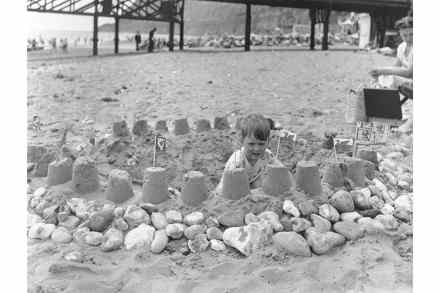
Nothing in the beach hotel was made of plastic. It wasn’t advertised as being a plastic-free hotel, but we noticed it. Nor was there a television in the room nor air conditioning nor a ‘no smoking’ notice on the wall nor a list of hotel rules. Instead there was a wall of books in the reception area, ashtrays from the golden age of smoking, sea breezes and an air of greater liberty. When I presented myself at reception to check in, the woman didn’t want to see a credit or identity card – my Christian name was credential enough. She led us up the marble-slatted stairs, unlocked the door with an old-fashioned key, wished us a very pleasant stay, and went away again.

The art of breaststroke

From our UK edition

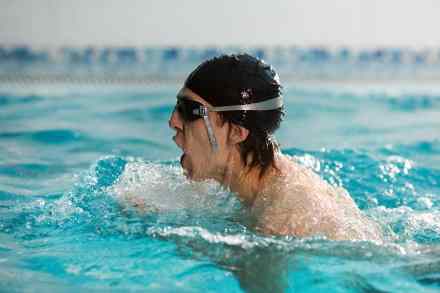
I’m house-sitting for the foreign correspondent while he attends the funeral of his beloved father-in-law Toto, the last of the languid Old Etonian gentleman bankers. And he has a pool. And what a pool it is. The days here are roasting; the sun is now the enemy. Already dead leaves crackle underfoot. So I swim in the evening, when it is a little cooler. The pool is built into the hill above the house. On one side is a wide apron of smooth white stone slabs. Beyond the apron is a rose garden and stone-built pool house with power sockets and a beer fridge. On the other side the water falls over a brim with an ‘infinity’ effect.

It is time for me to ‘get right with the Lord’

From our UK edition

‘But you look so well!’ How many times have I heard that lately. Kindly meant by most, but for a few it’s outrageous, after all they have heard or read about my health, and they feel cheated of the mushrooms growing out of the side of my head that they’d been hoping for. Either way I’m surprised by the compliment. Yes, the tan and this expensive shaving balm Catriona bought me, and now hair again, make me appear unravaged from the neck up.

Why I love Her Majesty

From our UK edition

I’ve often wondered whether Her Majesty the Queen glances through The Spectator from time to time. And if she does, I wonder whether her kindly eye lights on this column. And if it does, I wonder what she thinks of what she reads there. ‘Philip, there’s a man here writing about going to the Cheltenham Festival and messing his pents.’ ‘Very easily done at Cheltenham, my dear. I’ve often wondered why nobody has written about it before.’ Or, ‘Philip here’s that man again, the one who messed his pents at Cheltenham, assisting the ferret-judging at a country show. It’s frightfully interesting. The judge takes so long to judge each class, they drive a car into the tent so that he can judge them in the headlights.

The art of oncology

From our UK edition

The main side effect of the six-month course of chemotherapy was ‘fatigue’. The main side effect of the three-monthly hormone injection is ‘fatigue’. The one and only side effect of the expensive, new-generation, last-chance-saloon anti-prostate cancer drug that I’ve been started on is ‘fatigue’. I’m clapped out. At night I sleep for 11 hours and wake up tired. Then I have about three hours to spend doing things in an upright position before lunch. After lunch I sleep for another two or three hours. After a long afternoon nap I wake up tired again. But I can read lying down on the bed or the terrace recliner. Then it’s a gin and the crossword, supper, and I’m looking forward to going back to bed for another 11 hours.

How not to fish

From our UK edition

After two nights at Le Grau-du-Roi (the King’s Pond) and a night spent within the medieval walls of Aigues-Mortes (Stagnant Waters) we drove north-west to our Remainer friend’s castle perched on the bank of the river Lot. Then duty called her and Catriona returned to Provence and I stayed on for a week to try to recoup a modicum of strength with a daily invalid regime of gentle breaststroke in a swimming pool sheltered by old walls and toddling unsteadily about in the sunny gardens, sometimes putting out my arms for balance like a tightrope walker. Any time I felt like it, I could then mount the 17th-century stone staircase to my town hall-sized bedroom and lie down and fall instantly asleep.

In the footsteps of Hemingway

From our UK edition

‘They were living at le Grau du Roi then and the hotel was on a canal that ran from the walled city of Aigues Mortes straight down to the sea.’ So begins Hemingway’s posthumously published transgender-themed novel The Garden of Eden. He began writing it in 1946 and kept at it intermittently through his long mental and physical decline. Yet it’s a marvellous novel, in parts as vivid as Hemingway’s miraculous early stuff, which, once read, susceptible people confuse with their own lived experience. In 1927 Hemingway and his second wife Pauline came to Grau-du-Roi on the Camargue coast for their honeymoon and the first three chapters of the novel are clearly based on that visit.

How a May Day car-boot sale gave me back my optimism

From our UK edition

So that’s it. Is a third world war possible? It’s already begun, opined a retired US general in the newspaper. Oh good. I shouted down the stairs to Catriona: ‘World War Three’s started.’ Catriona said she’d better get the washing in, then go down to the village shop to get fresh coriander. May Day in France is also Fête du Muguet – the festival of the lily of the valley. Lovers give each other bunches to signify love, affection and workers’ rights. She returned with coriander and a lily of the valley for me. The latter was wilting a bit. ‘It’ll probably only last two or three days,’ she said.

The call of opium-based analgesics and introspection

From our UK edition

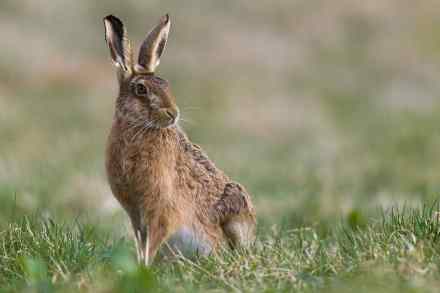
On the morning of my last day in England, I drew back a curtain and there in the garden, browsing one of the flower beds, was a brown hare. It hobbled cautiously but not timidly among the spring bulbs, choosing thoughtfully like a discriminating shopper. I leaned on the window sill and watched it for perhaps ten minutes. The hare was in the process of exchanging its tatty winter fur coat for a shorter, smoother, lighter-brown one, visible underneath. Overnight late spring had turned to the softer air of early summer and I was sorry to be leaving the country at the exact point of the season’s changing. In the bedroom I regretfully set about packing my trolley bag for the flight back to Nice.

The nature of luck

From our UK edition

I was walking across a fallow field to the pub with my two grandsons. ‘What’s this?’ said my 11-year-old Oscar, showing me a bone he’d noticed embedded in the footpath and prised out. I rubbed the mud off the delicate, strangely beautiful thing with my thumb. ‘That,’ I said, with more authority than knowledge, ‘is the shoulder blade of a hare. I’ll clean it up when we get back and if you keep it in your pocket it’ll bring you good luck.’ ‘What is luck?’ said Klynton, aged ten. ‘Hard to explain,’ I said. ‘Lucky people have mostly good things happen to them; unlucky people mostly bad. But nobody believes in luck any more. Not really.’ We were walking to the pub for a farewell supper.

My sojourn in the Test Valley

From our UK edition

After north Cornwall I came to the Test Valley, I think. That is what it says on the council vans anyhow. An immensely kind family lent me an immense cottage in farmland a mile outside a village. I’ve started new drugs costing the French taxpayer €4,000 a month. Possible side effects are thrush and fatigue. No thrush so far but fatigue yes, and I remained several days within these cottage walls before I tried to walk to the village pub for lunch. Walking was easier than I thought it would be and I diverted up a footpath that followed the edge of a huge field up to a viewpoint. Snowy hawthorn was the one vibrant colour in a panorama of leafless trees and hedges and muddy acres. The sky in contrast was a vivid, fast-moving drama of black, blue and white.

Modern capitalism has failed my son

From our UK edition

A light was on in the caravan site office so I went over to try and buy a gas canister. Come Easter the little Cornish seaside resort will be heaving. Now a stiff north wind blew in off the sea and it felt like the dregs of winter still. The site office was shut but a woman came out and said she was expecting a delivery tomorrow but she didn’t know yet how much a canister would cost. Nor did she know of anywhere open where we could get something to eat. She thought there might be a place down by the beach. Nobody had managed to get any seasonal staff yet and everything was a bit uncertain, she said. So me, my son and my two grandsons went down to the parade of seaside shops with our chins in our collars. There were no lights on or any people about.

Elegy in a country churchyard

From our UK edition

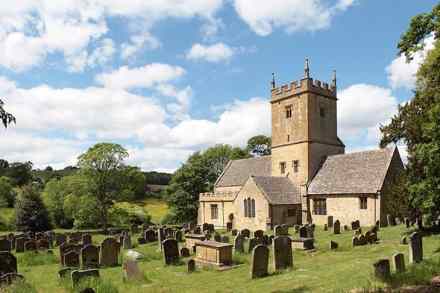
‘I love this old watering can,’ said my sister, sprinkling the miniature rose. ‘Though I do worry about soaking Mum. How far down is she? Do you remember?’ I said I thought about five foot. The country churchyard is sheltered by hedges and trees and the graves are decently spaced. On Mothering Sunday mown grass was scattered across the gravel path and graves and a chill sea mist billowed like smoke off the sea. Two months before Covid struck, I’d thrown my handful of soil in after her. This was my first visit since that day. The earth was still broken and heaped but now there was a grey headstone with her name and dates, her maiden name, and the phrase ‘Alive in Christ’.

The call of a blackbird’s full-throated song

From our UK edition

Speaking pretty good English, Dr Tayeb came straight to the point. Was I eligible for the ground breaking new cancer treatment? He was afraid not. The radioactive test scan had illuminated the bone tumours very nicely, but the more dangerous one in the liver had remained occluded. So in my case the new treatment – a series of targeted infusions – could have only a ‘suboptimal outcome’. He was therefore not recommending that we go ahead. This was at 8.30 in the morning. I’d been in a taxi since 6.30.

The shadowy charisma of the Mater Dei sisters

From our UK edition

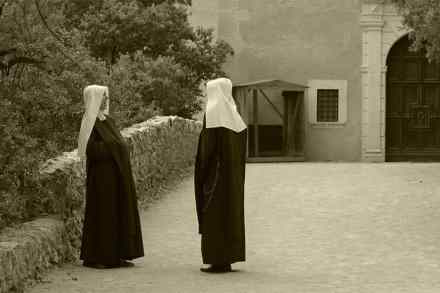
Catriona has a commission to paint the 17th-century façade of the chapel of St Joseph’s. She’d made a start when she decided that a foreground figure would lend greater interest and perspective to the composition. Following an email exchange, one of the nuns agreed to pose on the stony path leading up to the chapel for a photograph, from which Catriona would complete the work. At the appointed time she clanked the bell beside the pointed nunnery door. I was her out-of-breath photographer’s assistant. After two long minutes, the door opened and the youngest and prettiest of the seven sisters stepped from the cloister into the windy world.

The joy of wigs

From our UK edition

I thought, or anyway hoped, that once I’d finished the chemotherapy I would spring back to vitality. Seven weeks on and I’m still creeping about like a two-toed sloth. Now and then I study my face and head in the bathroom mirror for signs of rejuvenation. The narrow skull now boasts a light covering of baby fuzz. Sprouting from my upper lip are some widely spaced bristles. But no sign yet of any eyebrows. From their pouchy sockets the eyes look back at me uncertainly. Listening to In Our Time a few weeks ago, I heard Melvyn Bragg read aloud Thomas Hardy’s poem ‘I Look into My Glass’. The three short, deceptively simple stanzas, concluding with the phrase ‘throbbings of noontide’ undid him.

My oncologist has a new weapon in his arsenal

From our UK edition

‘We’re at war!’ said the taxi man as I installed myself for the long drive to Marseille. I put a fist to my mouth and tooted my imaginary bugle. But world war three – as he saw it – was no joking matter. My tootling bugle irritated him and his voice rose by a querulous octave. Didn’t I realise? Everything has changed since this morning! European politics had changed! French politics had changed! Who was now going to vote for a political novice like Zemmour, for example? Horizontal in its dashboard holder, his smartphone was showing a three-cornered TV debate on a rolling news channel. He turned up the volume. Everyone was yelling at once, including the presenter. He turned the pandemonium down a bit.

The joy of French car boot sales

From our UK edition

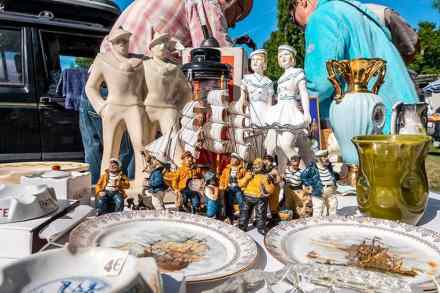
Every Saturday morning Michael rises at four and drives down to the Côte d’Azur to the Magic World car boot sale. He goes early to see the bric-à-brac unloaded in order to pounce on any interesting old bottles, which he collects. His collection of 18th-century champagne bottles is probably second to none. While hunting bottles, he might also impulsively buy something that tickles his fancy. His knowledge of old things is wide and deep and occasionally he unearths something that would make an Antiques Roadshow crowd gasp with avarice. Then he goes for a swim in the Mediterranean. He’s back at home by ten. Last month he came back with a set of late 19th-century French pharmacy scales. The glass and mahogany cabinet alone is a work of art.

My existential crisis was straight out the terrible twos’ playbook

From our UK edition

Early on St Valentines Day I walked down to the car park where the raindrops were knocking off the young almond blossom petals. The slow-dropping rain was refreshing after the January drought. In the car park the red car was shining wet instead of furry with dust. I drove for 20 minutes on a winding road through low hills, intensively cultivated since the days of Roger the Norman, but abandoned since the Grande Guerre. My destination was a commercial laboratory in the nearest town for a pre-scan blood test. On the journey I went over in my mind what Catriona had said to me the night before. I wasn’t yet up to it. Not an evening do. Not even with a lot of jovial, undemanding holograms Earlier in the week it was my birthday. I’ve never been one for celebrating birthdays.