Jeremy Clarke

Jeremy Clarke

The bump in the night that changed my mind about pygmies

From our UK edition

Music of the Forest on Radio 4 last week was a profile of the anthropologist Colin Turnbull, 1924–1994, who achieved celebrity with his book The Forest People: A Study of the Pygmies of the Congo (1961), which presented such an inspiring vision of a prelapsarian, non-violent, egalitarian society that it became a cult classic of the counterculture. Turnbull appeared to have stumbled on an ideal and idyllic society, proving Hobbes wrong. The life of a pygmy, by this account, was very far from being ‘nasty, brutish and short’. (Or ‘nasty, British and short’ as academics are fond of saying.) What gave his pygmies the advantage over other primitive peoples, said Turnbull, is that they weren’t in thrall to the spirit world. They fear no evil.


An undergraduate anorak at 32

From our UK edition

When I was 32, tired at last, for the moment anyway, of seizing the day, I stopped drinking and gave up smoking and enrolled for two A-levels in one year at the local technical college. My decision coincided with a state decision to expand the middle class and I was awarded a small government grant. I found I was ripe for study, passed both exams with good grades and applied to Hertford College, Oxford, to read English. The choice of college was specifically and perhaps idiotically based on a romantic obsession with Evelyn Waugh’s life and work.

Glazed tiles, a barred window: it must be another morning in a police cell

From our UK edition

In my late twenties, it was not unusual for me to wake up in a police cell wearing a paper suit. Waking to glazed tiles and a high barred window, and not knowing how one got there, is a bad way to start the day. On this particular occasion, I opened my eyes and pieced together that the party in the nurses’ home had gone on all night, that I had continued to drink, and that I had then gone to a football match. The last thing I remembered clearly was standing on the terrace drinking cider and vodka out of a vodka bottle. (My pals told me later that two St John Ambulance guys had carried me out of the ground on a stretcher.) At that time I was a trainee psychiatric nurse. Booze at the social club in the hospital grounds was cheap, and the nurses were a hard-drinking crowd.

What I learned working in the lunatic asylum

From our UK edition

In 1984 I was 27. Since leaving school I had done unskilled manual labour, when I could get any. Then l worked as a nursing assistant and then a trainee nurse in an 840-bed psychiatric hospital at Goodmayes in Essex, formerly the West Ham Lunatic Asylum. It was like a walled town. I ate, slept and socialised in there and became institutionalised and a bit mad, I believe. In ordinary life, among relatively sane people, one becomes fairly confident about the parameters of so-called normal human behaviour. They are narrow parameters, and all the time getting narrower, I think. But if you live in a large mental hospital, these parameters widen drastically, or even disappear altogether.

A road trip in the company of Long John Silver and an exciting pair of thighs

From our UK edition

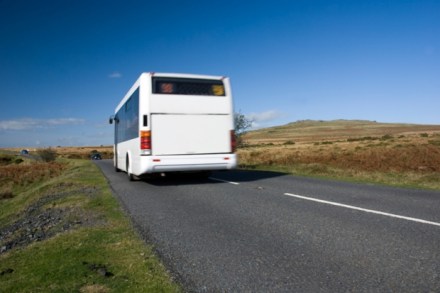
I live in south Devon. Last week I went up to north Devon, to visit a friend who was renting a cottage on the coast for a week. Devon is a big county. I decided to go by train to Barnstaple and then by bus. At Exeter the train caught fire, however, and we were herded off and packed into an old charabanc that could barely get up the steep Exmoor hills. At Barnstaple, finally, I waited at stand J of the austere bus station. Punctually, a minibus drew up and six of us climbed on: a blond lad with airline tags on his backpack; a man-mountain in a baggy suit carrying a guitar case; a middle-class woman who greeted the driver with genial condescension; a pair of teenage lovers, she showing as much as possible of an exciting pair of thighs; and me.

I might have no testosterone but I do have a Fiat Barchetta

From our UK edition

I’ve might have no testosterone. (My production is currently being stopped by injection once every three months.) But what I do have is a Fiat Barchetta, bought for a grand on a whim on eBay. It’s the prettiest little two-seater, an old-school, fun drive, with a lot of growl and it makes people smile. Left-hand drive. I’ve had it a month and so far I have yet to see another on the road. The one obvious change thus far in my testosterone-free personality is my taste in music. I’ve gone from liking aggressive stuff like ZZ Top and AC/DC to preferring soppy Nick Drake and Joni Mitchell. The theme from Out of Africa. Gentler stuff. Triteness. I love you-oo. Also tabernacle choirs. Even folk.

The indiscreet charm of Jim Davidson

From our UK edition

Le tout Torquay was there, cramming into the Princess Theatre with a drink in each hand ten minutes after the show had begun. I pressed in among them. Jim Davidson, in a black shirt, a baggy old pair of jeans and business shoes, was already onstage introducing his show and bantering with people in the front row. ‘What’s the matter with you in the wheelchair, love?’ he said, cupping his ear at her. She was blind, she said. ‘Then what the fuck are you doing right down here at the front?’ (Laughter.) ‘Can you see anything at all, love?’ She couldn’t, she said. ‘Well, just to give you an idea,’ he said, vainly smoothing his hair, ‘I look a lot like Brad Pitt.’ (Laughter.

My grandson’s Great Leap Forward

From our UK edition

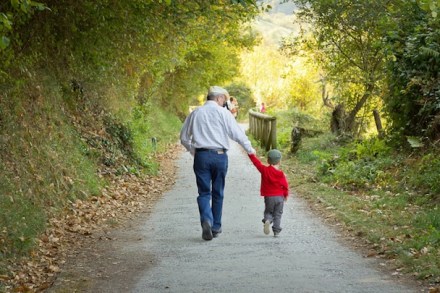
‘Oscar!’ cried Miss Herd as I arrived. She was standing at the classroom door releasing her charges one by one as the parent, or in my case the grandparent, arrived to escort them safely back to their respective homes. Oscar came solemnly out in his navy Academy sweatshirt carrying his red Fireman Sam lunchbox and placed his four-year-old hand in his grandfather’s 57-year-old one. We headed off to the car. ‘Did Tom play with you today?’ I said. Tom, by all reports, is omnipotent and capricious in his choice of playmates. ‘No,’ said Oscar tragically. I was standing in on the school run for Daddy, who had to work an extra 12-hour shift at the care home unexpectedly. Oscar lives with Daddy and goes to stay with Mummy at the weekends.

I am walking to the Spectator party — sober, clean and in all my finery

From our UK edition

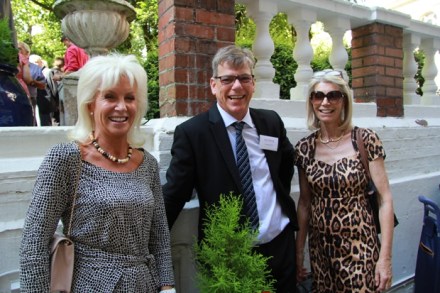
They do love a party at The Spectator. I was invited to four in ten days last week: the Apollo Summer party, the Spectator ‘At Home’ Summer party, the annual Spectator ‘Meet the Readers’ afternoon tea party, and our Spectator arts editor, the great Liz Anderson’s farewell party. I hadn’t been up to town this year, and on the train journey up from Devon, I felt like a hick up from the sticks. But I love London and I had that same old heart-lift as I stepped down from the train under the great iron roof of Paddington station, then passed along the platform beneath that giant unkempt simpleton representing the Great Western Railway employees who fell in the first world war. But my favourite arriving-in-London moment was yet to come.

Honesty, simplicity, integrity: not what I want the morning after

From our UK edition

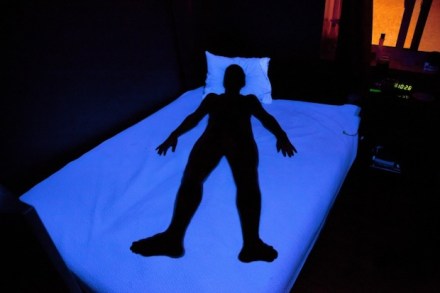
Tap tap tap at the door. I opened my eyes. ‘Check-out 10.30,’ said a neutral or possibly slightly hostile female voice on the other side of the door. I looked at my phone. As I looked, the clock changed from 10.29 to 10.30. Then I heard what I perceived to be the irritated rustling of a large plastic bag and receding carpeted footfalls. This wasn’t a hotel as such. It was a ‘club’ into which non-members like myself are welcomed and charged slightly more than members. I’d chosen it because it was called the Penn club, and it was in Bloomsbury, and I’d seen it advertised in the Times Literary Supplement, and, being densely stupid, or romantic, or both, I had imagined it to be some sort of a writer’s club.

A circle of love with Brown Eagle Feather

From our UK edition

‘I’m wasted,’ said Trev, meaning not that his life is futile, but that his mind was overwhelmed by illegal drugs. He conceded it. It wasn’t often that drugs ruined him, but tonight they had, and credit where credit’s due. We were a disparate post-pub gathering of about a dozen people. At a push you might call it a party. The house was small, the party confined to a brightly lit kitchen and a square, semi-dark living room. Everyone bar me was in the kitchen doing this, that and the other. I was standing in the darkness of the living room listening to Hawkwind on the CD player and thinking that surely they were the greatest band in the world, ever. Then Trev came in from the kitchen with this latest report on the state of his mind.

My night in a room haunted by falling cannonballs

From our UK edition

On Saturday night I went to Charlie’s 69th birthday party. What a gaff he’s got. The rather snooty description of the Grade II listing sums the place up as ‘a slightly provincial but nonetheless interesting example of an early to mid 18th-century gentleman’s house which has a remarkably complete interior and has not suffered from any extreme 20th-century modernisation’. The writer is quite correct: inside the house, apart from the telly and the odd iPad lying about, George I might still be on the throne, poaching a capital offence, and John Wesley fervently preaching to multitudes in a field just outside the parish bounds. You can look out of any window and the views are the same as then, too.

An orgy of violence at the summer fête

From our UK edition

After three days tête-à-tête (and sometimes tête-à-pied) I walked into town alone to get some air and see what the town was like and the people in it. In one direction, above the hills, the sky was black. Above the town, however, the sun was shining fiercely through a gap in the clouds. Approaching the outskirts, I heard African drumming and a man yelling with demented good humour into a microphone. A single strand of bunting strung between the lamp posts told that the town was celebrating its summer fête. The first person I encountered was a man of about 30. He was walking towards me carrying a plastic litre bottle of cider horizontally. He was gently agitating the liquid inside and seemed to be talking to it affectionately.

A free gin, a cheeky joint: welcome back to the local

From our UK edition

My first time back in the local for eight weeks. The manageress lifts the flap, comes around to my side of the bar and kisses me on the lips. We can’t hear ourselves speak as there is a ska DJ barricaded into a corner behind a waist-high wall of speakers and the bar is small and the ceiling low. She indicates that my gin and tonic is on the house. I take it outside and take a seat on one of the picnic benches on the patio. This hippie guy is prancing ecstatically around the tables with fluttering fingers. A couple sit themselves down opposite me and the bloke starts rolling a single skin joint. I know them by sight but I don’t know either of their names.

Sharon took to the madness of Pamplona like a duck to water

From our UK edition

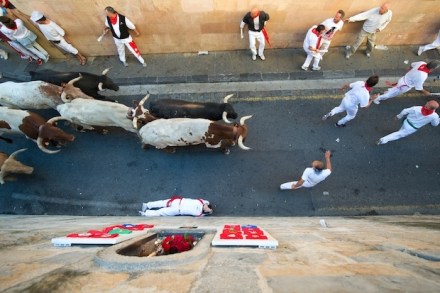
Then there was the time I took Sharon to the Pamplona bull run. She looked very fetching in the traditional St Fermín costume of white T-shirt, white cut-off jeans, red sash tied around the waist and the red neckerchief symbolising the saint’s martyrdom by beheading. She wore her neckerchief in a big rumpled V at the front, like a cowgirl. The Sanfermines last a week. Hundreds of thousands of young revellers cram into the old fortress town’s narrow streets and cane it. As well as the famous bull runs each morning, and the evening bullfights, there are fairs and parades and marching bands and pop concerts and a nightly firework display competition that is worth going for on its own.

Two narcissists trapped in one static caravan

From our UK edition

I was two days alone in the caravan and no signal or reception of any sort. It was like a Buddhist silent retreat, where you have to listen in horrified amazement to your own thoughts. During the day I walked the cliff path; in the evenings I sat on the caravan steps wishing I had a rook rifle. On my walks, I did acquire a book, however: Sigmund Freud’s essay On Narcissism. It was on a community book-swap shelf in a disused telephone box. I’ve been picking up Freud and putting him down again perplexed and defeated for most of my adult life. But when I opened this one and glanced inside, I thought here at last was something I might be able to get to grips with.

In the soft Cornish air, with the pressure off, I caved in

From our UK edition

Just when I was beginning to think I’d had enough, I was offered a free week in a caravan. I took it like a shot, threw a few shirts in the boot of the car, and buggered off down to Cornwall. I arrived in darkness and couldn’t find the electricity switch. But I was so tired I simply climbed into a sleeping bag by the light of my phone and fell asleep. I was woken by sunshine and the cawing of rooks. At this caravan, there is no internet, no phone signal for miles, no telly, no radio. And the air I swear is soporific. It was like crawling out of my sleeping bag on a different, quieter continent.

‘I know what you are, and where you’ve come from. Be aware we are under God’s protection’

From our UK edition

I couldn’t find the house so I called the number again. Instead of the man I’d spoken to previously, this time a woman answered. ‘I’m surprised you couldn’t find the house with all your advanced technology,’ she said. She sounded elderly. A mid-Devon accent — an older version of it. ‘I’ve yet to join the sat-nav generation, I’m afraid,’ I said, apologetically. ‘Sat-nav?’ she said. ‘You must think us very quaint. Stay there and I’ll ask Maynard to come and fetch you in his car.’ So I pulled the car over and waited. Five minutes later, a beard driving a Nissan Micra came along, saw me, indicated, slowed down, showed me a palm and performed a U-turn. I started the car and followed him.

My love for Sharon was like a mental illness

From our UK edition

As Sharon stooped to pour boiling water from the kettle into two mugs, I studied her back and wondered what, if anything, remained in me of the love I once had for her. Was there a residue somewhere? Or a stain? I pictured her back as it had been a dozen years earlier, tanned by the Sardinian sun and bisected by the thin turquoise strap of her bikini top. My love for Sharon was more in the nature of a terrible mental illness than anything nourishing, and when it was at its height, we went away for a week to Santa Teresa Gallura, a quiet seaside town at the northern tip of the island. We stayed in a cool, family-run hotel with views from our window across the blue Strait of Bonifacio to the southern coast of Corsica, and looking the other way, down to the town beach.

Sharon’s back, altered in mind as well as body

From our UK edition

Sharon’s back. As soon as I heard, I went straight round to the house and let myself in. She was standing in the kitchen wearing that deceptively vulnerable look that she has. Also in the room was a little girl aged about three with ruby red hair and a Boxer dog. The Boxer was built like Sonny Liston and capered before me. It span round in circles, glancing coquettishly over its shoulder. The little girl was my superior in intelligence and composure. I could see it straight away, as could she. Her name was Amy. Sharon and her partner had adopted her 18 months before. Sharon and Amy shared a companionable stillness that was unruffled by my appearance. I hadn’t seen Sharon for six months. She was thinner than ever, which made her liquid eyes appear larger.