Jay Elwes

Uniform beats

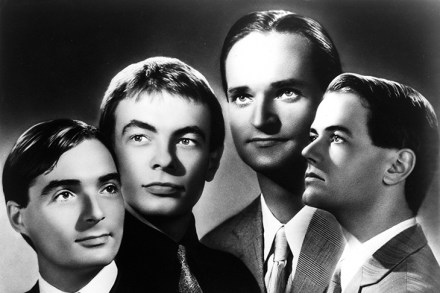
This article is in The Spectator’s March 2020 US edition. Subscribe here. Right from the beginning, everything about Kraftwerk was odd. They had no frontman, they seemed to play no instruments and their strange, electronic music owed nothing to blues, soul or any of the other forms of music that underpinned 20th-century pop. Instead, a Kraftwerk gig consisted of four gauche-looking fellows from Düsseldorf standing in a row, each poking at a synthesizer while strange, apparently unconnected images appeared on screens behind them. A Kraftwerk album could be just as confounding. The cover of 1977’s TransEurope Express featured the band in suits and ties, looking more like the partners at an accounting firm than a pioneering electronica band.

kraftwerk

Why were Kraftwerk such a colossal success?

From our UK edition

Everything about Kraftwerk was odd. They had no front man, they seemed to play no instruments and their strange, electronic music owed nothing to blues, soul or any of the other forms of music that underpinned 20th-century pop. Instead, a Kraftwerk gig consisted of four rather gauche-looking fellows from Düsseldorf standing in a row, each poking at a synthesiser, as a strange, apparently unconnected series of images appeared on screens behind them. A Kraftwerk album could be just as confounding. The cover of the 1977 album Trans Europe Express featured a portrait of the band. In suits and ties, they looked more like the partners at an accountancy firm than an electronica band.

Liberty depends on a delicate balance between state and society

From our UK edition

Liberty is a fragile thing. For thousands of years, civilisations have risen, flourished and fallen, and most of them have been rigid, brutal and despotic. Freedom for the masses is a historical rarity. It arises only as the product of a fine balance between competing interests. That balance is the subject of this book. According to the authors, both of whom are American economists, the first of those countervailing forces is the state, or what Hobbes called the Leviathan. The second is society. For liberty to exist, the state and society must achieve equilibrium. If one dominates the other, the result is a slide away from liberty towards despotism.

The great betrayer

From our UK edition

When Klaus Fuchs started passing atomic secrets to the KGB, he changed the course of world events. Forget about Philby and the Cambridge Five, that preening group of loudmouths that still dominate our national history of Soviet treachery. In his own quiet, devastating way, Fuchs proved more significant than all of them put together. A brilliant but unassuming German refugee who found sanctuary in Britain, Fuchs rose to become one of the leading theoretical physicists of the Allied nuclear bomb project. As Frank Close, himself an Oxford nuclear physicist, writes: ‘By 1946, Fuchs knew more about the construction of the atomic bomb and the conception of the hydrogen bomb than anyone in the UK and all but a handful in the world.