Jane Ridley

Spectator books of the year: Jane Ridley on her favourite books about The Great War

From our UK edition

2014 has been the year of 1914. In the same way that Christmas puddings appear in supermarkets in October, many of the contestants in the publishing race for 2014 defied starter’s orders and came out pre-maturely in 2013. What has been striking about the bumper crop of first world war books is the terrifically high standard. One of last year’s books which I’ve only just got round to reading in paperback is David Reynolds’s Long Shadow (Simon & Schuster, £9.99). Because the Great War seemed so meaningless, killing so many British soldiers for reasons which remain remote and obscure even today, it has always been especially difficult for the British to make sense of it.
Is there anything left to say about Queen Victoria? A.N. Wilson has found plenty

From our UK edition

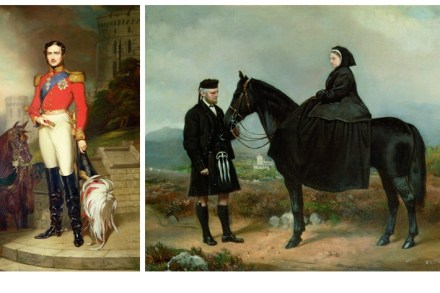
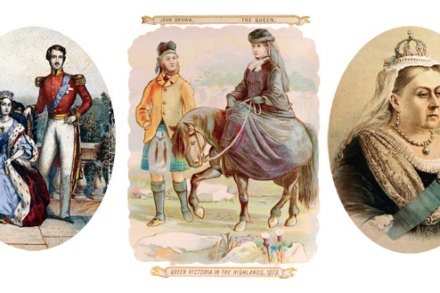
Do we really need a thumping new life of Queen Victoria? She seems to be one of our most familiar figures, the subject of countless books; but the surprising fact is that there hasn’t been a full, authoritative study since Elizabeth Longford’s life of 1974. A.N. Wilson has spent many years thinking and reading about Queen Victoria, and this superb revisionist biography is the book that he was born to write. In Wilson’s view there are two Victorias. The young Victoria was always someone’s pawn, trying to be a person that she wasn’t. She was in thrall first to Lord Melbourne and then to Baron Stockmar and Prince Albert. Only after Albert’s death was she able to become her true, strong-minded self.

The Paris of Napoleon III was one big brothel – which is why the future Edward VII loved it

From our UK edition

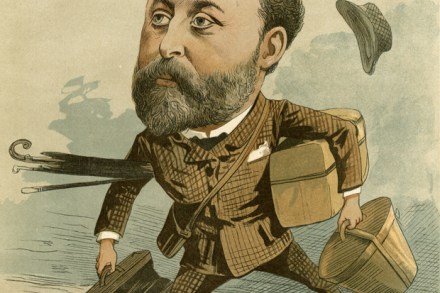
Stephen Clarke lives in Paris and writes book with titles such as 1,000 Years of Annoying the French. Dirty Bertie is a book in the same line — a comic history which manages to combine his brand of jaunty, bawdy humour (not mine, I confess) with being genuinely informative about French history. Clarke claims that there is a gap in the biography of King Edward VII. Biographers have not said nearly enough about Bertie’s jaunts to Paris. He is absolutely right about this. To Bertie’s British biographers Paris is a collection of clichés about grandes horizontales and a few well-worn anecdotes.

Queen Victoria with the naughty bits put back

From our UK edition

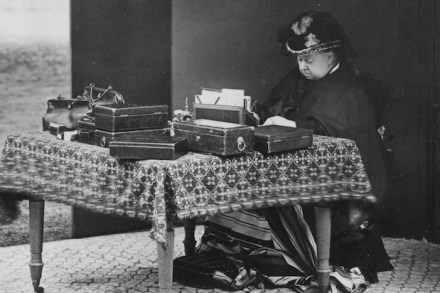
Queen Victoria was the inventor of official royal biography. It was she who commissioned the monumental five-volume life of Prince Albert, a controversial and revealing work. She wrote most of the personal sections herself. She also published bestselling volumes, such as Leaves from a Journal of Our Life in the Highlands. She was a gifted and prolific writer, penning an estimated 2,500 words a day. When she died in 1901, however, there was no authorised biography. Instead, the decision was made to publish her letters. People tend to assume that letters are the truth but, as Yvonne Ward shows in this original and engaging book, selection is everything. The idea of editing Victoria’s letters originated with Lord Esher.

What was the secret of Queen Victoria’s rebel daughter?

From our UK edition

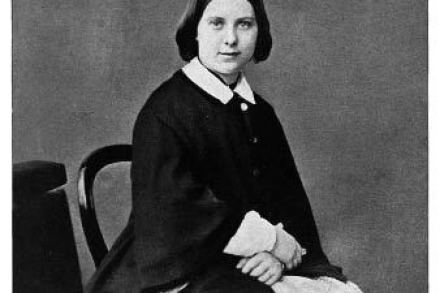
Princess Louise (1848–1939), Queen Victoria’s fourth daughter, was the prettiest and liveliest of the five princesses, and the only one who broke out of the royal bubble. Artistically talented, she trained as a sculptor, and her marble statue of Queen Victoria can still be seen in Kensington Gardens. Unlike her sisters, who all married royals, Louise became the wife of a commoner, Lord Lorne, later Duke of Argyll. The marriage was childless and unhappy, and the couple lived separate lives. Like that other rebel, Princess Margaret, Louise was clever but difficult. She could be charming and witty one moment and unexpectedly disagreeable the next. She kicked against the royal rules, but she was only too willing to pull rank when she felt like it.

The food of love | 3 January 2014

From our UK edition

The Albek Duo are two astonishingly beautiful and talented Venetian musicians, Fiona and Ambra, who are identical twins. Hearing the sisters perform inspired Christopher Ondaatje to create this book. He tells a story — ‘Love Duet’ — in which he imagines what would happen if the twins both fell in love with the same man. They agree that one should marry, and they should carry on as before. For the sisters, abandoning their music or each other is unthinkable. This is an anthology of stories on the theme of music and how it can govern our lives and express our emotions. You don’t need to be a concert-goer to enjoy this book — all the pieces assembled here are accessible and absorbing.

Can virgins have babies?

From our UK edition

Mrs Christabel Russell, the heroine of Bevis Hillier’s sparkling book, was a very modern young woman. She had short blonde hair which she wore in two large curls on the side of her head, she was wildly social and she was a fearless horsewoman. In 1920 she set up a fashionable dress shop, Christabel Russell Ltd, at 1 Curzon Street. At the end of the first world war she had married John Russell, known as ‘Stilts’ (he was 6’5” tall), the heir to Lord Ampthill, a cousin of the Duke of Bedford. His snobbish and crusty parents disapproved furiously of the marriage. The young couple spent little time together. Christabel, who adored dancing, went out night after night with one of her many admirers.

What caused the first world war?

From our UK edition

The centenary of August 1914 is still almost a year away, but the tsunami of first-world-war books has already begun. The government tells us that 1914 must be commemorated, not celebrated, and ministers worry about British triumphalism upsetting the Germans. But the debate about Germany’s responsibility for the outbreak of war in 1914 won’t go away. Historians are divided into those who blame Germany — John Rohl, Max Hastings — and those who point the finger at someone else, such as Serbia (Christopher Clarke) or Russia (Sean McMeekin) or even Britain (Niall Ferguson). The blame game is of course conceptually flawed. The international system in 1914 was seriously dysfunctional. The alternative to searching for scapegoats is to examine the system.

The Girl Who Loved Camellias, by Julie Kavanagh – review

From our UK edition

Verdi’s La Traviata is the story of a courtesan who is redeemed when she gives up the man she loves in order to preserve his family honour, and then dies tragically in his arms. Verdi based his opera on a novel by Alexander Dumas the younger, The Lady of the Camellias (1852). This work was inspired by a courtesan whom Dumas had known — and had an affair with — but she has been largely forgotten. Her name was Alphonsine Plessis — later changed to Marie Duplessis — and she was only 23 when she died. Julie Kavanagh has written the story of her extraordinary life. Alphonsine was born in 1824 in Normandy. Her peasant family could hardly have been worse. Today, social workers would have put her in care. She was probably sexually abused.

Perilous Question, by Antonia Fraser— review

From our UK edition

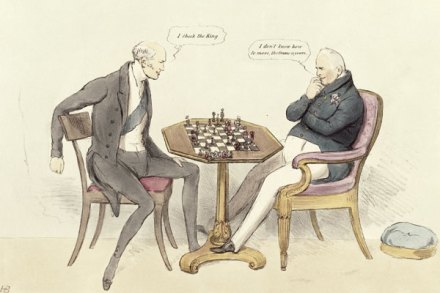
There are times when a major drama in the House of Commons really does change the course of British history. The period 1974–79, dramatised in the play This House, was one such. The crisis over the Great Reform Bill was another. Not so long ago, every schoolboy knew that the 1832 Reform Act gave the vote to the middle classes. Nowadays, thanks to the collapse of history teaching, very few schoolboys or girls know anything about it at all. Antonia Fraser has written a compelling and timely book on this almost forgotten political battle. The story begins with the election of 1830, which was called because of the accession of King William IV. The Tories, who had been in power for virtually 60 years, scraped in with a flaky majority.

‘Holland House: A History of London’s Most Celebrated Salon’, by Linda Kelly – review

From our UK edition

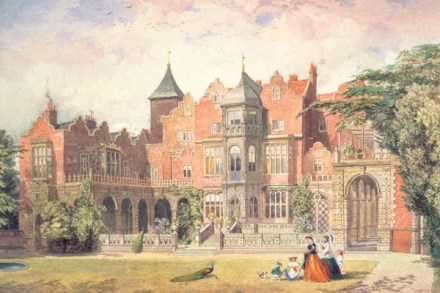
Holland House, which was bombed in 1940, was a large, rambling Jacobean mansion off Kensington High Street. In 1800 it was still in the country, surrounded by leafy woods and fields. Here Lord Holland and his wife Lady Holland created a glittering and influential salon. For over 30 years before the 1832 Reform Act, Holland House was the headquarters of the Whig party. Lord Holland was the nephew of Charles James Fox, and at Holland House the Whig aristocracy — ‘they are all cousins’, as someone said — dined and talked and plotted. An intellectual nerve centre, Holland House was the place where the new men with the new thinking from Scotland met and influenced the Whigs. Byron was a favourite, and it was at Holland House that he first met Lady Caroline Lamb.

Secrets and ties

From our UK edition

It is a truth universally acknowledged that secrets are toxic and break up families. Today we look back smugly on the bad old days of the stiff upper lip when skeletons were kept firmly locked in their cupboards. We think we know better. The English, once famous for their secretiveness and reserve, have become addicted to confessional culture. Celebs expose their childhood scars in misery memoirs, and transparency is hailed as the greatest good. In this timely book, American historian Deborah Cohen challenges our complacency. The history of secrets and their relation to the family turns out to be far more complex and vastly more interesting than might be imagined. In spite of our much-vaunted openness, we hide away our mentally disabled children.

Taking a pop at the Queen

From our UK edition

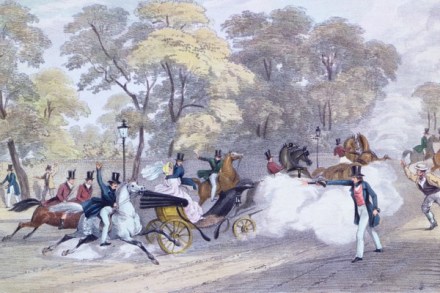
On 10 June 1840 an 18-year-old out-of-work Londoner named Edward Oxford cocked his pistol and fired two shots at Queen Victoria as she made her daily carriage drive with Prince Albert on Constitution Hill. Oxford was mobbed by the crowd, who shouted ‘Kill him!’ He was charged with high treason. Though he claimed that his cheap flintlock pistol was loaded, no ball was ever found. Oxford, who (according to Prince Albert) was ‘a little mean-looking man’, delighted in the attention the shooting brought him. During the trial the family insisted that he was mad. He was found guilty but insane, and sentenced to confinement for life in Bethlem hospital. Oxford was the first of seven men who attempted to kill or assault Queen Victoria.

No stone left unturned

From our UK edition

Dickens, the inspiration and source for this book, was addicted to walking the London streets at night. A man who felt uneasy in the countryside without a pavement beneath his feet, he was said to know the mean streets of London better than any cabbie. His skill was to write about the city in his own time, describing the world of the London poor as if they had never been seen before. Dickens realised that to understand London, you need to know how to read the street. That is the idea behind Judith Flanders’s new book. Like Dickens, Londoners walked everywhere. In 1866 an estimated three-quarters of a million pedestrians poured in to work each day, a thick line of black-coated clerks tramping the streets.

The Criminal Conversation of Mrs Norton, by Diane Atkinson

From our UK edition

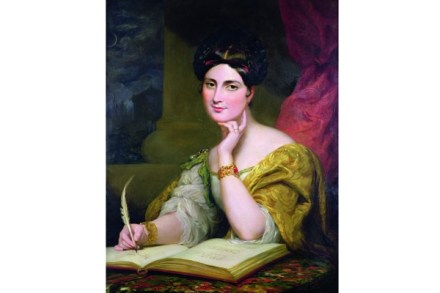
Caroline Norton seems an unlikely pioneer of women’s rights. Born in 1808, the granddaughter of the playwright Sheridan, she was a black-eyed beauty, a sharp-tongued socialite with a gift for writing. She matters today because she quarrelled with her husband and refused to put up and shut up. That quarrel is the subject of Diane Atkinson’s book.   Caroline and her two beautiful sisters were brought up in genteel poverty by their widowed mother in a grace-and-favour apartment at Hampton Court. Lack of money meant that when Caroline was 19 she was married off to the first eligible man who came along.  George Norton, her husband, was the younger brother and heir to a childless peer named Lord Grantley. George was neither so pretty nor so witty as Caroline.

Another night to remember

From our UK edition

At 6 o’clock on the evening of 16 October 1834 the old House of Lords burst into flames. By 3 a.m. most of the Palace of Westminster was a burned-out wreck. The Lords and the Commons, the Law Courts and the ramshackle mess of medieval offices, kitchens and houses which made up the Palace had gone up in smoke. Only Westminster Hall remained intact. It had taken roughly 500 minutes to torch over 500 years of English history. This disaster forms the subject of Caroline Shenton’s book. The crowd hailed the fire as retribution for the cruel Poor Law Act of 1834. Victims of social care cuts perhaps feel just as incendiary about parliament today. But this was no Guy Fawkes plot, and there was no hint of arson.

Crusader on the attack

From our UK edition

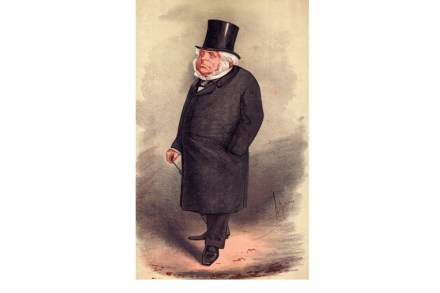
Why have we forgotten John Bright? In his day he was a massive political celebrity. He could command audiences of 150,000, delivering thrilling impromptu speeches night after night. Perhaps, as Bill Cash suggests, Bright’s eclipse has to do with the decline of conviction politics and public alienation from parliament. Or perhaps, as the novelist Anthony Trollope remarked, the trouble with Bright was that he didn’t actually create anything — he spent a lifetime attacking evils: ‘It was his work to cut down forest trees, and he had nothing to do with the subsequent cultivation of the land’. Bright was a Quaker, the son of a self-made businessman who established a successful cotton mill in Rochdale, Lancashire.

The woman in black | 3 December 2011

From our UK edition

The history of the royal family is punctuated by dramatic, premature deaths which plunge the monarchy into crisis. The most disastrous of these — historically more significant by far than the death of Princess Diana — was the death of Prince Albert in 1861. By the time he died, aged 42, this minor German prince, the second son of the obscure and dissipated Duke of Coburg, had taken over the entire public work of the monarchy. After 21 years of marriage, his wife Victoria had become deskilled and emotionally dependent upon him. His death left the monarchy in tatters and condemned Queen Victoria to a lifetime of black dresses. Helen Rappaport, who is best known as a writer about the Romanovs, has chosen an excellent subject.

The call of the wild | 27 August 2011

From our UK edition

Christopher Ondaatje is best known as a member of the great and the good and a generous patron of the arts, notably the National Portrait Gallery. The pieces collected in this book give glimpses of another, quite different life as a traveller and writer. Ondaatje’s family were long-established Dutch tea planters in Ceylon. In 1947 Christopher was sent to Blundell’s School in the West Country, a ‘sallow, thin, frightened’ 13-year-old; transplanted from the ‘carefree wilderness life’ of his father’s tea plantation, he was lonely and bullied. He had been banished from the Garden of Eden. Independence for Ceylon came in 1948, and his father’s descent into alcoholism and debt followed soon after. He never saw his father again.

The gay Lambeth way

From our UK edition

Archbishop Edward Benson was the ideal of a Victorian churchman. Stern and unbending, he was a brilliant Cambridge scholar and a dreamily beautiful youth. Older men fell over themselves to promote him, and he climbed effortlessly from one plum post to the next, rising almost inevitably to become Archbishop of Canterbury. As Rodney Bolt shows in this fine book, Archbishop Benson’s domestic life was less than perfect. When he was 23, Benson chose an 11-year old girl named Mary Sidgwick to become his wife. She was his second cousin, and when she was 12 (which was at that time the age of consent) he proposed to her. They married when she was 18. Mary Sidgwick later claimed that being a child wife meant that ‘I did not grow up’. Benson tried to control her in everything.