James Heale

James Heale

James Heale is The Spectator’s deputy political editor.

Was Starmer right to praise Thatcher?

From our UK edition

11 min listen

This weekend Keir Starmer's team took the opportunity to discuss Margaret Thatcher in an op-ed for the Sunday Telegraph. Whilst Starmer also praised other former prime ministers – such as Tony Blair and Clement Attlee – his admission that ‘Margaret Thatcher sought to drag Britain out of its stupor by setting loose our natural entrepreneurialism', has ruffled a few feathers in the Labour party. Could this be a genius piece of politics to reach out to those on the right? Or is it a misfire?  Also on the podcast, Rishi Sunak has started the week with the news that he has recorded his lowest rating ever in the latest ConservativeHome league table, racking up a dire -25.4 among card-carrying Conservatives. Can he turn it around?

Starmer risks a backlash with his Thatcher praise

From our UK edition

Two Telegraph stories in successive days illustrate Labour's dilemma. Today the paper gives a favourable write-up to the party's Australian-style scheme for AI to analyse hospital scans. It comes after the Sunday edition yesterday splashed Keir Starmer's praise for Margaret Thatcher – a tactic they have previously deployed in the same paper to great success. Alongside warm words for Tony Blair and Clement Attlee, Starmer wrote that the Tory premier effected 'meaningful change' in the UK as she 'sought to drag Britain out of its stupor by setting loose our natural entrepreneurialism.' Both stories are positive for Labour, making use of the opposition's relatively-few tools to try to dominate the news agenda. The key difference between the two though is the sums involved.

Will Boris surprise at the Covid inquiry?

From our UK edition

13 min listen

As Matt Hancock appears before the Covid inquiry for a second day, we take a look at the revelations from the former health secretary, including the allegation that involving the Prime Minister and former prime minister, Boris Johnson. Both are due to be up at the Covid inquiry in the coming weeks. Cindy Yu talks to Katy Balls and James Heale. Produced by Cindy Yu.

Starmer goes for Sunak’s sore spot at PMQs

From our UK edition

It can be difficult sometimes to declare a victor at Prime Minister's Questions. Exchanges are often hard-fought, even-handed affairs in which neither opponent really lands a blow. But today was not such a day, with Keir Starmer recording the parliamentary equivalent of a three-nil thumping at the despatch box. Rather than dwell on last week's Autumn Statement, Starmer opted to focus on record migration figures instead – a sensible move, given the very public Tory divides. With polls pointing to its increasing salience as a political issue, the Labour leader laid into the government, repeatedly punching a self-inflicted Conservative bruise.

Has No.10 lost its marbles?

From our UK edition

12 min listen

An extraordinary row has broken out between the British and Greek governments over the future of the Parthenon Marbles. Prime Minister Kyriakos Mitsotakis was due to meet Rishi Sunak in London today, but No. 10 cancelled the meeting at the last minute over comments that Mitsotakis made on the Laura Kuenssberg show. Is this whole row all part of a high-culture war, to win back the Red Wall? Or has No.10 lost its marbles?  Natasha Feroze speaks to Katy Balls and James Heale.  Produced by Natasha Feroze and Oscar Edmondson.

Sunak under pressure to curb legal migration

From our UK edition

11 min listen

Rishi Sunak is on the defensive over legal migration. After figures late last week revealed net migration hit a record 750,000 in the year to December 2022, the Prime Minister is under pressure from his own side to act. This afternoon James Cleverly will address the House and is expected to lay out a series of proposals the government is considering. Can they shift the dial?  James Heale speaks to Katy Balls and Isabel Hardman.  Produced by Oscar Edmondson.

Have we seen peak migration?

From our UK edition

12 min listen

After much Whitehall spin, the official figures are now in. Net migration in the year to June hit 672,000, down from 745,000 in 2022. A total of 1.2 million people arrived to live in the UK, whilst 508,000 moved overseas. The ONS says it's too early to call this a downward trend, but has migration to the UK peaked?  Katy Balls speaks to James Heale and Kate Andrews.  Produced by Oscar Edmondson.

Tory backlash as net migration hits record levels

From our UK edition

After much Whitehall spin, the official figures are now in. Net migration in 2022 is estimated to have hit 745,000, a huge revision upward from an earlier estimate of 606,000. That figure only fell slightly by 10 per cent to 672,000 for 2023, as a total of 1.2 million people arrived to live in the UK in the 12 months up until June. Today's net migration figure is more than three times the level when the 2019 Conservative manifesto pledged to ensure 'overall numbers come down.' The reaction of Conservative MPs to these figures has not been a happy one. The New Conservatives group of 25 right-wingers has released a collective statement, noting that the high levels of migration are 'a consistent trend' caused 'directly by the policy decisions of this government.

Jeremy Hunt’s Autumn Statement announcements in full

From our UK edition

There were few surprises when Jeremy Hunt presented his second Autumn Statement to the House of Commons this afternoon: National Insurance has been cut and the state pension and benefits will rise. The Chancellor is hoping that these measures will woo voters ahead of next year's election. But while Hunt tried to paint an image of the economy being back on track, there were some nasty surprises in the updated forecasts released by the Office for Budget Responsibility (OBR). Although growth has been revised up this year to 0.6 per cent, it has been downgraded for the following three years, rising to 2 per cent in 2027. Inflation is meanwhile forecast to drop to 2.8 per cent by the end of 2024, down from 4.6 per cent recorded in October.

Did Covid expose a ‘failure of imagination’?

From our UK edition

11 min listen

This week it is the scientists’ turn to appear before the Covid Inquiry with Sir Chris Whitty, the Chief Medical Officer and Sir Patrick Vallance. James Heale speaks to Fraser Nelson and The Spectator's data editor, Michael Simmons to discuss the findings this week.

Chris Whitty says Covid exposed a ‘failure of imagination’

From our UK edition

Why was the UK plunged into a lockdown with such little understanding about the likely consequences? This week it is the scientists’ turn to appear before the Covid Inquiry and Sir Chris Whitty, the Chief Medical Officer, has highlighted a problem: the extensive and expensive UK pandemic planning did not consider lockdown as an option. This 'might be considered a failure of imagination by a group of scientists who understood the nature of epidemics and their history,' says Sir Chris, in his witness statement to the Inquiry. With 'the benefit of hindsight', he said, the first lockdown in March 2020 was 'a bit too late'.

Why has Rishi Sunak made five more pledges?

From our UK edition

11 min listen

James Heale, Katy Balls and Fraser Nelson look ahead to the Autumn Statement this week. Will Rishi Sunak commit to cutting taxes? And with barely a year to go before the election, would implementing any policies now be felt in time?

Can Sunak shift the dial?

From our UK edition

13 min listen

The chancellor Jeremy Hunt will deliver his autumn statement next week and Rishi Sunak will be hoping to stamp his authority onto a fracturing party after a difficult few days. There are lots of rumours swirling around about what might be included, such as cuts to inheritance tax and to taxes for small businesses. What should we expect?  Oscar Edmondson speaks to James Heale and Isabel Hardman.  Produced by Oscar Edmondson.

Mass Labour rebellion over Gaza vote

From our UK edition

With no end to the war in sight, expect the theme over Labour splits on Israel to be a constant one Ten of Sir Keir Starmer's frontbenchers have tonight left their posts after backing an SNP motion calling for a ceasefire in Gaza. Jess Phillips, Afzal Khan, Paula Barker and Yasmin Qureshi were among 56 Labour MPs who defied their party’s whips to abstain tonight. Sarah Owen, Andy Slaughter, Naz Shah and Rachel Hopkins also left their briefs, as did two parliamentary private secretaries: Dan Carden and Mary Foy. They follow Imran Hussain’s departure last week in protest at Labour's unwillingness to differ from the government in his support for Israel. The SNP motion was heavily defeated, with 125 ayes for a ceasefire and 293 noes against.

The Rishification of the Tory party

From our UK edition

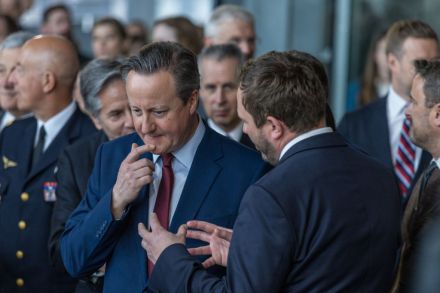
When David Cameron arrived at the Foreign Office on Monday, he told staff he might be a bit rusty when it comes to modern politics. He joked that the only WhatsApp group he is in ‘is to do with my children’s school play’. Cameron may have been out of frontline politics for a while, but the rules stay the same. As Tory leader, he championed his favourites and promoted his supporters to the cabinet table, even at the expense of ignoring older colleagues’ claims. This week, his successor has done the same. A trio of thirtysomething former special advisers elected in 2019 now comprise the Prime Minister’s Praetorian Guard. Laura Trott, 38, the former pensions minister, is the chief secretary to the Treasury.

Supreme Court rules Rwanda scheme unlawful

From our UK edition

11 min listen

The Supreme Court has ruled that the government scheme to deport illegal migrants to Rwanda is unlawful. Why? And how will Rishi Sunak respond? Will he try to take Britain out of the European Convention on Human Rights? James Heale speaks to Katy Balls and Kate Andrews.

Supreme Court rules Rwanda scheme unlawful

From our UK edition

The Supreme Court has this morning concluded that the Rwanda scheme is unlawful, ending 18 months of legal battles in UK courts. In a succinct 10-minute summary, the court ruled against the flagship scheme because of the risk that genuine refugees could be returned to countries from which they have fled. Delivering the verdict, Lord Reed, the Supreme Court's President, said that there are 'substantial grounds to believe asylum seekers sent to Rwanda would be at real risk of refoulment' – that is being sent to their home nations – something which happened under a 'similar' deal with Israel between 2013 and 2018.

Sunak’s reshuffle: refresh or rewind?

From our UK edition

15 min listen

It's reshuffle day in Westminster. Suella Braverman is out as Home Secretary, replaced by James Cleverly, with former prime minister David Cameron making a shock return to parliament in the vacant Foreign Secretary slot. It's the first time since 1974 that a former PM has been appointed to the cabinet. Can Rishi Sunak really still claim to be the candidate to end the 'thirty year status quo'? Will he regret bringing Cameron back? James Heale speaks to Katy Balls and Fraser Nelson.  Produced by Oscar Edmondson.

Has Nadine Dorries lost the plot?

From our UK edition

14 min listen

This week Nadine Dorries’s new book The Plot: The Political Assassination of Boris Johnson has been published, and it has ruffled some feathers in Westminster. In it, she claims there was a plot orchestrated by a secret cabal of back room advisors, politicians and individuals in the media to overthrow Boris Johnson. Just what is ‘the movement’? James Heale speaks to Fraser Nelson and Christopher Howse, assistant editor at the Telegraph.  Produced by Oscar Edmondson.

Is Suella Braverman safe for now?

From our UK edition

12 min listen

Despite mounting pressure from Conservative MPs to remove Suella Braverman, no announcement has been made yet. How much pressure is Rishi Sunak facing over the Home Secretary's stand-off with the Met Police? Also on the podcast, Natasha Feroze speaks to James Heale and Isabel Harman about the Conservative Home Cabinet league table ahead of a possible reshuffle.