James Heale

James Heale

James Heale is The Spectator’s deputy political editor.

The role of political spouse has changed completely

From our UK edition

The changing nature of political power was neatly demonstrated in Westminster yesterday. In the House of Lords, members debated Labour's plans to purge parliament of its hereditary peers. Yet down the corridor in the Commons, that same principle seems alive and well. Ten Labour MPs are descended from former members, including scions of the Benn, Kinnock and Chamberlain families. The trend is certainly a cross-party one: a tenth of all Conservative MPs have had family members serve as Honourable Members. They include Victoria Atkins, Andrew Mitchell, Jerome Mayhew and Bernard Jenkin, whose fathers served as ministers under Mrs Thatcher. But the shift between the last parliament and this is the number of ministers whose spouses are directly involved in politics themselves.

Have Labour got a grip of the prisons crisis?

From our UK edition

12 min listen

Labour are planning to publish a 10-year plan to get on the front foot when it comes to the prisons crisis. Shifting from the previous government’s preference to run the system hot to a policy of early release and carving out more places, the headline figure is that there will be 14,000 more prison places by 2031. But the fear today is that these won’t be enough to tackle the critical lack of space in UK jails. So, will Labour’s ongoing sentencing review advocate for greater leniency for certain offenders? And will the public see that as justice being served? James Heale speaks to Katy Balls and Danny Shaw, former adviser to Yvette Cooper. Produced by Oscar Edmondson.

Gaza independents to register new party

From our UK edition

There has been much focus in recent weeks on Reform's potential impact on British politics. But a rival quintet of insurgents has been quietly making their own plans too. In July, four independents were elected to parliament on a staunchly pro-Palestine ticket: Shockat Adam in Leicester South, Ayoub Khan who took Birmingham Perry Barr, Adnan Hussain won Blackburn and Iqbal Mohamed, victorious in Dewsbury and Batley. They have since formed an 'Independent Alliance' with Jeremy Corbyn, who stormed back in Islington North, and are referred to as 'the Gaza five.'Supporters are now understood to be stepping up their efforts to strengthen ties between members of the group.

Spending review: a return to austerity?

From our UK edition

13 min listen

Preparations are stepping up for the government’s spending review, due in June. The Chancellor has taken a more personable approach to communicating with ministers, writing to them to outline how they plan to implement the Budget – with a crackdown on government waste and prioritising key public services. So, expect money for clean energy, the NHS, and more ‘difficult decisions’. Will Rachel Reeves’s war on waste work? How will this all go down within the Labour Party and the Cabinet? James Heale speaks to Katy Balls and Kate Andrews. Produced by Oscar Edmondson.

The new diplomacy of Nigel Farage

From our UK edition

Nigel Farage is not generally seen as one of nature's diplomats. Yet the Reform leader is proving to be a formidable force in the international arena. This is most obvious in matters of transatlantic interest, with Donald Trump's return offering Farage the chance to try and derail Labour's Chagos Islands deal. But last week showed a different side to the Clacton MP on a sensitive overseas matter. On Tuesday, Farage met with Mandy Damari, the mother of the last remaining British captive in Gaza. Her 28-year-old daughter Emily was kidnapped on October 7 last year and has now been a hostage for 430 days. The pair were hosted in one of the Commons committee rooms, with Farage subsequently a video of support calling on David Lammy to do more for her.

How does the Syrian conflict affect Britain?

From our UK edition

12 min listen

Following news that President Bashar Al-Assad's regime in Syria has fallen, Natasha Feroze discusses what comes next with James Heale and Michael Stephens, senior associate fellow at RUSI. What does the Syrian conflict mean for Britain? Do we need to reconsider our counter-terrorism policy? And how will Britain's historic relationship with Syria shape our path going forward?

Are the SNP exploiting Labour woes?

From our UK edition

13 min listen

The SNP presented their budget this week in Holyrood with the news that all pensioners would receive a winter fuel allowance and a pledge to scrap the two-child benefit cap. Questions remain about how they will make this budget work financially, but it is clear that they have one eye on the 2026 Scottish Parliament elections. How could this impact Labour north, and south, of the border? And, after a torrid year for the SNP, can First Minister John Swinney turn things around?  Iain MacWhirter and Lucy Dunn join James Heale to discuss.  Produced by Patrick Gibbons.

Is immigration not a priority for Labour?

From our UK edition

12 min listen

There is a feeling of deja-vu in Westminster today as Keir Starmer unveiled his plan for change and six 'milestones' (not pledges) to turn the country around. They are: raising living standards in every part of the UK; rebuilding Britain with 1.5 million homes and fast-tracking planning decisions on major infrastructure projects; ending hospital backlogs and meeting the standard of 92 per cent of patients being treated within 18 weeks; putting police back on the beat; giving children the best start in life; and securing homegrown energy and putting the UK on track to 95 per cent clean power by 2030. The problem with setting out any list of priorities is that others are conspicuous by their absence, namely immigration.

Is Starmer planning a foreign policy reset too?

From our UK edition

18 min listen

Keir Starmer is preparing to give his big reset speech on Thursday. But the more interesting address is perhaps the one he gave last night at the annual Lord Mayor’s Banquet, where the Prime Minister gave his first major speech on foreign policy. The most interesting passage saw Starmer reject the notion that Britain will need to pick sides between the US and the EU under the looming Trump presidency – particularly in the event of a trade war. How long can No. 10 afford to keep their foreign policy preferences ambiguous?  Also on the podcast, Sir Chris Wormald has been announced as the successor to Simon Case as Cabinet Secretary, in another example of Labour prizing experience when it comes to senior civil service roles.

Why the Welsh Tory leader has quit

From our UK edition

Andrew RT Davies has quit this lunchtime as the leader of the Conservative group in the Welsh parliament. It follows a confidence vote among the 16 Tory Senedd Members (MSs) who narrowly voted by nine to seven to keep him on as leader. With the group split how best to proceed, Davies has opted to fall on his sword. In a letter, he says he does so ‘with regret‘ after members of his frontbench threatened to resign last week if he did not. Davies described his position as ‘untenable’ following the vote, saying that ‘it was clear from the result that a substantial minority of the group do not support our approach’. This is despite Davies claiming it is ‘the only viable strategy available.

Is Starmer planning a foreign policy reset too?

From our UK edition

Keir Starmer is preparing to give his big reset speech on Thursday. But the more interesting address is perhaps the one he gave last night. The annual Lord Mayor’s Banquet was the setting for the Prime Minister to give his first major speech on foreign policy since entering No. 10. The most interesting passage saw Starmer reject the notion that Britain will need to pick sides between the US and EU under the looming Trump presidency – particularly in the event of a trade war. 'I reject it utterly. Attlee did not choose between allies, Churchill did not choose,' he said. 'The idea that we must choose between our allies, that somehow we’re with either America or Europe, is plain wrong.

Labour risks death by consultation

From our UK edition

After 14 years in opposition, you might have expected Labour to come into government bursting with plans for Britain. Yet the first four months of the Starmer supremacy have seen ministers commission a glut of various reviews, consultations and task forces about what they should actually do in office. Helpfully, Sky News has compiled a running tally of these. Their current figure is 61 in less than 150 days: a rate of one every two-and-a-half days. The obvious risk is ‘paralysis by analysis’. Under Yvette Cooper, the Home Office has commissioned seven reviews on police and fire fighter pensions, knife sales, ninja swords, police prosecutions, family visas and counter-extremism.

Sir Chris Wormald is the new cabinet secretary

From our UK edition

Keir Starmer has today resolved one of his longstanding headaches: who to appoint to lead the civil service. The man chosen to replace Simon Case as cabinet secretary is Sir Chris Wormald. The 56-year-old has served as permanent secretary of the Department of Health since 2016, leading colleagues throughout the ups and downs of the pandemic. Prior to that, he was permanent secretary at the Department of Education (DfE) from 2012 to 2016. Government is very much in Wormald’s blood: his father Peter served as under secretary in the DHSS from 1978 to 1981. The task that faces the new cabinet secretary is considerable With 33 years of continuous service in Whitehall, it is clear that the Prime Minister is opting for a ‘greybeard’ over a wildcard.

Is Keir Starmer turning into Rishi Sunak?

From our UK edition

11 min listen

The government is trailing a major policy speech ahead of Thursday, in which the Prime Minister will set out key 'milestones' that he wants to hit, in terms of healthcare, living standards, the climate and so on. It's all sounding a little like a previous prime minister... Cindy Yu talks to Katy Balls and James Heale about the opportunities and perils in setting public targets. Produced by Cindy Yu.

Assisted dying bill passes second reading – what next?

From our UK edition

14 min listen

The controversial assisted dying bill has passed its second reading in the House of Commons with a majority of 55 after just hours of debate. It now heads to committee stage for further scrutiny. What does the bill's passing at this stage mean for its likelihood of eventually becoming law? And will Labour's front bench unify behind the bill given the deep-seated opposition from figures such as Justice Secretary Shabana Mahmood? James Heale discusses with Katy Balls and Michael Gove. Produced by Patrick Gibbons and Cindy Yu.

Louise Haigh’s resignation raises questions for Keir Starmer

From our UK edition

11 min listen

In the small hours of this morning Louise Haigh resigned as Transport Secretary following the revelation that she had pleaded guilty to a criminal offence in 2014. Haigh admitted fraud by false representation at a magistrates’ court after she incorrectly told the police that a work mobile had been stolen in 2013. She was then convicted and received a conditional discharge. The incident occurred six months before she became an MP. Haigh had been in hot water just a month ago after her comments nearly cost the government a one billion-pound investment deal with P&O. Is her resignation a little too convenient for the Prime Minister?  James Heale speaks to Katy Balls and Isabel Hardman.  Produced by Cindy Yu and Oscar Edmondson.

Transport Secretary admits to fraud conviction

From our UK edition

In recent years, Labour has made great political hay out of allegations of rule-breaking. The party was never slow to criticise Boris Johnson's government for breaches of lockdown, with Sir Keir keen to depict himself as 'Mr Rules.' So it is sub-optimal, to say the least, that a senior minister has tonight admitted pleading guilty to an offence connected with misleading the police while she was a parliamentary candidate. Louise Haigh, the Transport Secretary, appeared at Camberwell Green Magistrates' Court six months before the 2015 general election, after making a false report to officers that her mobile phone had been stolen. Haigh claimed that she was 'mugged while on a night out' in 2013 and then reported the incident to the police.

Starmer attacks ‘open border’ Tories, plus Andrea Jenkyns defects

From our UK edition

15 min listen

It's been a day of press conferences in Westminster. First to Reform UK, where Nigel Farage unveiled their newest defection: Dame Andrea Jenkyns, who had served as a Conservative MP from 2015-24. Could there be more defections on the horizon?  Next to Keir Starmer who reacted to the newly published migration figures from the ONS. Net migration for the 12 months to June 2024 stands at 728,000. But the real story was the revised 2023 figures, which showed net migration exceeding 900,000. The politics from the press conference were solid - but what about policy announcements? Oscar Edmondson speaks to James Heale and Michael Simmons, and they also look ahead to tomorrow's unpredictable assisted dying vote. Produced by Patrick Gibbons and Oscar Edmondson.

Starmer attacks ‘open border’ Tories

From our UK edition

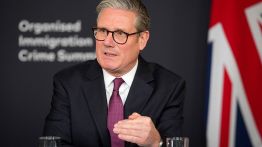
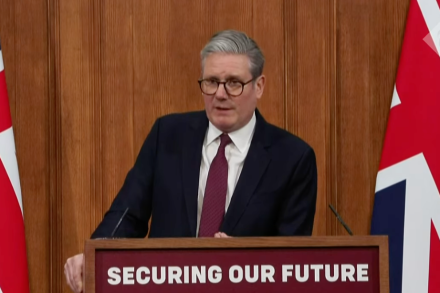
Anyone else want to do a Westminster press conference? Keir Starmer made it a hat-trick this afternoon when he gave his reply to the new immigration figures, following Kemi Badenoch’s comments yesterday and Nigel Farage’s response this morning. The Prime Minister’s team gave it the full No. 10 treatment: the flags, the lectern, Starmer looking statesmanlike as he used the trappings of office for all they were worth. From the bully pulpit of Downing Street, he intoned gravely about the revised 2023 figures that showed net migration exceeding 900,000. The Tories, he said, were guilty of running an ‘open borders experiment’ by ‘design, not accident’. Policies were reformed ‘deliberately’ to ‘liberalise immigration’, with Brexit exploited ‘for that purpose’.

Reform hits 100,000 members

From our UK edition

There was a business-like manner in Nigel Farage’s response to the news that net migration was more than 900,000 in 2023. Speaking this morning at a Mayfair press conference, Farage was almost flat in his reply on the ‘horrendous’ figures. He insisted that the Tories would ‘never be forgiven’ for presiding over a nine-fold increase in the ‘tens of thousands’ target promised by David Cameron in 2010. As for Labour, he was similarly withering about the government’s decision to hike the asylum budget by 36 per cent to £5.8 billion. But after the business, came the pleasure. Farage took great delight in revealing that – after months of growing grassroots support – Reform has at last hit the 100,000 membership mark.