James Heale

James Heale

James Heale is The Spectator’s deputy political editor.

Is the Home Office fit for purpose?

14 min listen

With the news that the Home Office has spent billions of taxpayers' money on asylum hotels – and following the accidental release of the Epping sex offender – Tim Shipman and James Heale discuss this most shambolic of government departments. Is it fit for purpose? Can Shabana Mahmood fix the cursed department? And, if not, who will voters turn to instead? Produced by Megan McElroy and Patrick Gibbons.

Has Starmer misled parliament? Plus Lucy Powell wins

14 min listen

We thought when we organised this podcast that there would just be the newly announced deputy Labour leader to discuss – Lucy Powell beat Education Secretary Bridget Phillipson by 87,407 votes to 73,536. But instead we also have evidence the Prime Minister may have lied to Parliament over the collapse of the China spy case, and there is a manhunt under way to recapture a dangerous criminal released by mistake. Bad news clearly comes in threes for No. 10: Lucy Powell was not their pick for the job; lying to Parliament is the kind of thing that the ministerial code is quite clear on; and the criminal in question is the Epping migrant hotel sex offender. Oscar Edmondson speaks to James Heale and the Sunday Times’ Gabriel Pogrund. Produced by Oscar Edmondson.

Lucy Powell wins Labour deputy leadership race

Lucy Powell has won Labour’s deputy leadership election, beating her rival Bridget Phillipson. The result was announced this morning after a low-key, five-week contest. Having led in each of the various membership polls, Powell duly triumphed with 54 per cent of the vote to Phillipson's 46 per cent. A worryingly low turnout of just 16 per cent of the 970,000 eligible Labour members and affiliate voters speaks to the level of discontent and dissatisfaction among the party faithful. In her victory speech, Powell delivered a textbook mainstream soft left script. ‘My politics have always been shaped as a proud Mancunian’, she said ‘and Labour through and through’. Setting out her ‘diagnosis’ of the nation’s ills, she attacked ‘Farage and his ilk’ for blaming immigrants.

Caerphilly by-election: ‘a tale of two faces’

16 min listen

On the face of it, the Caerphilly by-election result is a disaster, a drubbing and a humiliation for Keir Starmer’s Labour party. A once secure bastion of the Welsh Labour heartlands fell without a squeak from the governing party. Their vote collapsed to a miserable 11 per cent, while Plaid Cymru won with 47 per cent and Reform surged to second place with 36 per cent. The result suggests Labour is on course to surrender a boatload of seats at the 2029 general election, both to Reform and to whatever protest party is best suited to beat the government around the head – be it Plaid, the Greens, the Corbynites, the Islamist independents or the SNP. But is there good news for the PM beyond the headlines?  Lucy Dunn speaks to Tim Shipman and James Heale.

Plaid Cymru storms to victory in Caerphilly

The Welsh nationalists have won almost half the vote in the Caerphilly by-election, storming to a victory in a seat that has voted Labour for more than a century. The party's candidate Lindsay Whittle took 47.4 per cent of the vote, with Reform UK's Llyr Powell taking 36 per cent and Labour's Richard Tunnicliffe on a miserable 11 per cent. As expected, the Conservatives, Greens and Liberal Democrats all lost their deposits. Turnout was exceptionally high for a Senedd race: 50.4 per cent at a by-election, despite miserable conditions on polling day. Caerphilly is an ominous portent for the Welsh parliamentary elections next May. It is sometimes said that the Tories are the most successful party in political history, but Welsh Labour would perhaps be more accurate.

What’s inside Farage’s brain?

16 min listen

With every new poll predicting a Reform win at the next general election, the party continues its preparation for government. James Heale joins Oscar Edmondson and Tim Shipman to talk about his article in the magazine looking at what – or who – is shaping Reform’s intellectual revolution. Cambridge intellectual James Orr, close friend to J.D. Vance, has recently joined as an adviser, following in the footsteps of recent defector Danny Kruger, who was widely seen as an intellectual heavyweight on Conservative benches.  Tim also discusses his piece looking at the narrative Rachel Reeves is trying to set ahead of next month’s budget. Tim says she has four audiences and is trying to direct the blame elsewhere – namely at the Conservatives.

Left-wing Ultras, Reform intellectuals & capitalist sex robots

38 min listen

‘The Ultras’ are the subject of The Spectator’s cover story this week – this is the new Islamo-socialist alliance that has appeared on the left of British politics. Several independent MPs, elected amidst outrage over the war in Gaza, have gone on to back the new party created by former Labour MPs Jeremy Corbyn and Zarah Sultana. The grouping has got off to a rocky start but – as Angus Colwell and Max Jeffery write – there are expectations that they could pick up dozens of seats across the country. Can the hard-left coalition hold? Host Lara Prendergast is joined by the Spectator’s deputy political editor James Heale, commissioning editor Lara Brown and Angus Colwell – who also writes the Spectator’s new morning newsletter Spectator Daily.

The battle for Farage’s mind

If New Labour was Margaret Thatcher’s greatest achievement, then Reform UK is perhaps Tony Blair’s. Distaste for the three-time election winner is a thread which connects much of the party’s leadership. Nigel Farage clashed with him at the European parliament in 2005. His deputy, Richard Tice, did the same as a Question Time audience member four years before. Their colleague Danny Kruger was once set to stand for the Tories against Blair in Sedgefield – but was forced out after promising a ‘creative destruction’ in public services. Such ‘creative destruction’ is precisely the approach Reform wants to take to the post-Blair political world.

Grooming gangs: Kemi accuses Labour of a ‘cover up’

14 min listen

We’ve just had PMQs, which have become much more interesting now that Kemi Badenoch has got her act together. She led on the Grooming Gangs Inquiry after a fourth survivor quit the inquiry over fears that it’s being watered down. She went as far as to say that the government is in a ‘briefing war against survivors’, and accused Labour of a ‘cover-up’. Nigel Farage attempted to upstage proceedings with his own stunt – he watched from the public gallery to make the point that he isn’t given the chance to defend himself or his party. However, Badenoch’s display meant that his tantrum has gone pretty much unnoticed. Is Kemi on the front foot? Also today, Starmer’s new go-to girl Louise Casey is back in the news as she joins the inquiry.

Britain’s doom loop continues

11 min listen

Rachel Reeves is hosting an investment summit in Birmingham, trying to turn the narrative away from Britain's economic 'doom loop' ahead of next month's budget. But the harbinger of bad economic news Michael Simmons – who joins James Heale and Patrick Gibbons on the podcast – points to the news today of soaring government borrowing costs, and expected higher inflation figures tomorrow. Plus, what have some politicians made of further developments in the Prince Andrew scandal? Produced by Patrick Gibbons.

Can Reform run a council?

11 min listen

There have been lots of movements in foreign affairs over the weekend, including a potential collapse of the Gaza peace deal, a Trump–Putin bilateral and new revelations about the China spy case. But closer to home, all eyes are on Kent Council, Reform’s flagship administrative project run by Linden Kemkaran (formerly of this parish). Over the weekend, a Zoom call was leaked to the Guardian, in which council leader Kemkaran used some choice language – many are calling it a Jackie Weaver moment, if you can cast your mind back to 2021. Labour have put out a press release and the Lib Dems are apparently going to capitalise on it with something Traitors-themed, in an attempt to demonstrate that, for all their success in the polls, Reform can’t govern. Will this cut through?

Prince Andrew stops using his titles

Prince Andrew’s humiliation is near-complete. He has tonight agreed to immediately stop using his Duke of York title after ‘discussion with The King,’ his family and ‘with His Majesty’s agreement.’ In a statement, Andrew said that ‘I have decided, as I always have, to put my duty to my family and country first.’ It comes after weeks of growing pressure about his links to the late sex offender Jeffrey Epstein. Andrew’s statement is short, concise and lacks any apology or contrition. It does, however, contain a reassertion of his innocence: ‘I vigorously deny the accusations against me’. He will remain a prince – but will cease using the title bestowed by his late mother, in accordance with the law set down by George V in 1917.

Antisemitism, Chinese spies & GB’s economic fragility

14 min listen

It's been a rough week for the government: the row over the collapsed Chinese spy trial has rolled on, all while the Chancellor has been trying to lay the groundwork ahead of next month's budget. Then, overnight, another issue has emerged as fans of the Maccabi Tel Aviv football team have been banned from attending a football game against Aston Villa next month, leading to accusations of antisemitism. Tim Shipman and Michael Simmons join James Heale to discuss the day's developments. Tim reveals how the Chinese spy row has been picked up by American legislators, threatening to undermine the Five Eyes security alliance. Meanwhile Michael points out that the news that the IMF has upgraded UK growth forecasts – to the second fastest growing of the G7 – might not be all it seems.

The truth about Chinese espionage

13 min listen

Tim Shipman's bombshell cover piece for the magazine this week explains how the collapsed spy trial blew up in the government’s face. As well as raising ‘serious questions’ about Keir Starmer’s judgment and Jonathan Powell’s role, ‘the affair reveals a Whitehall tendency to cover up the gory details of foreign spying in the UK’. According to Tim, four ‘highly credible sources in the upper echelons of the last government… have revealed that far worse scandals have been hushed up’. One, involving Russia, was suppressed ‘to avoid embarrassing a former prime minister’.

Why Sheridan Westlake is the Tories’ best weapon

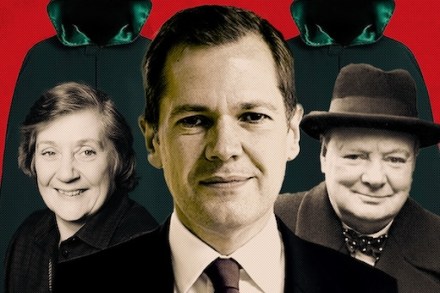
Who is responsible for Labour’s recent woes? For some Conservatives, the answer is obvious – Sheridan Westlake. He is that rarest of beasts: an effective Tory operator who has served every leader since John Major. Flaxen-haired with an impish grin, he is spoken of by colleagues as part myth, part political mastermind. Yet ask him what he does, and the stock answer is modest: ‘I simply do the photocopying.’ ‘He just likes getting up in the morning and kicking socialists. He’s in it for the love of the game’ The resignation of Angela Rayner last month is widely attributed within Conservative Campaign Headquarters (CCHQ) to an effective campaign by the party’s attack team.

Are the Tories to blame for the China spy scandal?

14 min listen

Keir Starmer did not go into Prime Minister’s Questions with the intention of resolving the row over the collapse of the Chinese spying case: he merely wanted to avoid the pressure building too much. He announced in a long statement at the start of the session that the government would be publishing its three witness statements, and then spent the rest of his sparring with Kemi Badenoch arguing that this was all the fault of the previous government anyway. So who is to blame, the Tories or Labour? What does the inability to deal with this scandal say about the ineptitude of successive governments, and how they communicate with the public? James Heale speaks to Tim Shipman and Isabel Hardman.

China spy scandal: ‘a masterclass of ineptitude’?

13 min listen

Tim Shipman and Charles Parton, China adviser at the Council on Geostrategy, join James Heale to discuss the ongoing fallout over the collapse of the Westminster spy case. Security minister Dan Jarvis answered an urgent question on the matter late on Monday in Parliament, stringently denying that the government played an active role in collapsing the case. But, as Charles and Tim stress, the case still doesn't add up. Is it as simple as the government not wanting to offend China? And is the deputy national security adviser being 'hung out to dry'? Produced by Patrick Gibbons.

Spy scandal: what is Labour’s policy on China?

15 min listen

It’s a ‘great and beautiful day’, as Donald Trump wrote in the guestbook at the Knesset, where he will address the Israeli parliament after the final hostages were handed back to Israel. It is, of course, a historic piece of diplomacy, and the conversation in Westminster has turned to the extent to which the UK was involved. Bridget Phillipson claimed over the weekend that Britain played a ‘key role’ in bringing about peace – much to the chagrin of Mike Huckabee, the US Ambassador to Israel, who called her ‘delusional’. Is she? The government have more pressing issues, however, with the collapsed China spy case – the sudden abandonment of a case brought against two men (Chris Cash, a parliamentary researcher, and Chris Berry, an academic).

The Tories smell blood in the China spy case saga

The Prime Minister is in Egypt today at a peace summit aimed at ending the Gaza war. The question of whether he deserves any credit for the ceasefire is a contentious one. Some within Labour will claim that British recognition of a Palestinian state proved to Israel that it was alienating its allies. British officials argue that this country has performed some useful functions in the conflict. After the felling of Powell's close friend Peter Mandelson, the Tories clearly smell blood Operational intelligence gathering and hostage negotiations are two examples cited by Whitehall staff.

Revealed: the Lib Dems’ plan for Tory defectors

Reform UK’s momentum is influencing other parties too. The Greens voted overwhelmingly to elect Zack Polanski last month, partly on the basis that he would replicate Nigel Farage’s media success. Labour are basing much of their current strategy on a cordon sanitaire approach, hyping up the threat of any Farage-led government. The Liberal Democrats are now trying to copy a model that Reform has exploited to great effect: luring Tory defectors to their side. In April, Jamie Greene, a West Scotland MSP since 2016, crossed the floor at Holyrood. Sir Ed Davey sought to build on this in his recent conference address, issuing an explicit appeal for ‘One Nation Conservatives’ to join him. The Lib Dems have sought to hammer this message home in recent weeks.